
Farbrengen with the Rebbe

A Farbrengen with the Rebbe is the central meeting point between the Rebbe and his Chassidim, at which the Rebbe addresses the public with sichos and maamarim of Chassidus. At a farbrengen the Rebbe discusses Torah topics and current affairs, gives instructions to the Chassidim, and more.
The Rebbe's farbrengens were held regularly every Shabbos and at the conclusion of Yamim Tovim; until the passing of his wife, the Rebbetzin, in 5748 (1988), farbrengens were also held on weekdays, some on fixed dates such as the Chabad festivals, and some on other occasions. When the farbrengens were held on weekdays, they were broadcast to listeners all over the world by the Chabad Broadcasting Center.

History[edit | edit source]
The earlier Rebbeim farbrenged with the public a few times a year, on 19 Kislev, Purim and the like. There were set times for delivering Chassidus, and sichos were said mainly at the Shabbos and Yom Tov meals. The Rebbe changed this, farbrenging with the public far more often, at least once a month, on Shabbos Mevarchim.

Before the Nesius[edit | edit source]

The first farbrengen the Rebbe held, at the instruction of the Rebbe Rayatz, was on the festival of Sukkos in Tomchei Temimim Otwock.
The first farbrengen the Rebbe held in 770 was held on 2 Tammuz 5701 (1941) in the small zal on the first floor of 770, at the direct instruction of the Rebbe Rayatz, to mark the Rebbe's rescue and his arrival in the United States. The farbrengen began at nine o'clock and ended at three in the morning.[1] After that the Rebbe farbrenged with the Chassidim several more times.[2]
In the early years, only a few Lubavitcher Chassidim lived near 770 because of the high cost of housing in Crown Heights, and the minyan in 770 consisted mainly of local residents. When the Rebbe Rayatz was staying in Morristown, a group of Chassidim came to visit him, among them Rabbi Shmuel Levitin, Rabbi Shlomo Aharon Kazarnovsky, and the driver – a Jew named Roth (he was not a Chabad Chassid). After the Chassidim met with the Rebbe, he asked whether anyone else had come, and they said the driver was there. The Rebbe asked the driver whether he wanted anything. He replied that there was a kiddush after davening, but the Chabad Chassidim did not take part and so the kiddush had no substance, and he asked whether the Rebbe Rayatz's son-in-law (the Rebbe) could take part. The Rebbe Rayatz took out three one-dollar bills as his contribution to the kiddush, and said that when his son-in-law knew he was participating, he would participate too. From then on, every Shabbos Mevarchim the Rebbe would come about half an hour after the kiddush began and speak for about half an hour, and various niggunim (not necessarily Chabad ones) were sung at his request. The Rebbe made kiddush for himself, sat, and spoke about current matters.[3]
After Yud Shvat 5710[edit | edit source]
During the year after the passing of the Rebbe Rayatz, the Rebbe farbrenged with the Chassidim on Shabbosos Mevarchim, according to the takanah of the Rebbe Rayatz, and on festivals and Chassidic dates, but said only sichos, not maamarim, which only a Rebbe says. At the farbrengen on the second day of Yom Tov of Shavuos, the Chassid R' Eliyahu Simpson, one of the secretaries of the Rebbe Rayatz, called out that the sichos were good, but they wanted to hear a maamar. The Rebbe did not respond, and he asked again and again, until the Rebbe said: "Does it have to be specifically now? It does not have to be specifically now; it can be on another occasion".[4]
After Accepting the Nesius[edit | edit source]

At the farbrengen of 10 Shvat 5711 (1951) the Rebbe officially accepted the nesius, and said his first maamar – Basi LeGani.
Over the years Chassidus Chabad grew and more Chassidim came to the Rebbe's farbrengens, until the small zal, where all his farbrengens had been held until then, could no longer contain them. In 5714 (1953–54), therefore, the Rebbe began davening and farbrenging in a tent erected for the farbrengens and the Yamim Nora'im davening. The large winter farbrengens[5] were held in larger halls in the Crown Heights area, the first of them being the farbrengen of 19 Kislev 5714 (1953) in the "Franklin Manor" hall.[6]
Ahead of Rosh Hashanah of the year 5720 (1959) the first renovation carried out in the courtyard of 770 was completed, which then became the Zal HaGadol. From then on all the davening and farbrengens moved to the Zal HaGadol, and no more farbrengens were held in the small zal or in halls.[7]
After the passing of Rebbetzin Chana, the Rebbe did not want to farbreng on 19 Kislev, until Rabbi Shmuel Levitin came in to the Rebbe and said: "Won't they say that 19 Kislev is not a Yom Tov!" His words persuaded the Rebbe to come down to the farbrengen.[8]
In 5731 (1971), when an initiative was proposed to prevent bringing children to the farbrengens in order to prevent noise, Rabbi Dovid Raskin rejected it, saying that when such a proposal was put before the Rebbe, the Rebbe reacted with tremendous distress to the very idea of preventing the children from participating in the farbrengens.[9] The farbrengen of the second day of Yom Tov of Sukkos was held for many years in the large sukkah in the courtyard of 770, until 5730 (1970). In 5731 (1971) the farbrengen was held in the synagogue, without eating and drinking.[10]
Over the years the farbrengens were held on Chassidic festivals and dates, while farbrengens on Shabbos were held mainly on Shabbosos Mevarchim (according to the takanah of the Rebbe Rayatz) or when the festivals or Chassidic dates fell on Shabbos.
After Shemini Atzeres 5738[edit | edit source]
After the health event that occurred on Shemini Atzeres 5738, the Rebbe began, on the doctors' suggestion, to farbreng on Motzaei Shabbos instead of on Shabbos. These farbrengens, although they were on Motzaei Shabbos, were similar in style to the farbrengen of Shabbos, both in their order and in the style of speaking.
This arrangement continued until Shabbos Parshas Va'eira, Rosh Chodesh Shvat 5740 (1980), when the Rebbe returned to holding the farbrengen on Shabbos itself.[11]
After 22 Shvat 5748[edit | edit source]
During the year after the passing of Rebbetzin Chaya Mushka, the Rebbe began to farbreng every Shabbos, but stopped farbrenging on weekdays. This practice was first expressed on Purim 5748 (1988). The elder Chassidim and Chabad rabbis from all over the world asked the Rebbe in a letter to hold the farbrengen on Purim[12], but the Rebbe did not grant their request, and indeed from then on the Rebbe did not hold farbrengens on weekdays, only on Shabbos. But at the same time, he began to give many sichos on weekdays – some on auspicious days on which in the past the Rebbe used to farbreng, and some on ordinary days – after (and sometimes before) Maariv, at the stender. At these sichos the Rebbe stands.
Dates on Which the Rebbe Farbrenged[13][edit | edit source]
- Shabbos Mevarchim
- Motzaei Rosh Hashanah
- 6 Tishrei (from 5726)
- 13 Tishrei (from 5732)
- Motzaei the first day of Yom Tov of Sukkos
- Chol HaMoed Sukkos (until 5724)
- Motzaei Simchas Torah
- 19 Kislev
- 24 Teves
- Yud Shvat
- Purim
- 11 Nissan (5722, and afterwards from 5732 until 5745)
- The night of the second day of Pesach (until 5731)[14]
- Seudas Moshiach
- Erev Shavuos (from 5732)
- Motzaei Shavuos
- 12 Tammuz
- Tishah B'Av that falls on Shabbos
- 20 Menachem Av
- Erev Rosh Hashanah (from 5732)
Additional dates on which the Rebbe farbrenged
- Yud Kislev, the festival of liberation of the Mitteler Rebbe.
- Zos Chanukah
- 2 Iyar.
- Lag BaOmer.
- 15 Sivan
- 3 Tammuz
- 19 Tammuz
- 15 Av
- Rosh Chodesh Elul
- Chai Elul
A Farbrengen in the Rebbe's Presence[edit | edit source]

The Rebbe sits on a raised wooden platform adjoining the southern wall. The Rebbe sits at its front with a table before him, and behind him sit elder Chassidim and functionaries, rabbis and Rebbes, while most of the public stands on raised wooden bleachers. On Shabbos Parshas Toldos 5725 (1964), members of the Vaad HaMesader removed the benches from the zal so that the public would stand and not fall asleep during the farbrengen. The Rebbe objected to this at that same farbrengen because of the distress caused to the public, and it was never repeated.[15]
The Rebbe enters the hall, goes up on the platform, and begins to deliver a sicha whose main subject is the weekly parsha and the matters of the day for which the farbrengen was held. Between one sicha and the next he pauses to allow a niggun to be sung; sometimes he instructs explicitly which one to sing (for example, the preparatory niggun of four stanzas, which the chozer Rabbi Yoel Kahan would begin[16]).
When the Rebbe wants to begin saying a maamar, he instructs that the Rostov Niggun be sung, which he instituted and established as the preparatory niggun for a maamar, and toward the beginning of the maamar those sitting rise to their feet.[17]
The Rebbe's farbrengens on weekdays were recorded and afterwards transcribed, but at the farbrengens held on Shabbos and festivals a team of chozrim (headed by Rabbi Yoel Kahan) reconstructs the sichos and maamarim the Rebbe said at the farbrengen, and a team of maniachim puts the words in writing. From 5748 (1988), and also before that, the Rebbe regularly edits the Shabbos farbrengens. Of the other sichos and maamarim from earlier years too, the Rebbe edited part in the weekly booklet "Likkutei Sichos", and they were printed in various books[18], while most of the earlier farbrengens, and the weekday sichos, were not edited.[19]
Sometimes, due to lack of time, the Rebbe does not complete the whole explanation of the subject he is expounding[20], and sometimes he completes the explanation at a later time.[21]
At the farbrengens the Rebbe holds on festivals, which end on Motzaei Yom Tov[22], the Rebbe customarily washes his hands, and after the farbrengen recites Birkas HaMazon over the cup with a zimun, and afterwards makes Havdalah over that same cup, and afterwards the Rebbe customarily distributes kos shel berachah.
The Order of a Farbrengen on Shabbos[edit | edit source]
- He makes the blessing on the wine, and eats a little mezonos.
- Two sichos on the matter of the day.
- A maamar in the style of a sicha – stopped in 5749 (1989).[23]
- An additional sicha – in the last years this sicha is in the manner of sichos 1 and 2. In earlier years this sicha contained explanations of Rashi, Likkutei Levi Yitzchak (from 5731, 1971), the daily Rambam shiur (from 5744, 1984). In summer – Pirkei Avos.[24]
- (Sicha 4 –) Distribution of mashke.
- A reminder about the after-blessing (berachah acharonah).
Around the Farbrengen[edit | edit source]
The Rebbe's goblet and watch are placed by the attendant Meir Moshe Altman, a member of the Vaad HaMesader. In the past they were placed by Rabbi Berel Junik.
The wine for kiddush is poured by Rabbi Menachem Nochum Gerlitzky. Before him it was poured by Rabbi Berel Junik, who replaced Rabbi Mordechai Mentlick, who served in this role until his passing in 5748 (1988).
For many years the well-known artist Rabbi Hendel Lieberman stood behind the Rebbe and encouraged the singing, until his passing in 5736 (1976). From the month of Tishrei 5737 (1976), R' Zushe Wilmowsky began to encourage the singing at the Rebbe's farbrengens, until his passing on 16 Tishrei 5747 (1986).[25]
The Order of a Farbrengen on Yomei DePagra on a Weekday[edit | edit source]
- Sichos on the greatness of the day.
- Saying Chassidus (on the Yomei DePagra of Chassidus Chabad generally in the style of a maamar; on other days a maamar in the style of a sicha).
- An explanation of the Rambam shiur (from 5744, 1984).
- A hadran on a tractate of the Shas.[26]
- The niggun of four stanzas.
- A reminder about Birkas HaMazon.
The Virtue of the Farbrengen[edit | edit source]

Many times the Rebbe mentioned the virtue of these farbrengens as a special time of favor, by virtue of the large public, by virtue of the holy place – 770 – or by virtue of the special time – the date on which the farbrengen is held.
When the practice of entering for private yechidus stopped, the Rebbe established that participating in the Rebbe's farbrengen is like yechidus, and one can receive all the answers to one's questions at the time of the farbrengen.[27]
Gallery[edit | edit source]
-
 A rare photo from a farbrengen of the Rebbe on Motzaei Simchas Torah. The photo was taken by a non-Jewish reporter of the "New York Times" at the height of the farbrengen in 5728 (1967), while in 770 the holiday was still in progress
-
 The Rebbe at the second farbrengen held in a hall outside 770, Yud Shevat 5714 (1954)
-
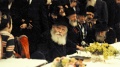 The Rebbe at the farbrengen of Tu B'Shevat in the Zal HaGadol of 770
-
 One of the farbrengens in the Zal HaGadol, 5731 (1971)
-
 Elder Chassidim sitting behind the Rebbe during the farbrengen in the Zal HaGadol. From left to right: Rabbi Tzvi Yosef Kotlarsky, Rabbi Shneur Zalman Gurary, Rabbi Yaakov Gorkov, Rabbi Uziel Chazanov, Rabbi Eliyahu Chaim Roitblat, Rabbi Zev Nisenvitz
-
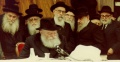 The Rebbe delivering a maamar during a farbrengen in the Zal HaGadol of 770. Behind the Rebbe stand the elder Chassidim: Rabbi Yisroel Leibov, Rabbi Shneur Zalman Gurary, Rabbi Yisroel Shimon Kalmanson, Rabbi Yaakov Yosef Raskin, Rabbi Shlomo Aharon Kazarnovsky, Rabbi Yaakov Menachem Mendel Sperlin
-
 The Rebbe saying a maamar at a farbrengen in the Zal HaGadol; the crowd is seen standing
-
 One of the last farbrengens held in the hall, 5719 (1959)
-
 The Rebbe delivering a sicha at a farbrengen in the Zal HaGadol, after the second expansion
-
 The "Zal HaGadol" at a farbrengen of the Rebbe after the third expansion, photographed from the window of the broadcast room


External Links[edit | edit source]
Farbrengen with the Rebbe[edit | edit source]
- Tag Farbrengen with the Rebbe Chabad.info (Hebrew)
- Farbrengens translated by Worldwide ATaH – Farbrengen with the Rebbe
- Farbrengen with the Rebbe – 19 Kislev, by JEM (video)
- Farbrengen with the Rebbe – 11 Nissan 5741, by JEM (video)
- Farbrengen with the Rebbe – 12 Tammuz 5741, by JEM (video)
- 8 Niggunim with the Rebbe, Chabad.org (Hebrew) (video)
References[edit | edit source]
- ↑ The story of the farbrengen, from "Kovetz Chof Ches Sivan - Yoivel Shanim" (Hebrew)
- ↑ The sichos the Rebbe said then were collected and appeared in the book Sichos Kodesh - Before the Nesius
- ↑ A small part of these sichos was collected in the book Sichos Kodesh 5683–5709. About the trip and the beginning of the farbrengen, Roth's son told in an interview with JEM.
- ↑ Yemei Bereishis, p. 167 (Hebrew)
- ↑ 19 Kislev, 10 Shvat and Purim
- ↑ p. 70 (Hebrew)
- ↑ p. 50 (Hebrew), although there were exceptional cases such as the farbrengen of Purim 5741. See about this in this booklet, p. 18
- ↑ Revelations from Purim with the Rebbe in 770 • Fascinating, Col.org.il (Hebrew)
- ↑ From Rabbi Yosef Yitzchak Gopin, in: Sholom Magidman, Imdu Hachen Kulchem, Kfar Chabad weekly, issue 2112, p. 43.
- ↑ Rabbi Michael Aharon Zeligson, "Zichronos MeHaRebbe" (Memories of the Rebbe), episode 151: "Yom Kippur & Sukos by the Rebbe", 13 Tishrei 5782.
- ↑ See the diary of R' M. M. Zeligson (available in the "Mafteach" app; there are also recordings of the Motzaei Shabbos farbrengens until then).
- ↑ "We the undersigned have decided to dare to turn with a supplicating request to the Rebbe Shlita, to farbreng on this day with a great multitude, the glory of the King, as has been the custom of the Chabad Rebbeim for generations, and we very much ask to gladden all of us on the day that was transformed etc., and a mitzvah of the many is different, and to keep the days of Purim, and from here true joy will flow for the whole year until Yinon comes, now". Revelations from Purim with the Rebbe in 770, Col.org.il (Hebrew)
- ↑ Generally Until 5748 (1988).
- ↑ In 5714 a special farbrengen on the night of the first day of Pesach, standing, near his holy room.
- ↑ Rabbi Yehuda Leib Shapiro, "A Gruss fun 770", episode 84: "Sleeping During Farbrengen", 10 Tammuz 5786.
- ↑ All this except for the niggun Tzamah Lecha Nafshi, which he would always begin singing himself (until Shabbos Parshas Naso 5743, which was the last time the Rebbe sang this niggun – except for once(?) afterwards when he sang this niggun).
- ↑ A video of the preparatory niggun at the Rebbe's farbrengen. Although sometimes another niggun is sung.
- ↑ Such as Likkutei Sichos, Sefer HaMaamarim - Melukot, Sefer HaSichos and more.
- ↑ And they were printed in the series Sichos Kodesh. From 5742 (1982) to 5752 (1992) also in the series Hisvaaduyos, and in recent years they are being reprinted in translation into Lashon HaKodesh (5710 (1950), and before that, to 5752 (1992)) in the series Divrei Moshiach.
- ↑ See the Rebbe's statements about this in several answers: Likkut Maanos Kodesh 5724–5726, answer 18, p. 27, and answer 144, p. 181. Supplements, part 4, p. 203.
- ↑ For example: an explanation that the Rebbe did not finish on Shabbos Parshas Toldos 5727 (in an answer after Shabbos the Rebbe said that due to lack of time he did not speak about it, Likkut Maanos Kodesh, supplements, part 4, p. 203) he completed on Shabbos Parshas Vayishlach 5727; see Sichos Kodesh 5727 volume 1, p. 168 (afterwards it was edited and printed in Likkutei Sichos volume 35, p. 113, Lubavitch Library website).
- ↑ On Shabbos Parshas Naso 5751 the Rebbe, unusually, held a second farbrengen after Minchah near Motzaei Shabbos, in connection with the end of the days of tashlumin, after which he acted as on Motzaei Yom Tov.
- ↑ Except for 5751 (1991), in which the Rebbe edited two sichos (of Shabbos Parshas Bereishis and Shabbos Parshas Chayei Sarah) as a "maamar in the style of a sicha".
- ↑ Afterwards several books were published collecting these sichos: Biurim in Rashi's commentary on the Torah, Toras Menachem – Tiferes Levi Yitzchak, Yayin Malchus, Biurim in Pirkei Avos and more.
- ↑ See the book HaPartizan.
- ↑ On days on which the Rebbe has a yahrtzeit.
- ↑ So he also wrote to Mr. Shimon Derbaremdiker, who came to Beis Chayeinu with the group from Brazil, for Yud Shvat 5740 (1980).