
The Apartment of the Rebbe Rayatz in 770
The second floor of 770 is the residential apartment of the Rebbe Rayatz.
The Apartment of the Rebbe Rayatz[edit | edit source]
From Elul 5700 (1940), the second floor was designated as the residence of the Rebbe Rayatz and his family. Because of the Rebbe Rayatz's state of health, he also davened, farbrenged and received people for yechidus in this apartment.

After his passing on 10 Shevat 5710 (1950), his wife, Rebbetzin Nechama Dina, continued to live there, and she would receive distinguished guests and family members there.
The Rebbe also continued to take part in the Yom Tov meals there. From the Rebbe's sichos at these meals, the set of books HaMelech B'Mesibo was published. Likewise, on special Chabad holidays such as Yud-Tes Kislev and Yud-Beis Tammuz, a short farbrengen would be held with the participation of the Rebbe and a small number of elder Anash, before the main farbrengen. After the passing of Rebbetzin Nechama Dina in 5731 (1970–71), the Rebbe stopped eating the Yom Tov meals on this floor and began to hold them in his private home on President Street. As a result, the place remained unchanged and without any special use.
During the Seforim Case, some of the books and objects were taken into safekeeping so that no stranger's hand would touch them. Afterwards, each was returned to its place.
Until 5773 (2012–13), tours were occasionally organized there, mainly during the visitor seasons, such as in the month of Tishrei and on Yud Shevat.
Today access to it is possible only for employees of the Library.
On this floor only maintenance work is carried out, without changes to the rooms and walls of the house, and the Rebbe's apartment has remained in its original form, as it was before 10 Shevat 5710 (1950).
The Rebbe Rayatz's Yechidus Room[edit | edit source]
At first, the Rebbe Rayatz would receive people on Tuesdays not in his private room but in the room that later became the Rebbe's room on the first floor.
Afterwards he received the public in his study on the second floor of 770, on the right side, above the secretariat office, until his passing on 10 Shevat 5710 (1950).
The walls of this room are lined with bookcases, and in it stands a desk similar to the desk in the Rebbe's room that had previously been used by the Rebbe Rayatz. In this room the Rebbe Rayatz also received people for yechidus. When the Rebbe stopped coming down to the davening in the small zal, a minyan would be held in the adjacent room and the Rebbe would daven in his room with the door open.
In this room the ceremony of the Rebbe Rayatz's receipt of citizenship was also held.
After the passing of the Rebbe Rayatz, during the first year after the passing, minyanim were held in this room, in which the Rashag and the Rebbe led the prayers as shluchei tzibbur (the Rashag davened in an earlier minyan than the Rebbe).
The Rebbe wanted avreichim to sit and learn there, but said that he was concerned whether the sanctity of the place could be preserved.
After the end of the year of mourning, the room remained closed except for minyanim held on Rosh Hashanah and Yom Kippur, in which several of the elder Chassidim usually davened
The Apartment After the Seforim Case[edit | edit source]
During the period of the Seforim Case, in which books were stolen from the library of the previous Rebbe, the Rebbe instructed that the books be cleared from the desk in the room, and these minyanim were discontinued.
After the affair, the Rebbe asked that the items be returned to the room, and the library staff wrote to the Rebbe that they had returned the items as they had been before 10 Shevat 5710 (1950), based on a photograph, which gave the Rebbe nachas ruach.

At the end of the affair, when the books were returned to the Rebbe Rayatz's desk, the Rebbe instructed: "It is worthwhile to dedicate the entire apartment, and especially the yechidus room and the room in which the Rebbe davened all the days (not that it should be a museum, but rather) that it should be a place of prayer and pouring out of the soul and reading of a pidyon nefesh (pan) for anyone who needs salvation, and this shall be the main use of the apartment"[1].
Rabbi Sholom Dovber Levine writes about the course of events[2]: We asked the Rebbe: Should it be made into a museum with exhibitions changing from time to time? That is: a) In the two dining rooms and in the bedroom of Rebbetzin Shterna Sarah, of blessed memory, glass cases would be built on top of the tables, etc., to serve for exhibitions. b) The yechidus room and the bedroom would be closed off with glass doors so that they could be seen through the glass doors from outside. c) The kitchen would be closed, and in it would be placed the collection of valuables, the collection of photographs and the like.
Or perhaps it is worthwhile to dedicate the entire apartment, and especially the yechidus room and the room in which the Rebbe davened all the days (not that it should be a museum, but rather) that it should be a place of prayer and pouring out of the soul for anyone who needs salvation, and perhaps also to learn a little. And this shall be the main use of the apartment.
The Rebbe crossed out the first option and underlined approval of the second option. In it, too, he crossed out the words "perhaps also to learn a little," leaving only "that it should be a place of prayer and pouring out of the soul for anyone who needs salvation," and added: "and reading of a pidyon nefesh (pan)."
We asked again:
Since we merited the answer of the Rebbe shlita, to dedicate the yechidus room of the Rebbe Rayatz, nishmaso Eden, as a place of prayer with pouring out of the soul, should this be done immediately now or after the completion of the construction?
And the Rebbe underlined the words "after the completion of the construction."
On the Yamim Noraim we would open the apartment for the recitation of Tehillim and for prayer; however, the Rebbe instructed at that time to leave the yechidus room closed.
Photo Gallery[edit | edit source]
-
 The Rebbe standing beside his father-in-law, the Rebbe Rayatz, in the room in which he received people for yechidus on the second floor of 770, at the ceremony of the Rebbe Rayatz's receipt of citizenship, 16 Adar 5709 (1949)
-
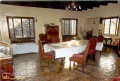 The living room of the apartment of the Rebbe Rayatz on the second floor
-
 The meal on the night after Yom Kippur 5729 (1968) in the living room of the Rebbe Rayatz's apartment


In the month of Cheshvan 5786 (2025), the media company JEM published for the first time a gallery of photographs of the Rebbe during farbrengens in the apartment of the Rebbe Rayatz, by Rabbi Chaim Baruch Halberstam
See Also[edit | edit source]
References[edit | edit source]
- ↑ The Form of the House (Hebrew), published by the ATAH HaOlami organization
- ↑ In his book Avodas HaKodesh.