Chaim Kanievsky
Rabbi Shmaryahu Yosef Chaim Kanievsky[1] (15 Teves 5688, 8 January 1928 – 15 Adar II 5782, 18 March 2022) was one of the most prominent spiritual leaders of the Chareidi-Lithuanian public (after the passing of Rabbi Shteinman) and the author of many books in a variety of Torah disciplines, among them the book "Derech Emunah", which deals with the mitzvos dependent on the Land.
Biography
He was born on 15 Teves 5688 (1928) in Pinsk (then in Poland), the eldest son of Rabbi Yaakov Yisroel Kanievsky ("the Steipler") and Pesha Miriam, the sister of the Chazon Ish. His father served as sandek at his bris milah and named him Shmaryahu Yosef Chaim, after his two grandfathers, Rabbi Shmaryahu Yosef Karelitz, the rabbi of Kosova, and Rabbi Chaim Peretz Kanievsky. On 1 Nissan 5694 (1934) he immigrated with his family to Eretz Yisroel and settled in Bnei Brak.
He studied at "Talmud Torah Rabbi Akiva – Merkaz", and in addition studied most of the tractates of the Shas with his father. At the age of 10 he entered the Tiferes Tzion yeshiva in Bnei Brak. After 6 years of study at Tiferes Tzion he moved to the Beis Yosef yeshiva, where he studied for one "zman" (semester), and immediately afterwards moved to study at the Lomza yeshiva in Petach Tikva, and in his first year there he completed (at the age of 17) the entire Shas[2].
On 7 Kislev 5712 (1951) he married Mrs. Batsheva, the daughter of Rabbi Yosef Shalom Elyashiv; he then moved to Petach Tikva for a few months and continued to study at the Lomza yeshiva. Afterwards they moved to Bnei Brak, where he began to study at Kollel Ateres Yosef (later called Kollel Chazon Ish), where he studied for decades.
Rabbi Kanievsky was considered an expert in Torah literature, and particularly in the literature of Chazal, including minor Midrashim which are not commonly studied. His method of study was based on broad expertise, comparing the sources and explaining them in light of one another. This expertise earned him the title "Maran Sar HaTorah" ("Prince of the Torah"), by which he is called in the Chareidi public.
After the passing of his father-in-law Rabbi Elyashiv, Rabbi Kanievsky's involvement in the leadership of the Lithuanian public grew, and he backed the moves of Rabbi Aharon Yehuda Leib Shteinman in leading the public; after the passing of Rabbi Shteinman in 5778 (2017–18) he began to serve as the leader of the Lithuanian public.
Rabbi Kanievsky headed many Lithuanian educational institutions and charity organizations.
He toiled in Torah day and night and received at his home every day hundreds of people seeking advice; he gave blessings and segulos in various areas, around which stories of miracles were woven – something which was an innovation in light of the reservations about leadership of this kind in the Lithuanian public in earlier years. Rabbi Kanievsky used to answer the questions he was asked concisely, both face to face and by mail. He gave haskamos (approbations) to many books that were brought to him for reading, on halacha, mussar or aggadah. He also used to participate in prayer gatherings held by various institutions and organizations. He likewise distributed the "wine of the siyumim" – wine from which they drank at the siyum HaShas that he used to make every year on Taanis Bechoros.
His passing and funeral
On the morning of Friday, 15 Adar II ("Purim of the walled cities") 5782 (2022), he collapsed at his home, and after unsuccessful resuscitation attempts he passed away at midday of cardiac arrest, at the age of 94[3]. His funeral was postponed to Sunday, 17 Adar II, and took place in the city of Bnei Brak with the participation of hundreds of thousands of people, and was one of the largest funerals ever held in the Holy Land.
Connections with Chabad

With our Rebbeim
Over the years the Rebbe worked to expand the library of Merkos L'Inyonei Chinuch, which he himself had founded, and in 5727 (1966–67) a letter was sent on behalf of the Rebbe's secretariat to Rabbi Azriel Zelig Slonim requesting additional books, and afterwards explicit mention was made of the book by the son of the Steipler (a nickname for Rabbi Yaakov Yisroel, R' Chaim's father, after the town in which he was born – Hornostaipil)" containing source references and annotations to the Rambam (see picture), his book "Kiryas Melech". A short time after the letter was publicized, R' Aryeh Ehrlich arranged for the letter to be brought before R' Chaim, who was moved to see the letter[4].
The Rebbe, in a letter from 5735 (1974–75), discusses a certain version of the text in the Mishneh Torah and notes that in Rabbi Kanievsky's book "Kiryas Melech"[5], it is written regarding this version "old printing"[6].
During the editing of the supplementary volume to the book Marei Mekomos L'Sefer Mishneh Torah, the Rebbe instructed that people go around to the great Torah and Chassidic scholars and ask them for help in finding source references for the Rambam which had not yet been printed. Among others, those who were working on the matter in Eretz Yisroel approached R' Chaim and requested his help. R' Chaim was very impressed with the book and said that they had "stolen" his work in editing his books on the Rambam, in which he had incorporated source references on the Rambam, and he presented to the representatives of the editorial board two source references on the Rambam that he had found since publishing his book, which had not yet been printed.
Some relate[7] that at the yechidus of the Rebbe with Rabbi Boruch Shimon Schneerson on 4 Elul 5749 (1989), the Rebbe asked him immediately upon his entry who is the gaon from Bnei Brak, Rabbi Chaim Kanievsky. Rabbi Schneerson, who was surprised at how the Rebbe had come to know of Rabbi Kanievsky, voiced his surprise aloud, and the Rebbe answered: "I saw his book on the Rambam – 'Kiryas Melech', and it is astounding!" When Rabbi Schneerson clarified to the Rebbe that Rabbi Kanievsky was not involved in public leadership, as was the case at that time, the Rebbe expressed his displeasure at this[8]. Some doubt the reliability of this story.
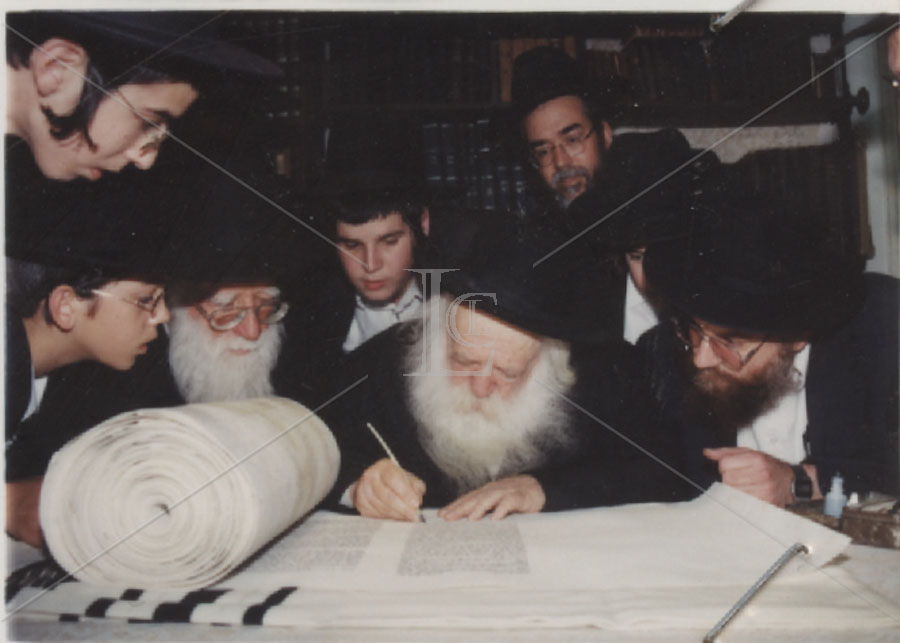
In the Chabad Lubavitch Library there is a picture of him writing a letter in the Sefer Torah that was sent to the Rebbe.
R' Chaim sided with the Rebbe's view on various subjects, such as the advantage of wearing a sheitel over a kerchief[9], the fact that the Tablets of the Covenant were rectangular[10] and that the branches of the Menorah were straight[11], that sums spent on distributing Shabbos candles to women who do not light are included in the concept of "Shabbos expenses are reimbursed"[12], and that it is proper to bring children to hear the Ten Commandments[13].
His father the Steipler, in his book of letters "Kraina D'Igresa", raised a difficulty with the view of the Alter Rebbe in Likkutei Amarim - Chapter 38 regarding "that which is permitted in your mouth". Rabbi Sholom Dovber Wolpo wrote a book to resolve the Steipler's difficulty. Some have written[14] that his son, Rabbi Kanievsky, received the book and thanked Rabbi Wolpo, and some have cast doubt on this[15].

In the month of Teves 5773 (2012–13), R' Chaim, together with many other rabbis and Rebbes, signed a call to study the Shulchan Aruch of the Alter Rebbe (see picture)[16]. In 5777 (2016–17) a video was published of R' Chaim listening with emotion to a niggun set to the words of the Alter Rebbe in chapter 41 of the Book of the Tanya: "Behold, Hashem stands over him, and the whole earth is full of His glory"[17].
During the spread of the Coronavirus, he answered a question about what one should strengthen in preparation for the High Holy Days as a segulah for health, that one should study every day the laws of Shemittah and Yovel in the Mishneh Torah, similar to the institution of daily Rambam study[18].
With Chabad Chassidim

Over the years he met with various Chabad figures, such as Rabbi Gedalya Oberlander, who presented him with the book "Nitzotzei Esh" (a collection of sayings arranged by subject and topics of avodas Hashem, from the books of the Alter Rebbe)[19], Rabbi Yaakov Glauberman[20], Rabbi Yeshayahu Weber[21], Rabbi Meir Alitov, who presented him with a book making accessible explanations of the Rebbe on Tractate Bava Kamma based on the book Hadranim on the Rambam[22], Rabbi Eliyahu Tzvi Jakubowicz[23], and others. After receiving the book of Rabbi Sholom Dovber Wolpo, "HaRambam HaShalem" on the laws of Shabbos, he noted that he enjoyed it and that "the toil and effort in Torah is evident from it"[24].
In Kislev 5772 (2011), R' Chaim met at his home with the chozer Rabbi Yoel Kahn and the mashpia Rabbi Mendel Wechter. At the end of the visit R' Yoel and Rabbi Wechter presented him with a set of Otzros Likkutei Sichos published by the organization Toras Chabad L'Bnei HaYeshivos[25].
In Kislev 5773 (2012), R' Chaim traveled to comfort the mourners and visit the sick at the home of the shliach Rabbi Shmuel Scharf, who was wounded by a rocket fired at Israel during Operation Pillar of Defense[26].
In the summer of 5775 (2015) he met with Rabbi Yaakov Lenchner as part of a memorization campaign for the children of R' Chaim's institutions, conducted through the "Yemos HaMoshiach" system. During the meeting Rabbi Lenchner presented him with a set of Dvar Malchus Pianuchim published by MMS Publishing. Rabbi Lenchner later related that when he visited Rabbi Kanievsky's home some time later, one of the members of the household told him that Rabbi Kanievsky had moved the set to the room in which he studies, and that from time to time the bookmark moved between the pages – which showed Rabbi Kanievsky's constant study of the book[27]. In Kislev 5778 (2017), the shliach Rabbi Berel Lazar, Chief Rabbi of Russia, visited Eretz Yisroel to take part in the large Yud-Tes Kislev farbrengen held in Bnei Brak. At that time he met with Rabbi Kanievsky and presented him with the kuntres Inyanah Shel Toras HaChassidus and a set of the annotated Likkutei Torah and Torah Or, published by Toras Chabad L'Bnei HaYeshivos. R' Chaim said that he would study the books[28].
In Sivan 5778 (2018), R' Chaim wrote a letter in a Sefer Torah written in memory of the shluchim Gabi and Rivky Holtzberg. He added that it is a privilege to write in a Sefer Torah written and donated in memory of the holy ones who were murdered in the Chabad House[29].
Rabbi Kanievsky wrote a letter in a Sefer Torah dedicated to the merit of the Rebbe, to the integrity of the Land and to the unity of Israel[30][31].
The Bnei Brak Rabbinate
In 5761 (2000–01), Rabbi Kanievsky was among the rabbis who added their signatures to a letter of protest by Chaim Shaul Karelitz against the appointment of Rabbi Moshe Yehuda Leib Landa as Rabbi of the city of Bnei Brak. In that same letter, Karelitz attacked Chabad Chassidus over its identification of the Rebbe as Melech HaMoshiach. When the "She'eris Yisrael" hechsher was established in opposition to Rabbi Landa's kashrus, R' Chaim also supported "She'eris Yisrael" and opposed Rabbi Landa's kashrus[32].
In Adar I 5765 (2005), Rabbi Moshe Landa met unexpectedly with the rabbis who lead the Lithuanian public, headed by Rabbi Kanievsky[33]. These meetings were extremely surprising after long years marked by a negative relationship and estrangement. They marked the beginning of a reconciliation between the Chassidic public and the Lithuanian public in Bnei Brak.
It later became known that at these meetings it was agreed that after the passing of Rabbi Moshe, a Chassidic rabbi and a Lithuanian rabbi would be appointed for Bnei Brak. The Chassidic rabbi would be his son, Rabbi Yitzchak Isaac Landa, and the Lithuanian rabbi would be Rabbi Shevach Tzvi Rosenblatt. This was carried out after the passing of Rabbi Moshe Landa on 24 Adar II 5779 (2019). In this way, Rabbi Kanievsky was a partner in making a historic peace between the Chassidim and the Lithuanians in Bnei Brak, and in establishing a joint kashrus body over all the factions[34].
About two weeks after the day Rabbis Landa and Rosenblatt were appointed, he received them in his home together with the mayor of Bnei Brak, Rabbi Avraham Rubinstein, and blessed them. This gave approval to the unifying appointment[35].

Anticipation of Moshiach
In a conversation he held with those close to him on the subject of the "Principles of Faith," they discussed the twelfth principle: belief in the coming of Moshiach. One of those present noted that among yeshivah students the topic seemingly belongs to other circles. R' Chaim expressed sorrow and said that the topic must become more familiar, and that people should sit and study the subjects connected to it.
He mentioned that the Chofetz Chaim had two main subjects: guarding one's speech and belief in Moshiach. Yet for some reason a great commotion is made about the one, while the other is left lying in a corner. In response to the question of one of those present as to what he meant, he answered: simply that people should sit and study the subjects connected to it. Through this they will fulfill the requirement of the twelfth principle. This also applies to the matter of "awaiting his coming," regarding which the Rambam writes that one who does not await him is a heretic, Heaven forfend. For if they study, they will automatically await his coming[36].
To someone who asked whether our time is the time of Moshiach's coming, he answered: "That is what we believe, that is what we anticipate, perhaps this is the time"[37]. On another occasion he noted: "Moshiach is alive with us today; the Geulah is ready and prepared"[38].
His attitude to the Rebbe as Melech HaMoshiach and as the Prophet of the Generation
In 5769 (2008–09), Rabbi Ben Tzion Gagula (director of the Chabad House in Haifa) met with Rabbi Chaim Kanievsky. His aim was to present to him the halachic ruling that the Rebbe is Melech HaMoshiach and the Torah sources regarding the Rebbe's identity as Melech HaMoshiach and as the prophet of the generation. This approach to HaGaon Rabbi Chaim Kanievsky followed a preliminary meeting and clarification that Rabbi Gagula held with HaGaon Rabbi Gershon Edelstein of blessed memory.
The preliminary clarification: During the conversation with Rabbi Edelstein, Rabbi Gagula presented the sources from the Rambam's "Iggeres Teiman," the works of the poskim, and the Rebbe's sichos (Shabbos Parshas Shoftim 5751) concerning the return of prophecy.
Verification of the ruling: HaGaon Rabbi Gershon Edelstein was greatly impressed by the signatures of his teachers on the ruling: HaGaon Rabbi Eliyahu Shmerler of blessed memory and HaGaon Rabbi Zalman Leib Estulin of blessed memory. Rabbi Gagula, on Rabbi Edelstein's behalf, then verified the matter with HaGaon Rabbi Eliyahu Shmerler, who said decisively: "Yes, I signed... It is permitted to believe in this! It is permitted to publicize it!" After this, HaGaon Rabbi Gershon Edelstein expressed his agreement with the matter.
The mission to Rabbi Chaim: Following this, HaGaon Rabbi Gershon Edelstein asked Rabbi Gagula to go as his emissary to Maran HaGaon Rabbi Chaim Kanievsky and convey to him the matter and his agreement to it. Accordingly, Ben Tzion Gagula met with HaGaon Rabbi Chaim Kanievsky and showed him all the sources and rulings in writing, and Rabbi Chaim studied them. Rabbi Gagula then conveyed to Rabbi Chaim the words of HaGaon Rabbi Gershon Edelstein. HaGaon Rabbi Chaim Kanievsky was impressed to hear them, and with that the meeting concluded[39][40].
Likewise: in the summer of 5775 (2015), Rabbi Yaakov Lenchner met with him in the framework of a memorization campaign for the children of R' Chaim's institutions, conducted through the "Yemos HaMoshiach" system. During the meeting, Rabbi Lenchner gave him a set of Dvar Malchus Pianuchim published by MaMash. Rabbi Lenchner later related that when he visited Rabbi Kanievsky's home some time afterward, a member of the household told him that Rabbi Kanievsky had moved the set to the room where he studies. From time to time the bookmark moved between the pages, which showed Rabbi Kanievsky's continual study of the book.
His works
- Shoneh Halachos - an abridgement of the rulings of the Mishnah Berurah and the Chazon Ish
- Shaarei Emunah - explanations and novel insights on the Mishnayos of Seder Zeraim
- Derech Emunah - a work arranged in the format of the Mishnah Berurah on the laws of Zeraim in the Rambam's Mishneh Torah, 5 volumes
- Derech Chochmah - a work arranged in the format of the Mishnah Berurah on the laws of Kodashim in the Rambam's Mishneh Torah
- Shekel HaKodesh - a commentary on the laws of Shekalim and the laws of Kiddush HaChodesh in the Mishneh Torah
- Orchos Yosher - words of mussar, collected mainly from the words of Chazal, the Rishonim and the Acharonim
- Siach HaSadeh - Part 1 and Part 2: kuntreisim on various subjects, among them tattoos, the kashrus of locusts, things beneficial for memory, and more. The parts also include kuntreisim that were printed separately. Part 3 is a collection of notes on the order of the Shas
- Nachal Eisan - on the laws of Eglah Arufah
- Taama D'Kra - novel insights on Tanach
- Kiryas Melech - source references on the Mishneh Torah
- B'Shaar HaMelech - clarifications and references on the Rambam's introduction to the Mishneh Torah. This book was also printed as part of Siach HaSadeh, Part 1
- Yishuv HaDaas - resolutions of the difficulties that the Maharsha left with "v'yesh l'yashev," printed as part of Siach HaSadeh, Part 2
- Explanations on the minor tractates, such as Emes V'Tzedek on Maseches Gerim, Matzref U'Metaher on Maseches Kusim, Kinyan HaGuf V'Kinyan Peiros on Maseches Avadim, and more
- Limechaseh Atik - places in Tanach where the verse is obscure and Chazal explained its meaning. Expanded versions of this book were issued by various authors.
- A commentary on the Jerusalem Talmud, edited by his son-in-law Rabbi Zelig Braverman. The commentary was printed in the margins of the Jerusalem Talmud in the "Oz VeHadar" edition, as well as in a special edition with the Yerushalmi alone
- Daas Noteh - a collection of halachic responsa arranged according to the order of the Mishnah Berurah. It includes notes and clarifications by Rabbi Kanievsky, as well as references to other poskim added by a team of editors headed by his son Rabbi Yitzchak Shaul. Three parts have appeared so far, 5769–5776 (2008–2016). It is estimated that the series will comprise about ten volumes.
- Derech Sichah - questions on a variety of subjects, arranged according to the weekly Torah portions, by his student Rabbi Eliyahu Mann (based on his conversations with Rabbi Kanievsky at every Friday night meal), two parts
- Kol Mishalosecha - questions and answers on a wide range of subjects, arranged according to the weekly Torah portions, Bnei Brak 5778 (2017–18)
- Shimah Tefillasi - explanations of the order of the prayers based on his answers to Tzvi Yavrov, Bnei Brak 5768 (2007–08)
- Bahir BaShechakim - an explanation of Sefer HaBahir. An additional volume contains glosses on Raziel HaMalach, Sefer Noach and Sefer Chanoch
- Perek B'Shir - an explanation of Perek Shirah
Personal life and family
He married the distinguished Bas-Sheva Esther Kanievsky (née Elyashiv), daughter of Rabbi Yosef Shalom Elyashiv. He was the father of five daughters and three sons:
- Chana Steinman, wife of Rabbi Shraga Noach Steinman.
- Rebbetzin Leah Koldetzky.
- Rabbi Avraham Yeshaya Kanievsky – editor of the writings of his grandfather the Steipler, "Krayna D'Igrasa," and of several of his father's books. Together with his father, he authored the book "Mussar Av" on the laws of Ben Sorer U'Moreh. He served as rosh yeshivah of the "Sfas HaYam" yeshivah for baalei teshuvah.
- Ruth Tzivyon, wife of Rabbi Yehoshua Tzivyon. Author of the book "Beis Imi" about her mother.
- Rabbi Shlomo Kanievsky – rosh yeshivah of Yeshivas Tiferes Tzion and Yeshivas Kiryat Melech.
- Bracha Braverman, wife of Rabbi Zelig Braverman. He is rosh yeshivah of the Sadigura, "Derech Emunah – Lod" and "Nesivos Yitzchak" yeshivos, and editor of his father-in-law's explanations on the Jerusalem Talmud and Maseches Kallah.
- Dina Epstein, wife of Rabbi Elazar Dovid Epstein. He is a maggid shiur in Yeshivas Torah B'Tifartah and author of the books "Mishnas HaShabbos" and "Shechitas Chullin".
- Rabbi Yitzchak Shaul (Shuki) Kanievsky. He studied in chavrusa with his father and wrote some of his letters. He is chief editor of the "Daas Noteh" books, which contain his father's responsa arranged according to the Shulchan Aruch. He is the author of the books "Bar Gibul" and "Ohel Arai," and of the commentary "Siach Emunah," compiled from his father's book on the laws of Shemittah.
- His grandson Yaakov Yisroel (Yanky) Kanievsky, son of Rabbi Yitzchak Shaul.
Further reading
- Truly awaiting the coming of Moshiach, Beis Moshiach issue no. 1304, pp. 24–26.
- Rabbi Moshe Marinovsky, Burning faith in Torah, Kfar Chabad issue 1952, p. 24, 5782 (2021–22).
References
- ↑ This is how he used to sign his name – "קניבסקי" in defective spelling, and not "קנייבסקי" in full spelling.
- ↑ And from then on he would complete every year, on Erev Pesach, the entire Talmud Bavli and Yerushalmi, the Rambam, Tanach, and much more.
- ↑ The leader of the Lithuanian public, Rabbi Chaim Kanievsky, has passed away
- ↑ How did Rabbi Chaim Kanievsky react to the letter from the Rebbe's secretariat? (col.org.il)
- ↑ Rabbi Chaim Kanievsky, Kiryas Melech, p. 160 (third edition), on HebrewBooks.
- ↑ Likkutei Sichos, vol. 12, p. 188.
- ↑ Rabbi Schneerson (currently one of the rabbis of the Tchebin yeshiva), a grandson of Rabbi Boruch Shimon Schneerson, who relates this in the name of his brother Rabbi Shlomo Zalman Schneerson, who heard it from their grandfather in his days of frailty.
- ↑ HaMevaser Torani, Parshas Shelach 5781 (page 5)
- ↑ A letter of Rabbi Kanievsky revealed: a sheitel is preferable to a kerchief
- ↑ U'Beoso HaZman issue no. 5 (Sivan 5781).
- ↑ Rabbi Kanievsky: the branches of the Menorah were diagonal
- ↑ Rabbi Kanievsky joins the Neshek campaign
- ↑ Rabbi Kanievsky: it is proper to take small children to hear the Ten Commandments
- ↑ An article on Chabad Info
- ↑ Comments on Shturem
- ↑ Gedolei Yisroel in a call: "To study the laws of Torah study in the Shulchan Aruch of the Alter Rebbe"
- ↑ The emotion of Rabbi Chaim Kanievsky
- ↑ Picture of the reply.
- ↑ Bnei Brak: Rabbi Kanievsky received the book "Nitzotzei Esh"
- ↑ Picture of the night ● Bnei Brak
- ↑ A Chabad Chassid held an event; Lithuanian Gedolim came to bless
- ↑ Rabbi Chaim Kanievsky received "the Rebbe's Book of Hadranim" (col.org.il)
- ↑ Lithuanian Gedolim gave an approbation to a book written by a "Tamim" from Kfar Chabad
- ↑ Rabbi Kanievsky's letter on Rabbi Wolpo's "HaRambam HaShalem".
- ↑ The Rebbe's "chozer" met with Rabbi Chaim Kanievsky ● Exposé (col.org.il)
- ↑ A surprise guest: Rabbi Chaim Kanievsky comforted the shliach
- ↑ Related by the person involved, Rabbi Yaakov Lenchner, at a farbrengen in the yeshiva Tomchei Temimim Rishon LeZion.
- ↑ Watch: Rabbi Berel Lazar meets with Rabbi Kanievsky
- ↑ HaGaon Rabbi Chaim Kanievsky wrote a letter in the Sefer Torah in memory of the Holtzberg couple, may Hashem avenge their blood
- ↑ A video short, "Rabbi Kanievsky, of blessed memory, writes a letter in the Moshiach Now Sefer Torah for the Rebbe Melech HaMoshiach shlita, the integrity of the Land and the unity of Israel," on the YouTube channel Schimon Elkayam שמעון אלקיים.
- ↑ The Sefer Torah was the initiative of R' Shimon Elkayam. It received broad support from Chabad rabbis and mashpiim in general.
- ↑ Maran HaGaon Rabbi Aharon Yehuda Leib Steinman revealed: "The Chazon Ish thought highly of Rabbi Landa", on the Kikar HaShabbat website.
- ↑ Who stands behind the historic reconciliation meeting?
- ↑ For the first time in history: a new kashrus headed by the rabbis of Bnei Brak
- ↑ Picture of the night
- ↑ Rabbi Chaim Kanievsky, One must study about Moshiach and strengthen the anticipation of him .
- ↑ "Likras HaGeulah," issue 1, p. 8, Menachem Av 5773 (2013).
- ↑ HaGaon Rabbi Chaim Kanievsky: "Moshiach is alive with us today. The Geulah is ready and prepared" (hidabroot.org) on the Hidabroot website.
- ↑ This took place during Gagula's round of visits to prominent rabbis, during which he documented and transcribed the content of the conversations.
- ↑ Torah greats from all circles believe that the Rebbe is a prophet and Moshiach!


