Israel Defense Forces
The Israel Defense Forces (known mainly by its acronym: Tzahal, IDF) is the military of the State of Israel, charged with safeguarding its security and sovereignty.

The Rebbe gave special attention to IDF soldiers, writing them letters and sending shluchim to encourage them. He also took a detailed interest in the conduct of the army in conversations with senior officers who came to consult with him and receive his blessing.
In his sichos the Rebbe often referred to Israel's wars and military operations; for the most part he backed them, and called on political leaders not to let political considerations override security considerations. He opposed the conscription of yeshivah students and of women, and worked to obtain exit permits for Chabad yeshivah students traveling to study at 770 ("Kvutzah"), an issue regulated by successive agreements with the IDF. In 5736 (1976) he met disabled IDF veterans and called them "Metzuyanei Tzahal" (outstanding IDF soldiers). Chabad Chassidim have been active with IDF soldiers since the army's early years, including the writing of a Sefer Torah for IDF soldiers, printing the Tanya at army bases and the work of the Or LaChayal organization.
History edit


Until the founding of the State of Israel in 5708 (1948), three Jewish fighting organizations operated in the country: the Haganah, the Etzel (Irgun Tzvai Leumi) and the Lechi (Lochamei Cherut Yisrael). With the end of British rule and the declaration of independence, the country's Arab residents, aided by the neighboring states, launched a war (which later became known as the "War of Liberation" or the "War of Independence") against the Jewish residents.
During the war, the head of the provisional government, David Ben-Gurion, signed the "Israel Defense Forces Ordinance". The new army was built on the Haganah's organizational infrastructure and absorbed the fighters of the Etzel and Lechi underground movements.
In a reply to Mr. Shimon Peres (through a third party – Mr. Jerry Weintraub), the Rebbe made clear that his having prevented the formation of Peres's government in the framework of the "dirty trick" did not involve any personal dispute with Mr. Peres, and the Rebbe notes that this is "especially after I received information (in the previous generation) that it was Mr. [Peres] who organized the IDF from its beginning[1] – in a way that would be a defense for Israel, from then until now".[2]
The Rebbe's Attitude to IDF Operations edit
In his sichos the Rebbe often addressed the integrity of the Land, and in that context frequently referred to IDF operations. For the most part he backed them, and called on Israel's political leaders not to mix politics into military matters concerning the security and sovereignty of the State of Israel and the safety of its residents.
On 22 Sivan 5749 (1989) the Rebbe said to Mr. Yosef Ben Hanan, an armored corps officer: "When the IDF is strong, then there will be no need for any war, because 'your fear and your dread' will be upon all the surrounding countries, and then there will be no casualties and no war, and Moshiach Tzidkeinu will come. This is the main point of all main points".
The War of Liberation edit
On 17 Kislev 5708 (1947), the General Assembly of the United Nations (the UN) voted to partition Eretz Yisroel into two states, one Arab and one Jewish. The Arabs of the land (led by the Arab Higher Committee) rejected the decision and began a series of attacks on Jews in Eretz Yisroel, aiming to destroy the Jewish population and take control of the entire land. The Jews fought back through the fighting organizations then active in the country. After the British withdrawal and the declaration of the state on 5 Iyar 5708 (1948), the armies of Syria, Jordan, Egypt and Iraq invaded Eretz Yisroel and joined the fighting. The IDF was established during the war and from then on was the main force fighting the Arab armies.
On 23 Tammuz 5709 (1949) the war ended. About 9,000 soldiers of the Arab armies were killed, and more than 6,000 Jews fell al kiddush Hashem, about one percent of the Jewish population of the Holy Land at the time. The war ended in a Jewish victory, after which immigration to the country grew by hundreds of percent. Tens of thousands of Arabs abandoned their homes and emigrated to Arab countries, and Jewish villages and settlements were built on their ruins, among them Kfar Chabad, which was established on the initiative of the Rebbe Rayatz on the ruins of the Arab village of Safriya, which was emptied of its residents during the war.
Following the victory and the founding of the state, differing views formed among the religious public about the proper attitude toward the state and the war. On one side, circles of Religious Zionism called for establishing a festival on Independence Day, saying Hallel on it and giving thanks for the miracles; on the other, zealot circles utterly rejected the state, saw it as an evil affliction to be abolished, and even claimed that one cannot speak of miracles performed for Jews who do not keep Torah and mitzvos.
The Rebbe rejected both approaches. He sharply rejected the view that the existence of Jewish sovereignty in Eretz Yisroel and the ingathering of Jews from all over the world is "Atchalta DeGeulah" (the beginning of the Redemption)[3], At the same time he asked his Chassidim to use the awakening that followed the victory to increase the observance of Torah and mitzvos among all strata of the people, explaining that when "one sees that Hashem Yisborach delivered the many into the hands of the few in a miraculous way, this should arouse added strength to serve Him, may He be blessed, and one should not be impressed at all by the fact that there are those who behave otherwise... that this is, in addition to all the other matters, conduct of ingratitude in the most shocking way. To what can this be compared? To a great and mighty king who shows his great and tremendous love to a lowly, despised commoner, the lowest of men etc., and descends to him from his place of honor with all his ministers etc., and brings him into his palace, the king's palace etc. Is it possible to say that this lowly man would say to the king that this palace is not the king's but the commoner's, and therefore he will behave in it as he wishes, and the beginning of his conduct is to drive the king out of his palace in every possible way, that is, through crude conduct contrary to the king's command at every single step?!"[4]
The Sinai War (Operation Kadesh) edit
On 24 Cheshvan 5717 (1956) Israel launched a military campaign against Egypt called "Operation Kadesh", following infiltrations by terrorist cells (the "fedayeen") into Israeli territory and the murder of innocent people, and the closure of the Suez Canal and the Straits of Tiran to Israeli shipping, which paralyzed the port of Eilat. The operation, backed by France and Britain, lasted about a week and ended on 1 Kislev.
During the war the IDF captured the Sinai Peninsula and severely damaged the Egyptian army's infrastructure. After a week IDF forces halted and dug in on the captured territory, while Britain and France launched "Operation Musketeer", taking the cities north of the Suez Canal and additional positions along it. The UN, the U.S. government and the Soviet Union then applied heavy pressure for the withdrawal of all military forces from the area, and after some time all of them withdrew and were replaced by a UN force stationed to safeguard free passage in the canal area, on 18 Teves 5717 (1956).
The operation ended in an Israeli victory and achieved its goal of opening the Straits of Tiran to shipping bound for Eilat, but it cost the lives of 177 soldiers. On the Egyptian side about 3,000 were reported killed, close to 5,000 wounded and more than 6,000 captured, and the Egyptian army's morale and strength were severely damaged.
At a farbrengen the Rebbe held during the war he said a maamar of Chassidus[5], in which he referred to the war: "Many waters cannot extinguish the love, nor can rivers drown it... The Holy One, blessed be He, said to the Jewish people: If all the nations of the world gather, a multitude of many peoples like the roar of many waters, they will not be able to extinguish (G-d forbid) the love between Me and Israel; and if all the kings of the earth and their ministers gather, the mighty and many waters of the river, they will not be able to wipe you out (G-d forbid) from the world". The maamar took on added importance when, immediately after Shabbos, the Rebbe asked for it for editing and instructed that it be printed in the Holy Land to be studied during the war, saying that it contained an answer to several matters connected with the war.[6]
Despite the Rebbe's objections, at the end of the war Israel voluntarily gave up all the captured territory, yielding to the pressure of the powers. In the years after the war the Rebbe referred several times to what he saw as the mistake of putting political considerations ahead of security considerations: the total surrender to the UN's decisions despite the security danger created by returning the territories without getting anything in return.[7]
The Six-Day War edit

In early summer 5727 (1967) the Arab armies prepared for an all-out war on the State of Israel, planning to attack on several fronts at once, collapse its army and bring about its destruction and the end of its sovereignty.
During the tense period before the war, despite the assessments of military experts and widespread fear of catastrophe, the Rebbe clearly prophesied that Hashem would bring the Jewish people out of the difficult situation with a great victory, and told people who asked him not to leave the country.[8]
The war, which broke out on 26 Iyar, lasted only six days. As the Rebbe had foreseen, and contrary to all the experts' forecasts, the IDF won on all fronts and even gained additional territory, capturing the area of the Western Wall, the Golan Heights, Gaza, the Sinai desert, Chevron, Kever Rachel, and other places.
The Rebbe harnessed the public's excitement over the victory, asking the Chassidim to make an effort to channel the general awakening into the observance of mitzvos, and sending Chabad Chassidim throughout the country to help passers-by put on tefillin.
Alongside this spiritual activity, the Rebbe began working to settle the territories liberated in the war, and fought the plan to hand them back to the Arab states. He made clear that if the Arabs within the expanded borders were not removed and were given Israeli citizenship, they would change Israel's demographic map, which could affect election results.
The War of Attrition edit
After the IDF's victory in the Six-Day War, the Egyptian army, aided by the Soviet Union, launched a frontal attack on IDF positions along the Suez Canal in a campaign that lasted about a year and a half, from 18 Adar 5729 (1969) until the ceasefire on 5 Av 5730 (1970). Although by dry military definition a war that ends in a ceasefire is undecided, the Egyptian army failed to force an Israeli withdrawal from the border line, while Israel inflicted losses of about ten thousand Egyptian soldiers, caused a flow of hundreds of thousands of refugees to Cairo, severely wore down the Egyptian army, which was forced to ask for Soviet help, and severely damaged the Egyptian economy.
Throughout the war the Rebbe called on the Chassidim to visit IDF positions and encourage the fighters, and called on the high command and government policymakers to take a firm stand and not yield to American pressure for a ceasefire, since the Egyptians would certainly use it to reinforce their forces and would soon start a new war that would cost the lives of many soldiers. The Rebbe's calls went unheeded, and his forecast proved accurate: just one day after the ceasefire was signed, the Egyptians violated it and began massive preparations for the Yom Kippur War.
The Yom Kippur War edit

The Yom Kippur War broke out, with relative surprise, on Yom Kippur, 10 Tishrei 5734 (1973), with an attack by the armies of Syria and Egypt on Israel. The war officially ended on 30 Tishrei 5734 (1973); however, on the Syrian side the war ended on 10 Sivan 5734 (1974).
The massive opening attack caught the Israeli government and the IDF unprepared in many respects, and the initial losses were painful and bitter, but forces were soon mobilized, and IDF soldiers repelled the attacks and captured vast territory on all fronts.
Unlike the government and the intelligence services, the Rebbe foresaw the outbreak of the war months in advance, beginning a long series of preparations and statements that made clear a great, imminent event was coming that would require great kindness. In particular, he spurred activity with children: "From the mouths of babes... to silence the enemy". About these words the Rebbe said that "he prophesied and did not know what he prophesied".
Operation Yonatan (Entebbe) edit
In Sivan 5736 (1976) a terrorist cell hijacked an Air France plane to Entebbe, Uganda, and held the passengers hostage, demanding the release of fifty-three terrorists and setting an ultimatum that endangered the passengers' lives.
On 6 Tammuz the IDF launched a complex rescue operation under the command of Yoni Netanyahu[9], and the fighters of Sayeret Matkal rescued the hostages and brought them back to Israel.
Unlike circles that called the rescue "an act of Satan" because the soldiers involved did not keep Torah and mitzvos, the Rebbe saw it as a miraculous rescue[10], and called for a spiritual awakening in response to the great miracle, rejecting the claims of Rabbi Yoel Teitelbaum, the Satmar Rebbe.
The First Lebanon War edit
In 5742 (1982) the First Lebanon War broke out[11], in which IDF forces fought the Syrian army and the Palestinian terror organizations operating against Israel from Lebanese territory. The IDF sent ground forces into Lebanon to root out the Palestinian terror nests.
After a week of ground fighting in which the IDF gained military superiority and encircled Beirut, Israeli politicians, under worldwide political pressure, ordered that Beirut not be taken by force. This led to a war of attrition that cost the lives of hundreds of IDF soldiers and prevented the final destruction of the terror nests in Lebanon.
While the forces waited outside Beirut, the Rebbe cried out many times that the politicians were not letting the military experts do what their military and security knowledge required, and were thereby endangering the soldiers' lives.[12]
In addition, the Rebbe warned that if they did not finish the job now, they would have to return after several years and fight in Lebanese territory under harder conditions, and without military superiority, which would claim additional casualties both on the Arab side and on the Jewish side. This prediction came true when, in 5766 (2006), the Second Lebanon War broke out, in which more than one hundred and fifty civilians and IDF soldiers were killed.[13]
IDF Senior Officers and the Rebbe edit

On 20 Adar I 5744 (1984) the Chief Rabbi of the IDF, Rabbi Gad Navon, visited the Rebbe. During the visit the Rebbe gave Rabbi Navon a Tanya printed in Grenada by the chaplain Rabbi Yaakov Goldstein, bearing the emblem of the U.S. Army alongside that of Kehot.[14] Rabbi Navon came away deeply impressed and instructed those around him to help Chabad as much as possible.[15]
Other senior figures also visited the Rebbe, among them Meir Amit (while serving as head of the Mossad), Rehavam Ze'evi (while serving as a major general in the IDF), Major General Rafi Peretz[16], Brigadier General Ran Peker, Brigadier General Menachem Eini[17], Major General Yossi Ben Hanan, and many other senior figures[18]. All of them said they were deeply impressed by the Rebbe's detailed knowledge and broad military vision, and marveled at his concern and interest in every detail of the military's conduct and at his positive attitude toward it.
Many of these meetings were documented by the Chabad media company JEM in a series of interviews with IDF generals and other senior figures, and were released in the video production "Emunah U'Bitachon – Army and Intelligence".[19]
The "Metzuyanei Tzahal" edit


On 23 Av 5736 (1976) a group of disabled IDF veterans on a trip to New York came to 770 to meet the Rebbe at a yechidus.
The Rebbe received the group, encouraged them, and gave each of them a dollar for tzedakah and as a blessing.
The sicha the Rebbe delivered to them was in Lashon Hakodesh[20], In it he explained that in his view they should not be called "IDF disabled", a name that implies inferiority, but "metzuyanim" (outstanding), reflecting their special strengths and the self-sacrifice they had shown in defending the Jewish people.[21]
Service in the IDF edit
The Rebbe regards with great affection every soldier who defends the country's borders and protects its residents. He notes this in many letters, reminding the soldiers of their great merit and of the great responsibility that Hashem has entrusted to them, which should spur them to keep Torah and mitzvos so that they succeed in their mission.[22]
Throughout the IDF's history many Chabad Chassidim have served in the army, fought in Israel's wars and contributed to the defense of its borders, using their free time, at the Rebbe's instruction, to bring their comrades closer to Judaism.
Conscription of Yeshiva Students edit


The Rebbe sharply opposes the conscription of Temimim. On several occasions he addressed the issue of "equal sharing of the burden" and the drafting of yeshivah students, emphasizing that their learning protects the country's residents even more than the soldier on the border.[23] At the same time the Rebbe emphasized the virtue of IDF soldiers who sacrifice their lives in practice and protect the residents of the country with their bodies: "...that a bochur who sits and learns Torah protects the country even more than the bochur who stands on the border and endangers his life. But there is, of course, a virtue in both; in this bochur who stands on the border – his virtue is actual mesirus nefesh. It turns out, then, that there is a virtue in both, both in the bochurim who sit and learn Torah and in those who stand on the border... Since there is a virtue in both, it is understood that those in charge of security need to take care both of appropriate help for the yeshivos and of making appropriate decisions in matters of security etc..."[24]
In 5773 (2013), amid renewed controversy over drafting yeshivah students, Chabad rabbonim issued a call, based on the Rebbe's words, instructing yeshivah students to persist in their learning and not to enlist under any circumstances.[25]
Conscription of Women edit

The Rebbe spoke out many times against drafting women into the army, and said[26] that it harms the army not only religiously and morally but also operationally, since the presence of women brings emotional tensions into military operations and reduces soldiers' ability to concentrate on their mission.
The Rebbe ruled[27] that, halachically, drafting women into the army falls into the category of "abizraihu degilui arayos" (an accessory to forbidden relations), and according to some poskim one must give up one's life rather than comply: "yehareg ve'al ya'avor" (be killed rather than transgress).
The Rebbe further emphasizes that this especially concerns a Jewish army, which needs Divine help, and that help depends on safeguarding the holiness of the army camps, as stated explicitly in the Torah: "For Hashem your G-d walks in the midst of your camp, to save you and to deliver your enemies before you; therefore your camp shall be holy, that He see no unseemly thing in you and turn away from you".[28]
Agreements Regarding Travel to "Kvutzah" edit
The Chabad course of study changed during the early years of the Chabad community in the Holy Land and took shape over time into its current format: after elementary school (the "Talmud Torah" in Chareidi parlance), a bochur learns three years in a yeshivah ketanah and then three more in a yeshivah gedolah. At the end, the bochurim travel for a full year of study in the court of the Rebbe, in the Central Yeshivas Tomchei Tmimim in 770.
This created a problem: young bochurim who had not yet served in the army needed exit permits, which meant obtaining a special exemption every year for an entire class of Chabad yeshivah bochurim to leave the country to study in the Rebbe's court.
To this end the Rebbe mobilized a whole network of contacts with senior government officials and wrote personal letters to the relevant figures[29][30], to persuade them to issue the special permit for Chabad yeshivah bochurim.
Eventually the IDF and Chabad askanim reached an agreement: a bochur who signed a commitment to return at the end of the year would receive an exit permit, and on his return could rejoin the general yeshivah-student arrangement, "Toraso Umanuso".
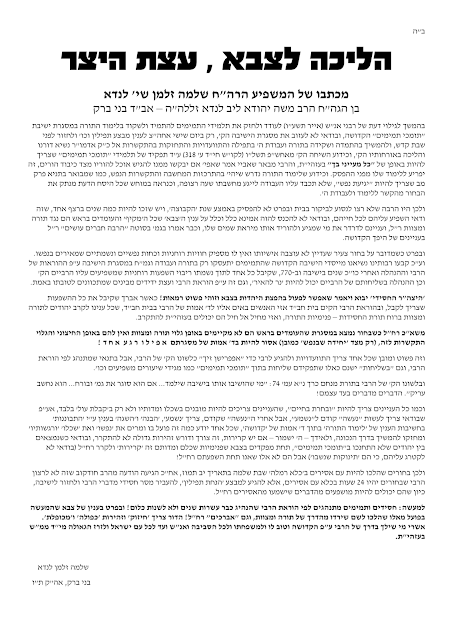
This agreement was in effect from the 5720s (1960s) until 5754 (1994). In 5771 (2011) an alternative agreement was reached[31][32], which created many disturbances[33][34], but it was cancelled in 5774 (2014), and in 5776 (2016) a new agreement was signed with some of the Chabad yeshivos[35] through the mediation and efforts of Rabbi Eliezer Wilschansky and Rabbi Moshe Havlin[36], under which the bochurim can travel to "Kvutzah" in exchange for giving up yeshiva-student status and a commitment to return to the country at the end of one year of study and to enlist by age 26. At first mashpiim and rabbonim came out against the agreement while it was taking shape[37], but after a public statement of the Beis Din Rabbonei Chabad in favor of the agreement was published[38], and an extensive interview was published with the roshei yeshiva in which they clarified their position[39], the opposition to the agreement subsided and many of the signatories of the "kol korei" withdrew their signatures.
In 5784 (2024) the agreement was cancelled following the conscription crisis and following Avigdor Dickstein.[clarification needed]
Chabad Activity with IDF Soldiers edit

From the IDF's earliest years, Chabad Chassidim came to army bases and worked with the soldiers in various frameworks, giving Torah classes and distributing sufganiyos, Chanukah gelt, Mishloach manos, and Jewish reading material.
Before the festivals and in wartime, many more volunteers joined this activity en masse in order to reach every IDF soldier, bringing them the joy of the festival and the light of Judaism and strengthening them as they stood with mesirus nefesh to defend the residents of Eretz Yisroel.
Because the public saw Chabad as removed from politics, and it maintained good relations with government and senior officials across the political spectrum, Chabad activists could enter IDF bases without difficulty, something not possible for activists of other movements.
For some activities the Rebbe himself instructed the Chassidim to try to obtain permission to go around the bases in IDF uniform.[40]
Difficulties After the Involvement in the Elections edit
After the election campaign of 5749 (1988), in which the Rebbe instructed the Chassidim to vote for the United Torah Judaism party, various movements insistently demanded that the IDF bar Chabad activists from its bases because of their political involvement, under the military regulation barring political activists from IDF bases.
Despite the obstacles, Chabad Chassidim still enter IDF bases with the approval of the top military command, on condition that they are accompanied by representatives of the Chief Rabbinate, who ensure the activity stays within the rules set by the General Staff.[41]
A Sefer Torah for IDF Soldiers edit
In 5742 (1982) the Rebbe initiated the writing of a special Sefer Torah for the unity of IDF soldiers and the security forces and for their added protection during operations. At the Rebbe's instruction, Chabad askanim persuaded the IDF leadership to adopt the project, and on 11 Nissan 5742 (1982) a ceremony was held to begin writing the Sefer Torah.
A month and a half later the First Lebanon War broke out, and it became clear that the Rebbe had foreseen it and had urged the Chassidim to hurry and begin the registration, providing the cure before the blow and safeguarding the soldiers.
During the war dozens of teams of Chabad Chassidim went deep into Lebanon and registered soldiers at the front. In less than a month they registered 304,805 soldiers for the Sefer Torah, and on 14 Tammuz the first Sefer Torah written in the merit of IDF soldiers was brought into the shul at Tzrifin in a ceremony attended by the IDF top brass.
The Tanya at IDF Bases edit
In the midst of the Yom Kippur War the Rebbe sent word to Rabbi Shlomo Maidanchik to print Tanyas and siddurim in the Fayid area across the Suez Canal and distribute them to the soldiers at the front. The secretary Rabbi Nissan Mindel also joined the mission. In Fayid the team met General Ariel Sharon, who approved the printing, gave it his full backing and opened every door for them. The Tanya was printed in two editions in the middle of the supply base and then distributed to the soldiers with the help of students from the vocational school in Kfar Chabad.[42]
When the Rebbe launched the campaign of printing the Tanya, Chabad Chassidim printed it wherever possible, including at IDF bases, taking a mobile printing press even to remote bases to carry out the Rebbe's instruction.[43]
During the First Lebanon War the Rebbe asked that the Tanya be printed in Beirut, Tyre and other places in Lebanon. At the farbrengen of 13 Tammuz he delivered a special sicha with the Tanya lying on the table, citing it as proof that the IDF was already in Beirut and should use the opportunity to take the city. He later added that the ability to print the Tanya there "is because the people of the 'Israel Defense Forces' made the preparation for it and helped in printing the book of Tanya... And it is understood that this activity of printing the book of Tanya in these places is about spreading the wellsprings outward in actual practice, including learning the book of Tanya with the people of the 'IDF'..."[44]
On several occasions, in letters and in person, the Rebbe spoke of the importance of the Tanya for IDF soldiers.[45]
Mivtza Pidyon HaBen edit
The Rebbe urged that a pidyon haben be held for IDF soldiers who had not been redeemed.
Headquarters for IDF Heroes edit
Tzeirei Agudas Chabad in Israel runs a special headquarters for IDF widows[46][47] and the children of soldiers killed in Israel's wars, directed by Rabbi Menachem Kutner.
Its work includes financial assistance to bereaved families, visits to those wounded in terror attacks before the Jewish festivals, special hosted Shabbosos[48], day camps and fun days for the families' children[49], and more.
Or LaChayal edit
The Or LaChayal organization, run by Rabbi Menachem Ofen, is a nonprofit he founded in 5767 (2007) after his rescue from Palestinian gunfire on his way to mivtzoim in the city of the Patriarchs, Chevron.
The organization operates on behalf of "the Association for the Soldier" (HaAgudah LeMaan HaChayal), organizing Jewish-themed social activities for IDF soldiers, producing monthly leaflets[50], distributing tefillin to soldiers who commit to putting them on every weekday[51], and running other recreational activities.[52]
| Some of the tokens of appreciation the Rebbe received from the IDF, as displayed in an exhibition at the Chabad Library |
|---|
|


See Also edit
Further Reading edit
- "Those who learn Torah and IDF soldiers", Beis Moshiach weekly, issue 1401
- "The rejection of the conscription of women into the IDF", in the "Nitzotzei Rebbe" column, Hiskashrus weekly, Parshas Behaaloscha 5781 (2021)
- Yisroel Alpenbein, "The IDF's secret weapon that will never reach the enemy", Beis Moshiach weekly, issue 2030, p. 28
- "Like the mercy of a father on his children", Kfar Chabad weekly, issue 2031
- Shmuel Shlomo Lifshitz, "Why do yeshiva students not enlist in the army?", the booklet Bnei Heichala, issue 2, Kislev–Teves 5785 (2024), p. 108[53]
External Links edit
The Rebbe's Statements About the IDF edit
- 8 things the Rebbe said about IDF soldiers, He.chabad.org (Hebrew)
- Interview with Zeev Ron – an Air Force man, Thinking outside the box, My Story magazine, 561, 24 Adar 5786 (2026), Jemcentral.org (PDF)
- "Keep Your Camp Holy: The Rebbe and the IDF", A Chassidisher Derher, Tishrei 5782 (2021), Derher.org (PDF)
- Are there "secular" soldiers in the IDF?, Chabad.org (video)
Conscription of Yeshiva Students edit
- LaVo BaTzava – a compilation of the Rebbe's statements regarding the army in general and the IDF in particular, Otzar.org (Hebrew)
- Who is greater: the fighters who sacrifice their lives or those who learn Torah?, 77012.blogspot.com (Lachluchis Geulatis) (Hebrew, video)
- Protecting the land, together, He.chabad.org (Hebrew)
- Are yeshiva students obligated in conscription? – the Rebbe's view on the conscription of yeshiva bochurim, Chabad.info (Hebrew)
- Lo Yeitzei BaTzava – a compilation of the Rebbe's statements regarding the conscription of yeshiva students and their integration into the IDF, Chabad.info (Hebrew, PDF)
- The conscription of yeshiva bochurim harms the military capabilities of the IDF Hageula.com (Hebrew, video)
- The Rebbe's response to the statement: there are baalei battim who are not pleased that there are students who do not go to the army (from minute 3:45), Chabad.info (Hebrew, video)
- Evading the IDF: what is the view of the Rebbe Melech HaMoshiach?, 77012.blogspot.com (Lachluchis Geulatis) (Hebrew)
- Do Chabad Chassidim serve in the IDF – and what about the yeshiva bochurim?, 77012.blogspot.com (Lachluchis Geulatis) (Hebrew)
Conscription of Women edit
- The Rebbe's view regarding the conscription of women into the IDF, Chabad.org.il (Hebrew)
- The Rebbe's view on the conscription of girls, from the Beis Moshiach weekly, Chabad.info (Hebrew)
News edit
- "The IDF will provide Chabad fighters with food under Rabbi Landa's kashrus for the festival of Pesach", Col.org.il (Hebrew)
- Chabad Chassidim were asked on the radio: "Are you planning to serve in the army?" – a recording from 5727, 77012.blogspot.com (Lachluchis Geulatis) (Hebrew, audio)
- Soldiers at a parade singing "Ani Maamin", Chabad.info (Hebrew, video)
- Rabbi Shneur Ashkenazi on Memorial Day for the fallen of the IDF, Chabad.info (Hebrew, audio)
References edit
- ↑ This refers to his work with Ben-Gurion and Levi Eshkol in the Haganah headquarters and his dealing with matters of manpower and procurement; afterwards he continued these activities within the framework of the Defense Ministry (after the IDF was established and the powers of the army versus the powers of the Defense Ministry were defined, when the division in which he worked was attached to the Defense Ministry).
- ↑ Teshurah Cunin – Hertz, 7 Kislev 5782 (2021), pp. 30–31, Teshura.com (Hebrew, PDF)
- ↑ "BeSod Si'ach" – published by U'Faratzta, 5751 (1991) (based on the yechidus of 28 Adar 5728 (1968))
- ↑ Igros Kodesh volume 11, p. 85, Chabadlibrary.org (Hebrew)
- ↑ The maamar in its edited version, Chabadlibrary.org (Hebrew).
- ↑ See Igros Kodesh volume 14, letter 4991.
- ↑ See for example: Sicha of Shabbos Parshas Eikev 5730, Collected sichos from the months of Sivan–Tammuz 5742 (as edited by the Rebbe for Kovetz HaMaor), Hebrewbooks.org (Hebrew).
- ↑ Igros Kodesh volume 24, letter 9317, Chabadlibrary.org (Hebrew).
- ↑ After whom the rescue operation was called "Operation Yonatan".
- ↑ "The Rebbe – "a miracle and rescue above the natural order"" (video) – Shturem website.
- ↑ Also called "Operation Peace for the Galilee", or by its acronym – Shelag.
- ↑ Recordings and a word-for-word translation of the sichos said on weekdays: sicha of 22 Sivan 5742, sicha of the night of 3 Tammuz 5742, sicha of 7 Tammuz 5742, sicha of 13 Tammuz 5742 (audio)
- ↑ Major General Yehoshua Saguy, head of the Intelligence Directorate at the time of the Lebanon War: the Rebbe was right in all his words! – HaGeulah website (Hebrew).
- ↑ A photograph of the Tanya and the story of the meeting in the booklet "Ker a Velt", p. 28, Chabad.info (Hebrew, PDF).
- ↑ "Rabbi Gad Navon instructed me: help Chabad as much as you can" .
- ↑ "Major General Rafi Peretz in an interview with COL", Col.org.il (Hebrew, video)
- ↑ Interview with Brigadier General Menachem Eini, head of the "Lavi" project, He.chabad.org (Hebrew).
- ↑ This is apart from the many exchanges of letters that took place between the Rebbe and senior IDF officers.
- ↑ "The new production from JEM has been released: "Emunah U'Bitachon – Army and Intelligence"" . Shturem.net website.
- ↑ This is the only sicha the Rebbe delivered in Lashon HaKodesh.
- ↑ The sicha to the delegation of Metzuyanei Tzahal, Hageula.com (Hebrew); a recording of the sicha, Chabad.info (Hebrew, audio)
- ↑ Letter of 15 Av 5729, 7 Elul 5729, 15 Av 5730, and more, Chabadlibrary.org (Hebrew).
- ↑ Letter of Rosh Chodesh Elul 5721, Chabad.info (Hebrew)
- ↑ 19 Kislev 5743 (1982), Hisvaaduyos 5743, volume 2, p. 647.
- ↑ Letter of the Chabad rabbis, Chabad.info (Hebrew)
- ↑ Igros Kodesh volume 15, p. 252, Chabadlibrary.org (Hebrew).
- ↑ Igros Kodesh volume 23, p. 61, Chabadlibrary.org (Hebrew).
- ↑ Devarim 23:15, Chabad.org.
- ↑ The Rebbe's words to Mr. Shneur Zalman Rubashov (Shazar), who served in those years as President of the State of Israel, were published in the book Nasi VeChassid by the researcher Shmuel Kraus (p. 238).
- ↑ The Rebbe's letter to Menachem Begin, Chabad.info (Hebrew)
- ↑ The army will allow bochurim to travel for the "Kvutzah" year, Chabad.info (Hebrew)
- ↑ "A new agreement allows the students to travel to 'Kvutzah'", Col.org.il (Hebrew)
- ↑ Dozens of Chabad bochurim sat in prison because of a personal rivalry, Chabad.info (Hebrew)
- ↑ Contacts with the IDF on the conscription of Chabad yeshiva students, Chabad.info (Hebrew)
- ↑ Tomchei Temimim Kiryat Gat, Tomchei Tmimim Migdal HaEmek, and Chassidei Chabad Lubavitch – Tzfas, while the roshei yeshiva of Tomchei Tmimim Kfar Chabad and Tomchei Temimim Rishon LeZion did not officially join the agreement (but the bochurim of those yeshivos themselves can join it independently).
- ↑ The representative of the roshei yeshiva in the agreement with the IDF speaks, Chabad.info (Hebrew), 17 Av 5776 (2016)
- ↑ A kol korei against the agreement, Chabad.info (Hebrew), 7 Av 5776 (2016); The letter of the mashpia Rabbi Shlomo Zalman Landa against the conscription, Chabadpedia.co.il (Hebrew)
- ↑ In a letter dated 7 Menachem Av 5776 (2016), at the top of which is written: "We hereby clarify that the agreement of the roshei yeshiva with the IDF was brought before us and received our approval".
- ↑ The conscription agreement: the roshei yeshiva talk, Chabad.info (Hebrew), 15 Av 5776 (2016)
- ↑ "Wear IDF uniforms when you come to the bases", Col.org.il (Hebrew).
- ↑ "What do you want from Chabad?! – protocols from Knesset meetings discussing Chabad activity in IDF camps" – Shturem website.
- ↑ For more details, see "HaMaidanchik – the locomotive of Chabad", pp. 115–116.
- ↑ A partial list of the Tanya editions printed at IDF bases: 1095 – Armored Corps camp. 1096 – Sinai formation camp. 1324 – Ramon camp. 1345 – IDF transport camp, Kiryat Malachi. 1540 – Field Forces Headquarters. 1745 – Air Force bases in Tzrifin. 1952 – Beit Dras, signal formation. 1953 – Hatzor base. 1954 – Malachi medical unit. 2210 – Uvda camp. 2211 – Southern Command headquarters. 2235 – Units camp. 2326 – Nevatim Air Force base. 2521 – IDF, Beit Guvrin. 2522 – Tze'elim camp. 2523 – Tel Nof base. 2592 – Navy base, Ashdod. 2593 – Jabalia camp.
- ↑ A description of the Tanya printings at IDF bases in the booklet Ker a Velt Haint, published by Vaad Chayalei Beis Dovid, Chabad.info (Hebrew, PDF)
- ↑ Igros Kodesh volume 10, p. 62: "He will find it right to give a Tanya to some of those among the army people who excel in matters of Judaism etc., in addition to giving Tanyas in the camp to the clubs or to the library of the army people"; see also Hisvaaduyos 5742, volume 4, p. 1851.
- ↑ "This is how Chabad's activity with IDF widows began", Col.org.il (Hebrew, audio).
- ↑ "JEM in a new film: the children of the heroes after the Six-Day War", Col.org.il (Hebrew, video)
- ↑ "A hosted Shabbos for terror victims organized by Tzeirei Agudas Chabad" – Shturem website.
- ↑ "Orphans of bereavement and hostile acts at Chabad day camps", Col.org.il (Hebrew).
- ↑ "Or LaChayal" – a portion of Judaism for IDF soldiers, photo of the leaflet, Chabad.info (Hebrew)
- ↑ The Or LaChayal organization distributes a hundred pairs of tefillin every month, Chabad.info (Hebrew)
- ↑ Channel One reporter Itai Rappaport on the activity of the "Or LaChayal" organization (video), Shturem website
- ↑ A follow-up article was published in issue 2, Nissan 5785 (2025). Also in the article of Rabbi Eliyahu Kirshenbaum in the bulletin "MiBeis HaHora'ah", 21 Nissan 5785 (2025), p. 6.