
Yitzchak Feivish Ginsburgh
| Rabbi Yitzchak Feivish Ginsburgh | |
|---|---|
 Rabbi Yitzchak Ginsburgh, 21 Elul 5778 (2018) | |
| Born | 28 Cheshvan 5705 (November 14, 1944) (age 82) |
| Spouse | Mrs. Romemia, daughter of Rabbi Moshe Tzvi Segal |

Rabbi Yitzchak Feivish Ginsburgh (also known as "the Malach"; born in 5705 (1944–45)) is a rabbi who belongs to Chabad Chassidus but is characterized by a unique approach that differs from what is accepted in Chabad, and some of his students are not counted among Chabad Chassidim. The rabbi is well-versed in Kabbalah and is considered one of the greatest teachers of Kabbalah and Chassidus of our generation[1]. He serves as president of the "Gal Einai" and "Derech Chaim" movements, and also heads the "School of Torah Psychology" (Beis HaSefer L'Toras HaNefesh). The yeshivos Od Yosef Chai, Dorshei Yichudcha, Tom VaDaas and Ruach Daas are under his presidency.
Rabbi Ginsburgh is a signatory of the psak din that the Rebbe is Melech HaMoshiach[2].
Biography[edit | edit source]
He was born in the United States on 28 Cheshvan 5705 (1944) to Shimshon Yaakov and Breina Malka. In his youth he studied mathematics and philosophy. He became a baal teshuvah at the age of 14 in Philadelphia, in the United States. In 5725 (1964–65) he moved to Eretz Yisroel and studied at the Kamenitz Yeshiva in Jerusalem. After the Six-Day War he returned to Jerusalem and, together with his future father-in-law, Rabbi Moshe Tzvi Segal, was among the first to move to the Jewish Quarter. During that period he became deeply acquainted with the writings of Chabad Chassidus through Rabbi Yosef Tzvi Segal.[3] That same year he visited the Rebbe and stayed with him for several months.
For a period he studied at the Tomchei Temimim Kfar Chabad yeshiva, and he even merited to serve the renowned mashpia R' Shlomo Chaim Kesselman before his passing[4].
When he returned to Eretz Yisroel he married his wife, Mrs. Romemia, daughter of Rabbi Moshe Tzvi Segal, and began teaching Gemara, Shulchan Aruch and Chassidus to a group of students in Kfar Chabad; afterwards he was appointed rosh yeshiva of the "Shuva Yisrael" yeshiva in Jerusalem.
Until the withdrawal of the IDF from Joseph's Tomb in Shechem during the "Al-Aqsa Intifada" (5761 (2000)), he served as rosh yeshiva of the "Od Yosef Chai" yeshiva and head of the kollel in Jericho; these kollelim, along with two additional kollelim, received the Rebbe's presidency. Today the yeshiva and the kollel are located in the settlement of Yitzhar. At a dollar distribution on 26 Adar I 5752 (1992), a Jew passed by and related that he has a kollel of pure sanctity named "Od Yosef Chai". The Rebbe turned to the secretary, Rabbi Yehuda Leib Groner, and asked him: "Od Yosef Chai?! But there is another..." The secretary replied that there is the yeshiva of Rabbi Yitzchak Ginsburgh and that this is a different yeshiva, and the Rebbe responded: "But 'Od Yosef Chai' has become a byword throughout all of Eretz Yisroel!"[5].
The Rebbe remarked about Rabbi Ginsburgh: "A comprehensive scholar" (chacham kolel)[6].
In 5752 (1991–92) he signed a ruling establishing that all the signs set out by the Rambam had been fulfilled in the Rebbe and that he is "presumed to be Moshiach" (bechezkas Moshiach), and therefore one blesses him with the blessing "Yechi Hamelech".
He participated in the Geulah and Moshiach Conventions held in 5755 (1994–95) by Rabbi Zimroni Tzik, and he also spoke at an activists' convention in preparation for the event.
Today he lives in Kfar Chabad according to the Rebbe's instruction and gives classes throughout the country. He devotes most of his time and energy to fulfilling the Rebbe's instruction to him from the days of Elul 5741 (1981): "..It is proper that he write in the form of a book the classes that he teaches. With blessing for success"[7] – by writing books on Kabbalah and Chassidus touching on various fields, from Kabbalistic and Chassidic commentaries on the Torah to the relationship between Torah and science. The books are published by the "Gal Einai" movement, which he founded.
Many come to his home to consult with him on various matters.
He serves as president of many educational institutions, among them: the "Od Yosef Chai" yeshiva and kollel in Yitzhar headed by Rabbi Yitzchak Shapira, the Tomchei Temimim yeshiva ketanah "Tom VaDaas" in Jerusalem headed by Rabbi Ephraim Ehrenberg, the "Toras Chaim" Talmud Torah, and the "Yaalas Chen" school and high school for girls.
Public and Torah Activity[edit | edit source]
Classes[edit | edit source]

At first Rabbi Ginsburgh would write his Torah teachings himself, but over the years he moved almost entirely to delivering classes, while several of his students write down his teachings.
Rabbi Ginsburgh gives classes in Chassidus throughout the country. There are a number of regular classes during the year, including annual, monthly and weekly classes. Among his well-known classes are:
Classes held on maamarim of Chassidus to mark a certain number of years since they were said. For example: in 5772 (2011–12) he gave a regular class in the central synagogue in Kfar Chabad on Hemshech Ayin-Beis of the Rebbe Rashab, and in 5775 (2014–15) he gave classes in the kollel in Kfar Chabad on the series of maamarim of 5705–5706 (1944–46) of the Frierdiker Rebbe.
An annual class at the Tomchei Temimim yeshiva in Ramat Aviv on the night of Purim of the unwalled cities, and at his home at the Purim seudah; and an annual class at the hillula of R' Menachem Mendel of Vitebsk at the Chabad House on the promenade in Tiberias, near his gravesite, on 1 Iyar.
A regular class on Friday night and on Shabbos morning; in 5784 (2023–24) the Friday night class was given on the book Keser Shem Tov, and the Shabbos morning class on the book Ahavas Shalom (by Rebbe Menachem Mendel of Kosov). Another regular class is an in-depth class on the daily Rambam. In 5786 (2025–26) he gives a weekly class on the book Meor Einayim (by Rebbe Menachem Nochum of Chernobyl), on the weekly Torah portion following that week. The classes are uploaded online (on a YouTube channel named "Gal Einai – The Gateway to the Inner Dimension of Torah"), and some of them are edited and rewritten into "Nifla'os" bulletins.
His Style[edit | edit source]
His classes and books dealing with Chassidus are characterized by a special style. Among other things, in his books he focuses mainly on explaining the Kabbalah aspect of Chabad Chassidus; he often explains matters in the manner of a partzuf – explaining a subject by matching the characteristics of the subject to each of the ten sefiros. In his books he points to a connection between science and Kabbalah and between psychology and Chassidus, and explains social matters according to a Torah outlook. He also makes extensive use of gematrios.
His Views on Political Issues[edit | edit source]
In 5754 (1994), after the Purim on which the massacre at the Cave of the Patriarchs took place, carried out by Baruch Goldstein, during which he killed 29 Arabs in revenge for a number of terror attacks that had occurred at that time, he published a booklet called "Baruch HaGever" with the consent of the Rebbe (he requested a blessing "to speak in defense of Jews who need someone to speak in their defense," and the Rebbe nodded his head in the affirmative[8]). In the booklet he reviewed arguments justifying the act.
In his book "Tzav HaSha'ah – Tipul Shoresh" (The Command of the Hour – Root Treatment), published in 5764 (2003–04), he blamed the Israeli left for responsibility for the murder of dozens of Jews and stated that "an Arab has no right to exist in Eretz Yisroel." As a result, an indictment for incitement to racism was filed against him. However, he reached a plea bargain with the prosecution, under which he submitted a letter of apology for what he had written and undertook to refrain from publishing inciting statements, in exchange for the cancellation of the charges against him.
After the implementation of the Disengagement Plan, his approach toward the state became more extreme. He said: "The Zionist spirit must be uprooted . . the court. We must break . . the government – whether a left-wing or right-wing government – we must eradicate"[9]
In Menachem Av 5770 (2010) he was summoned for questioning by the national unit for the investigation of serious and international crimes regarding the approbation he had given to the book "Toras HaMelech"[10].
In 5771 (2010–11) he founded a political movement called "Derech Chaim", which he heads.
The School of Torah Psychology[edit | edit source]
In his classes and books he deals extensively with the influence of Chassidus on the human soul. Within this framework an educational institution was established called "The School of Torah Psychology" (also called "The College of Torah Psychology"), which focuses on Jewish psychology. The institution offers courses for men and women (separately) throughout the country. The director of the school is Rabbi Noam Shapira.
The therapeutic method at the institution is based on content from the Sefer HaTanya[11] and on a process called "submission" (hachna'ah), "separation" (havdalah), and "sweetening" (hamtakah). Rabbi Ginsburgh derived a therapeutic framework from a teaching of the Baal Shem Tov dealing with the refinement of sparks that fell into the kelipos and the sweetening of the gevuros at their root[12]. The first stage of the process is called "submission", and it lowers the person's self-image; by lowering the self-image it is possible to create "separation" from the problem from which he suffers, and from this to reach "sweetening" – a positive view of the problem and seeing the good aspects hidden within it[13].
An additional emphasis at the institution is providing tools for acquiring empathy and love between the therapist and the patient.
Niggunim[edit | edit source]
Rabbi Ginsburgh is himself a baal menagen, and he also works to pass on ancient Chabad niggunim. In 5745 (1984–85) he printed a booklet he wrote containing the musical notes of Chabad niggunim he learned from the baal menagen R' Eliyahu Leib Rivkin of Kfar Chabad. He has also composed more than 700 niggunim himself[14]; among other things, every year in preparation for 11 Nissan he composes a niggun for the Rebbe's chapter of Tehillim[15].
To date about 30 CDs of his niggunim have been released, as well as ancient Chabad niggunim sung by him (and also niggunim he learned from other Chassidic groups, such as Breslov and Nadvorna).
Criticism[edit | edit source]
Rabbi Ginsburgh's style and approach are not accepted among most Chabad Chassidim. In addition, his critics claim that his students are connected to him instead of to the Rebbe, and that some of them even see him as the Nasi HaDor and the Moshiach of the generation[16].
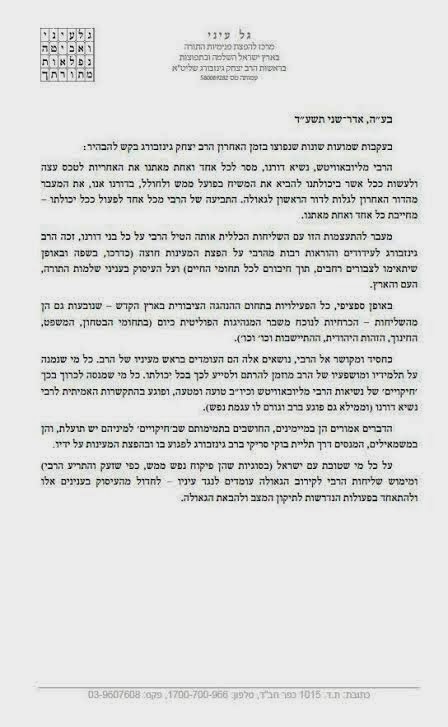
Rabbi Ginsburgh issued a letter of protest against these students in Adar 5774 (2014)[17], and he has also spoken several times about the Rebbe being Melech HaMoshiach and that he is alive and well (clarification: he did not speak as a rejection of the views of these students but as part of his classes).
His Books[edit | edit source]
Hebrew[edit | edit source]
Kabbalah and Chassidus
- "Sod Havaya L'Yerei'av" – an introduction to the Wisdom of Truth and the service of contemplation
- "Esa Einai" – contemplative essays on the inner dimension of our holy Torah and the service of Hashem
- "Sha'arei Ahavah V'Ratzon" – contemplative essays on the essence of love and will in the human soul and their source above
- "Shiurim B'Sefer Sod Havaya L'Yerei'av" – a series comprising Rabbi Ginsburgh's classes on the book he wrote (4 volumes; editor: Shilo Ofan)
- "Adamah Shamayim U'Sehom" – on nature and its song, the miracle above it and the chaos beneath it (editor: Yisroel Ariel)
- "Klal Gadol BaTorah" – an introduction to Jewish contemplation (editor: Itiel Giladi)
- "El Olam HaKabbalah" – a book for beginners in the study of Kabbalah (editor: Itiel Giladi)
- "Mavo L'Kabbalas HaArizal" – the foundations of the Kabbalah of the Arizal in light of Chassidus (editor: Dov Lieberman)
- "Mivchar Shiurei Hisbonenus" – a series (28 volumes) (editor: Amram Lida)
- "Chasdei Dovid HaNe'emanim" – the Kabbalah of the Arizal in light of Chassidus (5 volumes) (editor: Amram Lida)
- "Osiyos Lashon HaKodesh" – an explanation of the inner dimensions of the letters of the Hebrew alphabet (editors: Meir Klein and Itiel Giladi)
- "Yayin Yitzchak" on the Torah – a collection from Rabbi Ginsburgh's classes (2 volumes)
- "Yayin Yitzchak" on the Sefer HaTanya – a collection from Rabbi Ginsburgh's classes (editor: Rabbi Shmuel Yitzchak Gad Yudaikin)
- "Yayin Yitzchak" on the Pesach Haggadah – a collection from Rabbi Ginsburgh's classes
- "Maamarei Admur MiLubavitch Im Biurim" – notes and explanations on maamarim of the Lubavitcher Rebbe (editor: Itiel Giladi)
- "Shiurim V'Hisvaaduyos" – summaries of his farbrengens (20 volumes; editor: Itiel Giladi)
- "HaChochmah Me'Ayin Timatzei" – the Divine philosophers in the mirror of Chassidus (editor: Yisroel Ariel)
- "Olamos" – new gateways to Torah and Chassidus (editor: Nir Menusi; published by Yedioth Books)
- "Meitzitz Min HaCharakim" – short insights written on Twitter and on a blog in English, and translated into Hebrew by Nir Menusi and Dovid Hillel
- "Shivim Pnei Chen" – 70 contemplative essays on the secret of the word chen (grace)
- "Etz Pri" – studies in halachah and in the inner dimension of halachah (editor: Rabbi Yosef Peli)
- "V'Shavsah HaAretz" – the Shemittah year in light of Kabbalah and Chassidus (editor: Rabbi Yosef Peli)
- "V'Yatzah V'Haysah" – studies in the revealed and inner dimensions of tractates Gittin and Kiddushin (editor: Rabbi Yosef Peli)
- "Sha'arei Tevunah" – gateways of study and contemplation in Sefer HaTanya (editor: Menachem Mendel Axelrod; published by Maayanosecha)
- "Inyan HaTefillah V'HaHisbonenus" – the service of contemplation throughout the generations (editor: Itiel Giladi)
- "Maggid MeReishis Acharis" – two maamarim of Rabbi Hillel of Paritch, with abridgments and explanations by Rabbi Ginsburgh
The Jewish Home
- "Shechinah Beineihem" – shalom bayis according to Chassidus
- "Bris HaNissu'in" – chapters of study and contemplation on the concept of shalom bayis according to Chassidus (editor: Yonadav Kaplun)
- "Chassan Im HaKallah" – service "for its own sake" in married life (editor: Itiel Giladi)
- "Machol HaKeramim" – on shidduchim, covenant, teshuvah and Geulah (editor: Itiel Giladi)
- "Yayin Mesame'ach" – the mysteries of the wedding and marriage (5 volumes; editor: Itiel Giladi)
- "Panim El Panim" – the foundations of education according to Chassidus (editor: Itiel Giladi)
- "Omanus HaChinuch" – principles, skills and practical advice
- "Anochi V'HaYeladim" – 3 essays on the power of Jewish children, adapted for children and youth (editor: Itiel Giladi)
- "Ahavah" – the growth of the bond between man and woman (editor: Nir Menusi)
- "B'Oholei Tzaddikim" – building the Jewish home inspired by the great Chassidic leaders (editor: Itiel Giladi)
Torah and Science
- "Ichud HaTorah V'HaMada" – with Nir Menusi
- "Refuah Sheleimah" ("Guf Nefesh U'Neshamah") – Kabbalah and medicine (editor: Moshe Genut)
- "Einayich Breichos B'Cheshbon" – mathematical studies on the Torah portions (editor: Moshe Genut)
- "Na'aseh Adam" – an inner contemplation on the theory of evolution (editor: Yehuda Hershkovitz)
Stories of Tzaddikim
- "Or Yisroel" – stories of our master the Baal Shem Tov with in-depth explanation by Rabbi Ginsburgh (editors: Oded Mizrachi and Dov Lieberman)
Torah and Festivals
- "Teshuvas HaShanah" – contemplative essays on the service of Hashem in general and the service of teshuvah in particular, according to the yearly cycle
- "Maayan Ganim" – a Chassidic view of the weekly Torah portions (5 volumes; editor: Itiel Giladi)
- "Lichyos Im HaZman" – explanations of Likutei Sichos (5 volumes; editor: Dov Lieberman)
- "Amudeha Shivah" – the division of the Torah portions in an inner light (5 volumes; editors: Yisroel Katz and Itiel Giladi)
- "Sha'ashuim Yom Yom" – studies on the weekly Torah portion day by day (3 volumes; editors: Itiel Giladi and Yisroel Katz)
- "Toras Chaim" – a collection of monthly bulletins from the years 5758–5760 (1997–2000)
- "Ani L'Dodi V'Dodi Li" – contemplative chapters on how to come, during the days of teshuvah, to teshuvah out of love (editor: Yisroel Ariel)
- "Tom VaDaas" – essays for the months of Elul and Tishrei (editor: Yisroel Ariel)
- "V'Chamatmonim Tachpesenah" – the hidden treasures of Sefiras HaOmer in light of Chassidus (2 volumes; editor: Yisroel Ariel)
- "Purim Lanu" – contemplative essays on Purim (editor: Yisroel Ariel)
- "HaNeiros Halalu" – contemplative essays for the days of Chanukah (editor: Nir Menusi)
- "HaZman HaPnimi" – the seasons of the year in light of Kabbalah and Chassidus (editor: Rabbi Yosef Peli)
- "HaMemad HaPnimi" – the weekly Torah portion in light of Kabbalah and Chassidus (editor: Rabbi Yosef Peli)
- "Sodos Min HaSeder" – the Pesach Haggadah in the PaRDeS of the Torah (editor: Rabbi Yosef Peli)
Torah Psychology
- "Lev LaDaas" – the foundations of the service of Hashem in the way of Chassidus
- "HaNefesh" – the foundational book for understanding the structure of the soul, its powers and its garments (editors: Itiel Giladi and Noam Shapira)
- "Lahafoch Es HaChoshech L'Or" – Kabbalah and psychology (editor: Itiel Giladi)
- "Emunah U'Muda'us" – the power of faith, faith in the yearly cycle, the principles of faith in the inner dimension of the Torah
- "Nefesh Bri'ah" – psychology according to Chassidus
- "Lichyos B'Merchav Elokì" – Kabbalah and contemplation (editor: Itiel Giladi)
- "HaTeva HaYehudi" – the path ascending to natural consciousness (editor: Itiel Giladi)
- "Muda'us Tiv'is" – rectifying self-consciousness according to Kabbalah (editor: Moshe Genut)
- "Otzar HaNefesh" – transcripts of Rabbi Ginsburgh's classes on Torah psychology (3 volumes; editor: Oded Mizrachi)
Public Affairs
- "Malchus Yisroel" – the commandments of the community, the nation and the land; kingship, king and Sanhedrin; wars and the Beis HaMikdash (3 volumes)
- "B'Itah Achishenah" – the secrets of the final Redemption, for understanding the Redemption of our generation (editor: Itiel Giladi)
- "Tikkun HaMedinah" – a practical platform according to Kabbalah (editor: Itiel Giladi)
- "Rucho Shel Moshiach" – the era in the mirror of Chassidus (editor: Yisroel Ariel)
- "Melech B'Yofyo" – the Redeemer in the mirror of Chassidus (editor: Yisroel Ariel)
- "Shloshah Kesarim" – studies in the revealed and inner dimensions of the matters of judges, king and Kohen Gadol and the relationships between them (editor: Yisroel Ariel)
- "Kumi Ori" – chapters of struggle and revival (editor: Itiel Giladi)
- "U'Mimenah Yivashei'a" – the heroic approach to the establishment and to the struggles against it (Yisroel Ariel)
- "Tzav HaSha'ah: Tipul Shoresh" – studies in topics relevant to the times according to the inner dimension of the Torah (editor: Itiel Giladi)
English[edit | edit source]
- "The Hebrew Letters"
- "The Mystery of Marriage"
- "Transforming Darkness into Light"
- "Body, Mind and Soul"
- "Living in Divine Space"
- "The Art of Education"
- "Anatomy of the Soul"
- "What You Need to Know About Kabbalah"
- "Awakening the Spark Within"
- "A Sense of tha Supernatural"
- "Rectifying the State of Israel"
- "Consciousness and Choice"
- "Kabbalah and Meditation for the Nations"
His Family[edit | edit source]
- His sons
- Rabbi Chaim Yosef Ginsburgh – shliach of the Rebbe and rosh yeshiva of Tomchei Temimim Ramat Aviv.
- Rabbi Menachem Mendel Ginsburgh – ram at the Chabad yeshiva "Nachalas Shivah", and teacher at the "Kiryat Moshe" Chabad kindergarten in Jerusalem.
- His sons-in-law
- Rabbi Shneur Zalman Pevzner, nosei u'nosen at the Tomchei Temimim Migdal HaEmek yeshiva.
- Rabbi Menachem Mendel Hendel, director of the World Chabad Center to Greet Moshiach.
- Rabbi Aryeh Boruch Bloch, shliach of the Rebbe in São Paulo, Brazil.
- Rabbi Menachem Mendel Nachshon, rabbi of the city of Nof HaGalil and rosh yeshiva of Yeshivas Chassidei Chabad Lubavitch Nof HaGalil.
- Rabbi Menachem Mendel Friedman, rabbi of the Chabad community and head mashpia at Tomchei Temimim Petach Tikva.
- Rabbi Shai Haramati, of the Rebbe's shluchim in Yitzhar and rosh yeshiva of Tomchei Temimim Yitzhar.
- Rabbi Mordechai Freiman, educator at Talmud Torah Chabad Rishon LeZion, Kfar Chabad.
- Rabbi Yehuda Leib Weisglass, ram at the Tomchei Temimim Rishon LeZion yeshiva and Torah editor, Kfar Chabad.
External Links[edit | edit source]
- His speech at an activists' convention, 5769 (2008–09)
- 2 letters from the Rebbe published for the first time, in a teshurah from his granddaughter's wedding (PDF)
- The indictment – a political ploy Beis Moshiach weekly, issue 418, p. 57
- Messianic consciousness after Gimmel Tammuz Beis Moshiach weekly, issue 932
- Sarah Gal, The Malach, the Kabbalist, the terror of the Shin Bet ● Profile, "BaKehilla" newspaper (Hebrew)
References[edit | edit source]
- ↑ So it is written on the back cover of some of his books.
- ↑ The signature is located in the fifth row, fourth signature from the right; photo of his signature (photos) (Hebrew).
- ↑ Condolence visit at the home of Rabbi Yosef Tzvi Segal, Derech Chaim website, 6 Kislev 5787 (November 16, 2026) (Hebrew).
- ↑ According to his own testimony on Shabbos Parshas Vaera 5784 (2024), in a class on the maamar Basi LeGani – Ahavas Shalom (see the video "Review of the classes of Shabbos Vaera, Rabbi Itiel Giladi", minute 1:42:08); see also in the Nifla'os bulletin for Parshas Bo 5784 (2024), p. 22, an anecdote he heard from R' Shlomo Chaim while serving him.
- ↑ Divrei Moshiach, vol. 3, pp. 190–191
- ↑ Dovid Yaakov Glazer, Yayin HaMeshumar, on Chumash Vayikra, the chapter "The difference between Chabad and Breslov". Kiryat Malachi, Israel. Sivan 5784, June 2024.
- ↑ Photo of the letter, p. 8, Teshura.com (Hebrew) (PDF).
- ↑ Gabbai-Edrei teshurah, page 63 (Hebrew).
- ↑ Rabbi Yitzchak Ginsburgh, Kumi Ori, p. 8
- ↑ Rabbi Yitzchak Ginsburgh questioned by the police (Hebrew).
- ↑ The testimony of Rabbi Noam Shapira, director of the school, during a class titled "Toras HaNefesh – Jewish Psychology: Yes to Accepting, No to Resigning / Rabbi Noam Shapira", minute 2:59: "And the basic book on which we base ourselves – which we refer to – is the book of the Tanya."
- ↑ Keser Shem Tov (Kehot edition), section 28.
- ↑ The process is explained extensively in Rabbi Ginsburgh's classes, and especially in the book "Lahafoch Es HaChoshech L'Or, Kabbalah U'Psychologia" (Transforming Darkness into Light: Kabbalah and Psychology), edited by Moshe Wisnefsky, and in parts of the book "Esa Einai".
- ↑ [pnimi.org.il/קטגוריית-ניגונים/ספר-הניגונים/ The Book of Niggunim] on the Gal Einai website.
- ↑ See for example: In honor of 11 Nissan: "A received niggun" ● Listen (old2.ih.chabad.info) 3 Nissan 5770 (18.03.2010) (the niggun in the article is not Rabbi Ginsburgh's niggun) • • Avremke Eisenstein, "Ezreinu B'Shem Hashem": Rabbi Ginsburgh's melody for Kapitel 124 25 Adar 5785 (2025)
- ↑ Among his students, behaviors typical of Chassidim toward their Rebbe are widespread: hanging his picture in the living room, naming their children after him, spreading his teachings and learning his niggunim
- ↑ The letter, for reading (Hebrew).

- Chassidim in the Era of the Rebbe
- Rabbis Who Signed the Ruling That the Rebbe Is Melech HaMoshiach
- Current Chabad Rabbonim
- People in Kfar Chabad
- Ginzburg Family
- Baalei Teshuvah
- Segal Family
- People Born in 5705
- Torah Authors
- Baalei Menagnim
- Alumni of Kamenitz Yeshiva
- Alumni of Tomchei Temimim Kfar Chabad
- Staff of Yeshivas Tom VaDaas
- Composers