World Tehillim Society
The World Tehillim Society was founded in 5702 (1941–42) by The Rebbe Rayatz as an additional department within the activities of "Machane Yisrael," to add merits and prayers on behalf of the Jewish people and to remove the "birth pangs of Moshiach."
The society operates from Jerusalem, and every day its members recite the entire Book of Tehillim at the tomb of King David on Mount Zion.
The society unites members of Tehillim societies from all over the world, who are bound by the society's charter and hold rights according to the charter. Over the years the society was directed by Rabbi Shlomo Yehuda Leib Eliezrov, the rabbi of Chevron, the city of the Patriarchs, and Rabbi Yitzchak Avigdor Orenstein, the rabbi of the Western Wall, until its activity ceased in 5707 (1946–47) as a result of the riots carried out by the Arabs of Jerusalem and the great danger involved in going to the tomb of King David. In the years following the Six Day War, members of the board of Colel Chabad proposed renewing the society's activity, but the Rebbe did not respond to the proposals. Only on the eve of Shavuos 5750 (1990) did the Rebbe unexpectedly instruct the board of Colel Chabad to renew the society's activity.
Founding of the Society[edit | edit source]
At the festive meal on Acharon Shel Pesach 5702 (1942), The Rebbe Rayatz delivered a sichah and spoke about how in these days (the days of World War II) everyone is suffering from the "birth pangs of Moshiach," and therefore one must join the activities of "Machane Yisrael" (an organization founded two years earlier whose goal was the strengthening of Jewish observance).
Following this, the Rebbe instructed to open a new department in the organization – "Chevras Mishnayos B'al Peh," whose members divided the six orders of the Mishnah among themselves and reviewed them by heart every week.
A few weeks later, on 14 Iyar, The Rebbe Rayatz issued a letter[1] instructing the establishment of a "Tehillim Society" in every place in the world, and in it the proposal that the main society be in Jerusalem and that the Tehillim be recited at the tomb of King David. At the end of the letter he noted that this had the approval of the chief rabbis in Eretz Yisroel, Rabbi Dushinsky, Rabbi Uziel, and the Chief Rabbi of Jerusalem, Rabbi Herzog. Two days later, on 16 Iyar, he gave the letter to "Machane Yisrael" and asked them to publicize and distribute the letter as widely as possible.
The practical management of the World Tehillim Society was placed upon Rabbi Shlomo Yehuda Leib Eliezrov and Rabbi Yitzchak Avigdor Orenstein, the rabbi of the Western Wall. Both issued a letter to the public requesting that they join the society.
At that time the society worked to establish contact with all the Tehillim societies in the world and to set a uniform, worldwide recitation of Tehillim.
At the instruction of The Rebbe Rayatz, Machane Yisrael issued a general letter to all the rabbis of communities and gabbaim of synagogues, containing a call to strengthen the Tehillim societies and to found new societies. Attached to the letter was the general letter of the Rebbe Rayatz on the founding of the society and its regulations.
In the month of Elul 5702 (1942), an announcement was published in the Jewish newspapers in New York about the possibility of sending names for a "Mi Shebeirach" ceremony to be held by the World Tehillim Society for Tehillim societies and for individuals on the day of Hoshana Rabbah. The Rebbe wrote down the names of his parents, his own name and the name of the Rebbetzin, the names of his brothers, his brother-in-law and sister-in-law who perished in the Holocaust, his uncle and his aunt, and their son[2].
In the month of Adar 5703 (1943), the Rebbe asked Rabbi Eliezrov to print membership certificates for all the members, but this request was not carried out because of the laws of the British government that then ruled the land and prohibited printing of this kind. This was in addition to the exorbitant cost required for such printing in those days.
Regulations of the Society[edit | edit source]
The society's regulations were written, at the instruction of the Rebbe Rayatz, by Rabbi Alter Simchovitch and Rabbi Yitzchak Avigdor Orenstein. After the passing of Rabbi Alter Simchovitch, the Rebbe asked Rabbi Shlomo Yehuda Leib Eliezrov to take this on.
The regulations consist of several chapters, and they outline the purpose of the organization, as well as the rights and obligations of its members. The main points of the regulations:
- If there are several minyanim in one synagogue, each minyan should have its own Tehillim society, with all the societies included in the World Tehillim Society.
- There shall be three types of Tehillim societies:
Vasikin Tehillim Society – the members who pray "vasikin" (at sunrise) recite the Book of Tehillim according to the weekly division before the prayers.
Daily Tehillim Society – recitation of Tehillim after the prayers according to the monthly division.
Shabbos Tehillim Society – the members recite Tehillim before Shacharis or between Mincha and Maariv on Shabbos, and endeavor to complete the entire Book of Tehillim.
- In every synagogue a Tehillim society of every type may be established, and one person may be a member of all types of Tehillim society.
Each society shall have a gabbai, a deputy gabbai, a public reader, a deputy public reader, an agent and a deputy agent. Their role is to ensure that there are as many members as possible in the society, and also to arrange that there be a sufficient supply of Tehillim books. Their role is also to pay the members and to keep orderly accounts of income and expenses.
Among the members' rights – lists of all the members shall be sent in the month of Elul to the Tehillim Society in Jerusalem, and they will pray for all the members in the world at the tomb of King David or at the Western Wall. They will likewise pray for all the members on every Shabbos Mevarchim, and every member has the right to send a name with a request to pray for him.
Every year, on the first day of Shavuos, a seudas mitzvah will be held and additional Tehillim will be recited. In this way they will also mark the hillula of King David.
On the second day of Selichos in the founding year, 5702 (1942), the Rebbe sent a note to Rabbi Eliezrov that "at the suggestion of my revered father-in-law, the Rebbe shlita, we have announced here that the World Tehillim Society in Jerusalem, on the night of Hoshana Rabbah, will arouse mercy to receive good notes, and the next day, on the day of Hoshana Rabbah, will make a 'Mi Shebeirach' for all the Tehillim societies in the world and for individual members." Based on that request, the day of Hoshana Rabbah was established as a day of prayer for all members of Tehillim societies in the world, and the Rebbe himself would send names of people so that the Tehillim Society would pray for them. In one of the years the Rebbe added to the names the name of his father, Rabbi Levi Yitzchak Schneerson, the rabbi of Yekaterinoslav, so that they would pray and recite Mishnayos for the elevation of his soul, and the name of his mother, Rebbetzin Chana, so that they would pray for her recovery.
Cessation and Renewal of the Society's Activity[edit | edit source]
In 5707 (1946–47) the riots of the Arabs of Jerusalem intensified, and going to the tomb of King David involved tangible mortal danger. Because of this the members of the society were forced to [stop] the recitation of Tehillim at the tomb, and it ceased entirely.
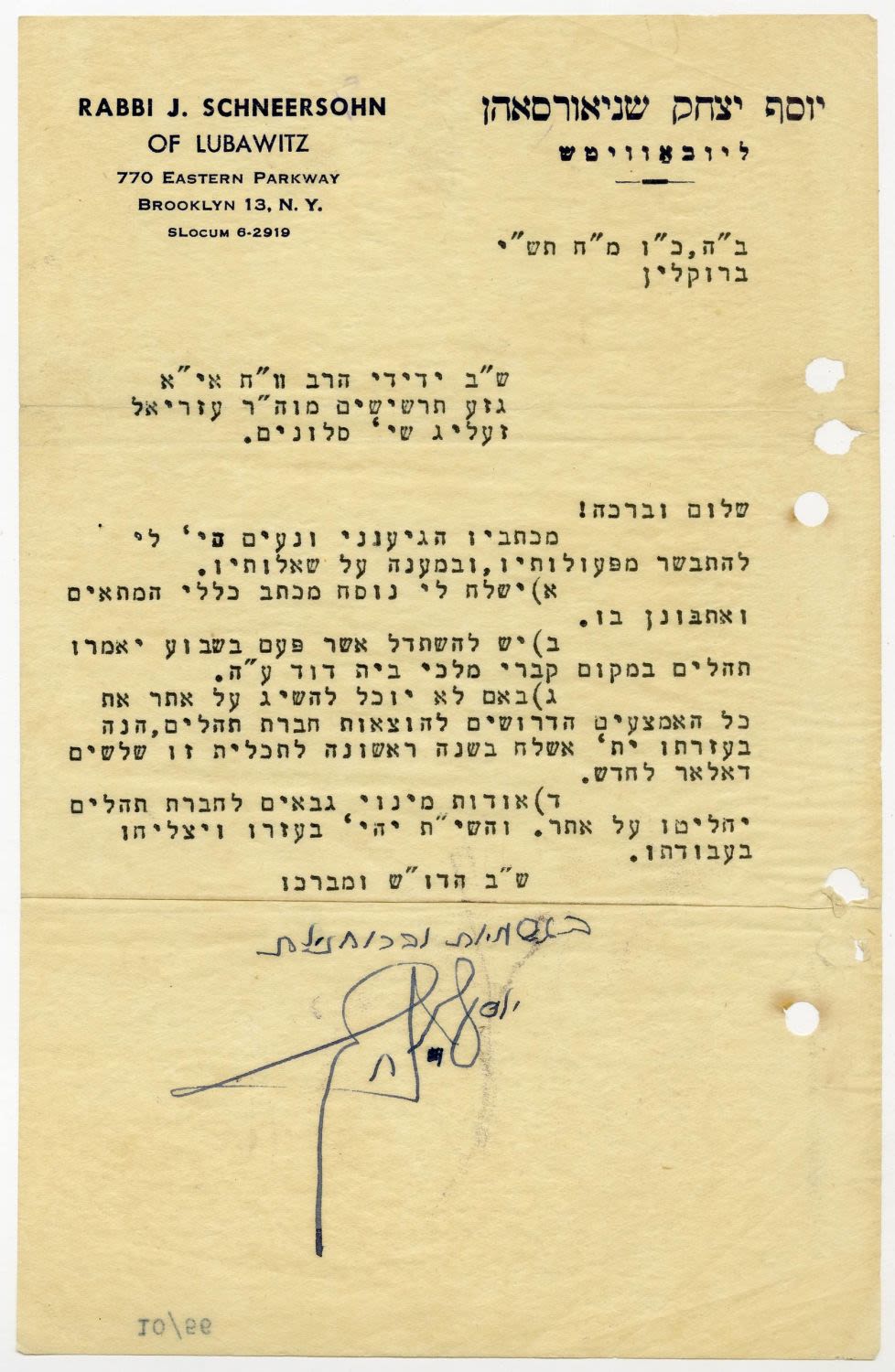
In 5710 (1949–50) the Rebbe Rayatz still sent requests that they try, at least once a week, to recite Tehillim at the graves of the "Kings of the House of David"[3].
Even after the establishment of the State and the Six Day War, when control of Jerusalem was entirely in Israeli hands, the society's activity was not renewed. The Rebbe was asked about it several times, but the Rebbe did not respond.
Close to Shavuos 5750 (1990), Rabbi Shmuel Elazar Heilprin, rosh yeshivah of Toras Emes, rabbi of the Beis Yisroel neighborhood in Jerusalem and chairman of Igud Tze'atzei Rabbeinu HaZaken, urged Rabbi Moshe Shmuel Deitsch, of the board of Colel Chabad, and proposed renewing the Tehillim Society. The director of Colel Chabad, Rabbi Sholom HaLevi Duchman, wrote about this to the Rebbe, and on the eve of the festival, while the Rebbe was at the Ohel, he unexpectedly called his secretary Rabbi Chaim Yehuda Krinsky and instructed him to inform Rabbi Sholom HaLevi Duchman to renew the activity of the "Society" at the tomb of King David already on Shavuos of that year. The instruction reached Eretz Yisroel a few minutes before the onset of the festival, and immediately at its conclusion they organized a minyan to recite the Book of Tehillim, and the next day, on Isru Chag, they celebrated the society's festive day.
Since then the custom has continued, and every day a minyan of G-d-fearing avreichim, headed by Rabbi Ephraim Prus, goes up to complete the entire Book of Tehillim. For those who recite Tehillim in the society in Jerusalem a charter was established, according to which all must have beards, recite the Tehillim pleasantly, conduct themselves respectfully, and avoid all kinds of strictness. They go up every day at eleven o'clock in the morning, and the recitation of Tehillim continues until one o'clock.
The Rebbe attached great importance to the old-new society, and several times The Rebbe's Secretariat called and asked for the names of the members and their mothers' names, and the exact details of the times of the Tehillim recitation. On one occasion, on the eve of 10 Shevat 5751 (1991), during the Gulf War, the Rebbe requested the list and waited with his trip to the Ohel until it arrived.
Further Reading[edit | edit source]
- Shneur Zalman Berger, Storm on Mount Zion, Beis Moshiach, Rosh Chodesh Sivan 5774 (2014), issue 928.
- Moshe Marinovsky, A Psalm of David, Kfar Chabad, Rosh Chodesh Sivan 5774 (2014), issue 1559.
External Links[edit | edit source]
- Letter of the Rebbe Rayatz from Rosh Chodesh Tammuz 5706 (1946) to the members of the World Tehillim Society, on the Kedem auction house website
References[edit | edit source]
- ↑ The letter was printed in the Kovetz Michtavim appended to the book Tehillim Ohel Yosef Yitzchak.
- ↑ Rabbi Moshe Marinovsky, "The note of names for the 'Tehillim Society' that the Rebbe wrote," Kfar Chabad, issue 2115, p. 46, 5785 (2024–25)
- ↑ Photograph of a letter to Rabbi Slonim, 26 Cheshvan 5710 (1949).