Israel Defense Forces: Difference between revisions
Fix link (Kiryat Gat) Tag: Disambiguation links |
Uniform spelling Tomchei Temimim |
||
| Line 136: | Line 136: | ||
At the end of the process, an agreement was reached between the IDF and the Chabad askanim, that a bochur who signed a commitment to return to the country at the end of the year would receive an exit permit, and on his return to the country would be entitled to enter again the general framework of yeshiva bochurim, "Toraso Umanuso". | At the end of the process, an agreement was reached between the IDF and the Chabad askanim, that a bochur who signed a commitment to return to the country at the end of the year would receive an exit permit, and on his return to the country would be entitled to enter again the general framework of yeshiva bochurim, "Toraso Umanuso". | ||
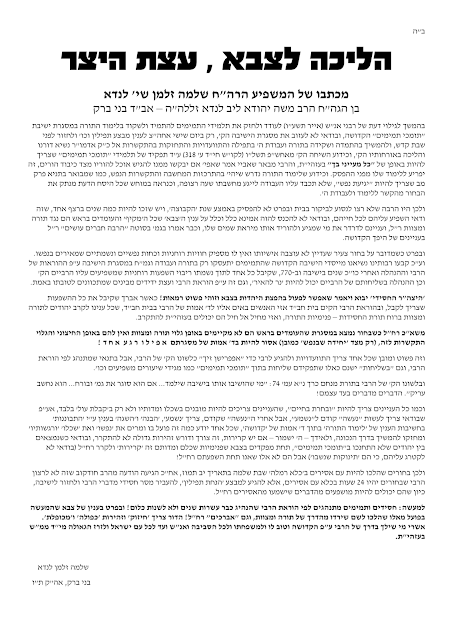
This agreement was in effect from the 5720s (1960s) until 5754 (1994). In 5771 (2011) an alternative agreement was reached<ref>[http://old2.ih.chabad.info/index.php?url=article_he&id=62991 Exclusive: the army will allow bochurim to travel for the "Kvutzah" year], Chabad Info</ref><ref>"[http://col.org.il/show_news.rtx?artID=64207 A new agreement allows the students to travel to 'Kvutzah' – all the details]", Col.org.il (Hebrew)</ref>, which created many disturbances<ref>[http://www.shop.chabad.info/index.php/images/he_new2/includes/favicon.ico?url=article_he&id=65436 Scandal: dozens of Chabad bochurim sat in prison because of a personal rivalry], Chabad Info</ref><ref>[http://new.chabad.info/index.php?url=article_he&id=69986 Scandal: contacts with the IDF on the conscription of Chabad yeshiva students], Chabad Info</ref>, but it was cancelled in 5774 (2014), and in 5776 (2016) a new agreement was signed with some of the Chabad yeshivos<ref>[[Tomchei Temimim Kiryat Gat|Tomchei | This agreement was in effect from the 5720s (1960s) until 5754 (1994). In 5771 (2011) an alternative agreement was reached<ref>[http://old2.ih.chabad.info/index.php?url=article_he&id=62991 Exclusive: the army will allow bochurim to travel for the "Kvutzah" year], Chabad Info</ref><ref>"[http://col.org.il/show_news.rtx?artID=64207 A new agreement allows the students to travel to 'Kvutzah' – all the details]", Col.org.il (Hebrew)</ref>, which created many disturbances<ref>[http://www.shop.chabad.info/index.php/images/he_new2/includes/favicon.ico?url=article_he&id=65436 Scandal: dozens of Chabad bochurim sat in prison because of a personal rivalry], Chabad Info</ref><ref>[http://new.chabad.info/index.php?url=article_he&id=69986 Scandal: contacts with the IDF on the conscription of Chabad yeshiva students], Chabad Info</ref>, but it was cancelled in 5774 (2014), and in 5776 (2016) a new agreement was signed with some of the Chabad yeshivos<ref>[[Tomchei Temimim Kiryat Gat|Tomchei Temimim Kiryat Gat]], [[Tomchei Tmimim Migdal HaEmek]], and [[Yeshivas Chassidei Chabad Lubavitch Tzfas (Gedolah)|Chassidei Chabad Lubavitch – Tzfas]], while the roshei yeshiva of [[Tomchei Tmimim Kfar Chabad]] and [[Tomchei Temimim Rishon LeZion (Gedolah)|Tomchei Temimim Rishon LeZion]] did not officially join the agreement (but the bochurim of those yeshivos themselves can join it independently).</ref> through the mediation and efforts of Rabbi [[Eliezer Wilschansky]] and Rabbi [[Moshe Havlin]]<ref>[http://chabad.info/special/בלעדי-נציג-ראשי-הישיבות-בהסכם-עם-צהל-מ/ Exclusive: the representative of the roshei yeshiva in the agreement with the IDF speaks about everything], Chabad Info, 17 Av 5776 (2016)</ref>, under which the bochurim can travel to "[[Kvutzah]]" in exchange for giving up yeshiva-student status and a commitment to return to the country at the end of one year of study and to enlist by age 26. At first mashpiim and rabbis came out against the agreement as it was taking shape<ref>[http://chabad.info/news/קול-קורא/ A kol korei against the agreement], Chabad Info, 7 Av 5776 (2016); [https://chabadpedia.co.il/images/e/e2/%D7%9E%D7%9B%D7%AA%D7%91_%D7%94%D7%9E%D7%A9%D7%A4%D7%99%D7%A2_%D7%94%D7%A8%D7%91_%D7%A9%D7%9C%D7%9E%D7%94_%D7%96%D7%9C%D7%9E%D7%9F_%D7%9C%D7%A0%D7%93%D7%90_%D7%A0%D7%92%D7%93_%D7%94%D7%92%D7%99%D7%95%D7%A1.png The letter of the mashpia Rabbi Shlomo Zalman Landa against the conscription]</ref>, but after a public statement of the [[Beis Din Rabbonei Chabad]] in favor of the agreement was published<ref>In a letter dated 7 Menachem Av 5776 (2016), at the top of which is written: "We hereby clarify that the agreement of the roshei yeshiva with the IDF was brought before us and received our approval".</ref>, and an extensive interview was published with the roshei yeshiva in which they clarified their position<ref>[http://chabad.info/magazine/סערת-הסכם-הגיוס-ראשי-הישיבות-מדברים-על/ The conscription agreement storm: the roshei yeshiva talk about everything], Chabad Info, 15 Av 5776 (2016)</ref>, the opposition to the agreement subsided and many of the signatories of the "kol korei" withdrew their signatures. | ||
In 5784 (2024) the agreement was cancelled following the conscription crisis and following [[Avigdor Dickstein]]. | In 5784 (2024) the agreement was cancelled following the conscription crisis and following [[Avigdor Dickstein]]. | ||
Revision as of 21:20, 21 November 2026

The Israel Defense Forces (known mainly by its acronym: Tzahal, IDF) is the main military arm of the State of Israel, entrusted with safeguarding its security and sovereignty.
The Rebbe gave special attention to IDF soldiers through letters he wrote to them and shluchim he sent to encourage their spirits, and he even took a detailed interest in the conduct of the army with members of the military echelon who came to consult with him and receive his blessing.
History


Until the establishment of the State of Israel in 5708 (1948), three Jewish fighting organizations operated in the country: the Haganah, the Etzel (Irgun Tzvai Leumi) and the Lechi (Lochamei Cherut Yisrael). With the end of British rule and the declaration of independence, the Arab residents of the country, with the help of the neighboring states, broke out in war (which later became known as the "War of Liberation" or the "War of Independence") against the Jewish residents.
During the war, the head of the provisional government, David Ben-Gurion, signed the "Israel Defense Forces Ordinance". The army that was established was built on the basis of the organizational infrastructure of the Haganah organization and merged into it the fighters of the Etzel and Lechi underground movements.
In a reply to Mr. Shimon Peres (through a third party – Mr. Jerry Weintraub), the Rebbe made clear that his having prevented the formation of Peres's government in the framework of the "dirty trick" did not of course involve any personal dispute with Mr. Peres, and the Rebbe notes that this is "especially after I received information (in the previous generation) that it was Mr. [Peres] who organized the IDF from its beginning[1] – in a way that would be a defense for Israel, from then until now".[2]
The Rebbe's Attitude to IDF Operations
In his sichos, the Rebbe dealt many times with the subject of the integrity of the Land, and as part of this he often referred to the various operations carried out by the operational arm of the IDF. For the most part he backed their operations, and called on the political leaders of the State of Israel not to mix politics into military matters that concern safeguarding the security and sovereignty of the State of Israel and the peace of its residents.
On 22 Sivan 5749 (1989) the Rebbe said to Mr. Yosef Ben Hanan, an armored corps officer: "When the IDF is strong, then there will be no need for any war, because 'your fear and your dread' will be upon all the surrounding countries, and then there will be no casualties and no war, and Moshiach Tzidkeinu will come. This is the main point of all main points".
The War of Liberation
On 17 Kislev 5708 (1947), the General Assembly of the United Nations (the UN) decided on the partition of Eretz Yisroel into two states – an Arab one and a Jewish one. The Arabs of Israel (led by the Arab Higher Committee) did not accept the decision and began a series of attacks on Jews in Eretz Yisroel, with the aim of destroying the Jewish population in the country and controlling all the territories of Israel. The Jews fought back through the fighting organizations that were then active in the country. After the evacuation of British rule and the declaration of the establishment of the state on 5 Iyar 5708 (1948), the armies of Syria, Jordan, Egypt and Iraq invaded Eretz Yisroel and joined the fighting. During the war the IDF was established, and from its establishment it was the main force that fought the Arab armies.
On 23 Tammuz 5709 (1949) the war ended, with about 9,000 killed from the Arab armies, and more than 6,000 Jews who were killed al kiddush Hashem, who made up a full percent of the entire Jewish population in the Holy Land at the time of the war. The war ended in a Jewish victory, and following it the flow of immigration to the country grew by hundreds of percent; tens of thousands of Arabs abandoned their homes and emigrated to Arab countries, and on their ruins Jewish villages and settlements were built, among them Kfar Chabad, which was established on the initiative of the Rebbe Rayatz on the ruins of the Arab village of Safriya, which was emptied of its residents during the war.
Against the background of the victory in the war and the founding of the state, various opinions formed among the religious public in the country regarding the correct attitude to the state and the war: on one side, circles of Religious Zionism called for establishing a festival on Independence Day, saying Hallel on it and giving thanks for the miracles; and on the other, the zealot circles that utterly reject the state, see it as an evil affliction and want it abolished, and even claim that it is impossible to say that miracles were done for Jews who do not keep Torah and mitzvos.
The Rebbe rejected both approaches. He sharply rejected the view that the existence of Jewish sovereignty in Eretz Yisroel and the ingathering of Jews from all over the world is "Atchalta DeGeulah" (the beginning of the Redemption)[3], and together with this he demanded of his Chassidim to use the awakening following the victory to increase the observance of Torah and mitzvos among all strata of the people, explaining that when "one sees that Hashem Yisborach delivered the many into the hands of the few in a miraculous way, this should arouse added strength to serve Him, may He be blessed, and one should not be impressed at all by the fact that there are those who behave otherwise... that this is, in addition to all the other matters, conduct of ingratitude in the most shocking way. To what can this be compared? To a great and mighty king who shows his great and tremendous love to a lowly, despised commoner, the lowest of men etc., and descends to him from his place of honor with all his ministers etc., and brings him into his palace, the king's palace etc. Is it possible to say that this lowly man would say to the king that this palace is not the king's but the commoner's, and therefore he will behave in it as he wishes, and the beginning of his conduct is to drive the king out of his palace in every possible way, that is, through crude conduct contrary to the king's command at every single step?!"[4]
The Sinai War (Operation Kadesh)
On 24 Cheshvan 5717 (1956) Israel opened a military campaign against Egypt that was called "Operation Kadesh", against the background of infiltration of cells of terrorists (the "fedayeen") into Israeli territory and the murder of innocent people, and the closing of the Suez Canal and the Straits of Tiran to the passage of Israeli ships and the paralysis of the port of Eilat. The military operation was backed by French and British assistance; it lasted about a week and ended on 1 Kislev.
During the war the IDF succeeded in conquering the Sinai Peninsula and in severely damaging the infrastructure of the Egyptian army. After a week IDF forces halted and entrenched themselves in the territories they had conquered, while the armies of Britain and France went out on "Operation Musketeer", during which they took over the cities north of the Suez Canal and seized additional positions along the canal. Subsequently heavy pressure was applied by the UN, the U.S. government and the Soviet Union for the withdrawal of all military forces from the area, and after a waiting period all the military forces withdrew and were replaced by a military force stationed by the UN to safeguard free passage in the canal area, on 18 Teves 5717 (1956).
The operation ended in Israel's victory and in achieving the goal of opening the Straits of Tiran, which would allow shipping to the port of Eilat, but it cost the lives of 177 soldiers. On the Egyptian side, by contrast, about 3,000 killed, close to 5,000 wounded and more than 6,000 captured were reported, together with severe damage to the morale and strength of the Egyptian army.
At a farbrengen the Rebbe held during the war he said a maamar of Chassidus[5], in which he referred to the war: "Many waters cannot extinguish the love, nor can rivers drown it... The Holy One, blessed be He, said to the Jewish people: If all the nations of the world gather, a multitude of many peoples like the roar of many waters, they will not be able to extinguish (G-d forbid) the love between Me and Israel; and if all the kings of the earth and their ministers gather, the mighty and many waters of the river, they will not be able to wipe you out (G-d forbid) from the world". This maamar gained added importance when immediately after Shabbos the Rebbe asked to receive the maamar for editing and instructed that it be printed in the Holy Land so that it would be studied during the war, and he said that in this maamar there is an answer to several matters connected with the war.[6]
Despite the Rebbe's outcries, at the end of the war Israel voluntarily gave up all the territory that had been conquered and surrendered to the pressure of the powers. Over the years after the war, the Rebbe referred several times to the regrettable mistake of preferring political considerations over security considerations, in the total surrender to the decisions of the UN despite the security danger that arose following the return of the territories without any return.[7]
The Six-Day War

At the beginning of the summer of 5727 (1967) the Arab armies prepared for an all-out war on the State of Israel, with the aim of attacking on several fronts at once and thereby collapsing the army and bringing about the destruction and the end of the sovereignty of the State of Israel.
Despite the assessments and forecasts of military experts during the tense period before the war, and a collective fear of catastrophic results, the Rebbe prophesied clearly that Hashem would bring the Jewish people out of the difficult situation with a great victory, and instructed people who asked him not to leave the borders of the country.[8]
The war, which broke out on 26 Iyar, lasted only six days, and as the Rebbe had foreseen – despite all the experts' forecasts – the IDF won on all fronts, and even achieved additional gains such as the conquest of the area of the Western Wall, the Golan Heights, Gaza, the Sinai desert, Chevron, Kever Rachel, and other places.
The Rebbe used the great excitement of the country's residents over the brilliant victory, and demanded of the Chassidim to make a great effort so that the general awakening would be used for keeping mitzvos, and sent Chabad Chassidim to spread out all over the country and give passers-by the merit of putting on tefillin.
Parallel to the spiritual activity he demanded of the Chassidim, the Rebbe began energetic activity to settle the territories liberated in this war, and fought against the intention to hand them back to the Arab states. The Rebbe made clear that if the Arabs were not removed from the expanded borders of the country and were given Israeli citizenship, they would change the face of Israel's demographic map, and this could affect the results of the elections.
The War of Attrition
After the IDF's miraculous victory in the Six-Day War, the Egyptian army, with the help of the Soviet Union, opened a frontal attack on IDF positions along the Suez Canal, in a campaign that lasted about a year and a half, from 18 Adar 5729 (1969) until the ceasefire on 5 Av 5730 (1970). Despite the dry military definition that a war ending in a ceasefire is defined as a war without a decision, the Egyptian army's goal of causing Israel's withdrawal from the border line was not achieved, while Israel caused losses of about ten thousand Egyptian soldiers, a flow of hundreds of thousands of refugees to Cairo, severe attrition of the Egyptian army, which was forced to ask for Soviet help, and severe damage to the Egyptian economy.
Throughout the war, which lasted about a year and a half, the Rebbe called on the Chassidim to go out to IDF positions and encourage the spirits of the fighters, and called on the high command staff and the policy makers in the government to take a firm approach and not to surrender to American pressure for a ceasefire, since the Egyptians would certainly use it to fortify their war formation and would within a short time open a renewed war that would cost the lives of many soldiers. The Rebbe's calls were not answered, and his forecast proved accurate, when just one day after the signing of the ceasefire agreement the Egyptians violated it and began massive preparations for the Yom Kippur War.
The Yom Kippur War

The Yom Kippur War broke out with relative surprise on Yom Kippur, 10 Tishrei 5734 (1973), with an attack by the armies of Syria and Egypt on Israel. The war officially ended on 30 Tishrei 5734 (1973); however, on the Syrian side the war ended on 10 Sivan 5734 (1974).
The massive attack at the beginning of the war caught the Israeli government and the IDF unprepared in many respects, and at first the losses were painful and bitter, but within a short time forces were mobilized, and miraculously IDF soldiers succeeded in repelling the attacks and also conquering enormous territories on all fronts. As opposed to the government and the intelligence.
The Rebbe foresaw the outbreak of the war months beforehand, when he opened a long chain of preparations and statements in which it was evident that there was a great and imminent event for which great kindness was needed, and in particular the Rebbe aroused activity with children: "From the mouths of babes... to silence the enemy". About these words the Rebbe said that "he prophesied and did not know what he prophesied".
Operation Yonatan (Entebbe)
In the month of Sivan of 5736 (1976) an "Air France" plane was hijacked to Entebbe in Uganda by a cell of terrorists, who held the passengers as hostages until the release of fifty-three terrorists, setting an ultimatum for the fulfillment of their demand and endangering the very lives of the plane's passengers.
On 6 Tammuz the IDF began a complicated and complex rescue operation under the command of Yoni Netanyahu[9], and after many efforts and open miracles the fighters of Sayeret Matkal succeeded in rescuing the hijacked passengers, freeing them from captivity and returning them to the borders of Israel.
Unlike other circles that saw the rescue operation as "an act of Satan", since the fighters who were involved in rescuing the passengers were people who do not keep Torah and mitzvos, the Rebbe saw it as a miraculous rescue[10], and called for a spiritual awakening following the great miracle that had been done, while rejecting the claims of Rabbi Yoel Teitelbaum, the Satmar Rebbe.
The First Lebanon War
In 5742 (1982) the First Lebanon War broke out[11], in which IDF forces fought the Syrian army and the Palestinian terror organizations that were operating against Israel from Lebanese territory; it led to the IDF entering with ground forces within the borders of Lebanon, in order to eradicate the Palestinian terror nests.
After a week of ground fighting in which the IDF reached military superiority in the encirclement of Beirut, following worldwide political pressure, the Israeli politicians ordered that the conquest of Beirut by force be avoided, which caused a war of attrition that led to the deaths of hundreds of IDF soldiers, and prevented the final destruction of the terror nests in Lebanon.
During the period of waiting at the borders of Beirut, the Rebbe cried out many times that the politicians were not letting the military experts do what was required of them according to their military and security knowledge, and were thereby endangering the lives of the soldiers.[12]
In addition, the Rebbe warned that if they did not finish the job now, they would have to return after several years and fight in Lebanese territory under harder conditions, and without military superiority, which would claim additional casualties both on the Arab side and on the Jewish side. This prophecy proved over the years to be absolutely true, when in 5766 (2006) the Second Lebanon War broke out, during which more than one hundred and fifty civilians and IDF soldiers were killed.[13]
IDF Senior Officers and the Rebbe

On 20 Adar I 5744 (1984) the Chief Rabbi of the IDF, Rabbi Gad Navon, visited the Rebbe. During the visit the Rebbe gave Rabbi Navon a book of Tanya that had been printed in Grenada by the chaplain Rabbi Yaakov Goldstein, in which the emblem of the U.S. Army appeared alongside the emblem of Kehot.[14] Rabbi Navon came away deeply impressed by the Rebbe, and instructed people around him to help Chabad people as much as possible.[15]
Like Rabbi Navon, other senior figures visited the Rebbe, such as Meir Amit (while serving as head of the Mossad), Rehavam Ze'evi (while serving as a major general in the IDF), Major General Rafi Peretz[16], Brigadier General Ran Peker, Brigadier General Menachem Eini[17], Major General Yossi Ben Hanan, and many other senior figures[18]. All of them testified that they were deeply impressed by the Rebbe's detailed knowledge and broad military vision, and marveled at the caring and interest the Rebbe showed toward every detail of the conduct of the military system, and the positive attitude he displayed toward it.
Many of the meetings were documented by the Chabad media company JEM in a series of interviews with IDF generals and other senior figures, and were released in the video production "Emunah U'Bitachon – Army and Intelligence".[19]
The "Metzuyanei Tzahal"


On 23 Av 5736 (1976) a group of disabled IDF veterans came on a trip to New York, during which they came to 770 to meet the Rebbe at a yechidus.
The Rebbe received the group with special warmth, spoke encouraging words to them, and gave each of them a dollar for tzedakah and for a blessing.
The sicha the Rebbe delivered to them was in Lashon Hakodesh[20], and in the course of what he said to them he explained that in his opinion they should not be called "IDF disabled", since that name carries a connotation of an inferior and lowly person; rather they should be called "metzuyanim" (outstanding), which indicates the special strengths they have, and the tremendous self-sacrifice they offered for the defense of the Jewish people.[21]
Service in the IDF
The Rebbe relates with great affection to every single one of the soldiers engaged in defending the country's borders and protecting its residents. In many letters the Rebbe notes this fact, and arouses the soldiers about the great merit they have, and about the great responsibility that Hashem has entrusted to them, which should spur them to keep Torah and mitzvos so that they will have success in fulfilling their role.[22]
Throughout the history of the IDF, many Chabad Chassidim have served within the military framework, and also took part in Israel's wars and helped in the war effort to defend the country's borders, while, at the Rebbe's instruction, they use their free time to influence their comrades to draw closer to Judaism.
Conscription of Yeshiva Students


The Rebbe sharply opposes the conscription of Temimim. On several occasions the Rebbe referred to the issue of "equal sharing of the burden" and the conscription of yeshiva students. The Rebbe emphasized that the learning of the yeshiva students protects the residents of the country even more than the soldier on the border.[23] Alongside this the Rebbe emphasized the tremendous virtue of IDF soldiers who sacrifice their lives in practice and protect the residents of the country with their bodies: "...that a bochur who sits and learns Torah protects the country even more than the bochur who stands on the border and endangers his life. But there is, of course, a virtue in both; in this bochur who stands on the border – his virtue is actual mesirus nefesh. It turns out, then, that there is a virtue in both, both in the bochurim who sit and learn Torah and in those who stand on the border... Since there is a virtue in both, it is understood that those in charge of security need to take care both of appropriate help for the yeshivos and of making appropriate decisions in matters of security etc..."[24]
In 5773 (2013), following a renewed controversy that arose around the conscription of yeshiva students, the Chabad rabbis issued a call – based on the words of the Rebbe – instructing yeshiva students to persist in their learning and not to enlist in military service under any circumstances.[25]
Conscription of Women

The Rebbe expressed his opinion many times against the conscription of women into the army, and said[26] that it harms the army not only from a religious and moral standpoint, but also from a technical and operational standpoint, since the presence of women in the army causes the involvement of emotional tensions in military operations, and reduces the soldiers' ability to concentrate on the operational task imposed on them.
The Rebbe ruled[27] that the severity of conscripting women into the army, from a halachic standpoint, is in the category of "abizraihu degilui arayos" (an accessory to forbidden relations), and according to some of the poskim one must give up one's life over it, to the level of "yehareg ve'al ya'avor" (be killed rather than transgress).
In addition to this, the Rebbe emphasizes that the matter especially concerns a Jewish army, in which Divine help is needed, which is conditional on safeguarding the holiness of the army camps, as is explicit in the Written Torah: "For Hashem your G-d walks in the midst of your camp, to save you and to deliver your enemies before you; therefore your camp shall be holy, that He see no unseemly thing in you and turn away from you".[28]
Agreements Regarding Travel to "Kvutzah"
The Chabad course of study changed in the first years of the Chabad community in the Holy Land, and was shaped over the years until it reached its current format, in which after studying in elementary school (the "Talmud Torah" in Chareidi parlance), the bochur goes on to learn three years in a yeshiva ketanah, and afterwards three more years in a yeshiva gedolah. At the end of the course, the bochurim travel for a full year of study in the court of the Rebbe, in the Central Yeshivas Tomchei Tmimim in 770.
This course of study created a problematic situation, in which young bochurim who had not yet served in the army needed to receive regular exit permits, and thus to receive an exceptional permit regulating the departure of an entire class of bochurim from Chabad yeshivos every year to study in the Rebbe's court.
For this purpose, the Rebbe activated an entire system of connections with senior government officials in the country, and wrote personal letters to the relevant figures[29][30], in order to persuade them to issue the special permit for the Chabad yeshiva bochurim.
At the end of the process, an agreement was reached between the IDF and the Chabad askanim, that a bochur who signed a commitment to return to the country at the end of the year would receive an exit permit, and on his return to the country would be entitled to enter again the general framework of yeshiva bochurim, "Toraso Umanuso".
This agreement was in effect from the 5720s (1960s) until 5754 (1994). In 5771 (2011) an alternative agreement was reached[31][32], which created many disturbances[33][34], but it was cancelled in 5774 (2014), and in 5776 (2016) a new agreement was signed with some of the Chabad yeshivos[35] through the mediation and efforts of Rabbi Eliezer Wilschansky and Rabbi Moshe Havlin[36], under which the bochurim can travel to "Kvutzah" in exchange for giving up yeshiva-student status and a commitment to return to the country at the end of one year of study and to enlist by age 26. At first mashpiim and rabbis came out against the agreement as it was taking shape[37], but after a public statement of the Beis Din Rabbonei Chabad in favor of the agreement was published[38], and an extensive interview was published with the roshei yeshiva in which they clarified their position[39], the opposition to the agreement subsided and many of the signatories of the "kol korei" withdrew their signatures.
In 5784 (2024) the agreement was cancelled following the conscription crisis and following Avigdor Dickstein.
Chabad Activity with IDF Soldiers

Already in the first years of the IDF, Chabad Chassidim would come to army camps and work with the soldiers in various frameworks, giving Torah classes and distributing sufganiyos, Chanukah gelt, Mishloach manos, and Jewish reading material.
Ahead of the festivals, and in times of war, Chabad activity in IDF camps was reinforced by many additional activists, who would enlist en masse in order to succeed in reaching all IDF soldiers and bringing them the joy of the festival and the light of Judaism, and strengthening them in their stand with mesirus nefesh to defend the residents of Eretz Yisroel.
Since the Chabad movement was perceived by the public as a body distant from politics, and maintained good relations with people in government and the top of the administration from all shades of the public spectrum, Chabad activists could enter IDF camps without difficulty, and the gates of the camps would open before them – something that was not possible for activists of other movements.
The Rebbe himself instructed the Chassidim, in some of the activities, to try to obtain permission to go around the camps in IDF uniforms.[40]
Difficulties After the Involvement in the Elections
After the election campaign of 5749 (1988), in which the Rebbe instructed the Chassidim to vote at the ballot box for the United Torah Judaism party, various movements began to demand insistently that the IDF prohibit the entry of Chabad activists into IDF camps in light of their involvement in politics, as part of the military law prohibiting the entry of political activists into IDF bases.
Despite the various obstacles that arose, Chabad Chassidim continue to this day to enter IDF camps with the approval of the top military echelon, with their activity conditional on the accompaniment of people from the Chief Rabbinate, who are supposed to supervise that the activity does not deviate from the rules set by the General Staff.[41]
A Sefer Torah for IDF Soldiers
In 5742 (1982) the Rebbe initiated the writing of a special Sefer Torah for the unity of IDF soldiers and the security forces, and for increasing their protection and defense during their operational activity. At the Rebbe's instruction, Chabad askanim in the country succeeded in bringing the IDF leadership to take the project upon itself, and on 11 Nissan 5742 (1982) the ceremony of beginning the writing of the letters in the Sefer Torah was held.
A month and a half later the First Lebanon War broke out, and it became clear that the Rebbe had foreseen the future and had asked the Chassidim who followed his instructions to hurry with the beginning of the registration, in order to provide the cure before the blow and to safeguard the security of IDF soldiers.
During the war dozens of teams of Chabad Chassidim went out deep into Lebanese territory and registered soldiers at the front in the middle of the war, and in less than a month they succeeded in registering 304,805 soldiers for the Sefer Torah, and on 14 Tammuz the ceremony of bringing the first Sefer Torah in merit of IDF soldiers into the synagogue at Tzrifin was held, with the participation of the IDF top brass.
The Tanya at IDF Bases
In the midst of the Yom Kippur War the Rebbe passed a message to Rabbi Shlomo Maidanchik to print books of Tanya and siddurim in the Fayid area beyond the Suez Canal, and to distribute the printed books to the IDF soldiers fighting at the front. The secretary Rabbi Nissan Mindel also joined the printing mission. When the printing team reached Fayid, it met General Ariel Sharon, who gave his approval and full backing to the printing operation and opened all the doors for them. The Tanya was printed in two editions in the center of the supply base, and at the end of the printing it was distributed to the soldiers with the help of students from the vocational school in Kfar Chabad.[42]
When the Rebbe launched the campaign of printing the Tanya, Chabad Chassidim initiated printings of the book in every possible place, including the various IDF camps, and went around with a mobile printing press even to remote bases in order to carry out the Rebbe's instruction.[43]
During the First Lebanon War the Rebbe asked that the Tanya be printed in Beirut, in Tyre and in other places in Lebanon, and he even delivered a special sicha at the farbrengen of 13 Tammuz while the book of Tanya was lying on the table, and brought it as proof that the IDF was already in Beirut and should use the opportunity to conquer the city. Subsequently the Rebbe also said that the fact that they could print the Tanya there "is because the people of the 'Israel Defense Forces' made the preparation for it and helped in printing the book of Tanya... And it is understood that this activity of printing the book of Tanya in these places is about spreading the wellsprings outward in actual practice, including learning the book of Tanya with the people of the 'IDF'..."[44]
On several occasions the Rebbe spoke in letters and orally about the importance of the Tanya for IDF soldiers.[45]
Mivtza Pidyon HaBen
The Rebbe urged holding a pidyon haben among IDF soldiers who had not been redeemed.
Headquarters for IDF Heroes
Tzeirei Agudas Chabad in Israel runs a special headquarters for IDF widows[46][47] and the children of soldiers who were killed in Israel's wars, run by Rabbi Menachem Kutner.
The headquarters works through financial assistance to the bereaved families, visits to people who were wounded in terror attacks ahead of the Jewish festivals, and arranging special hosted Shabbosos[48], organizing day camps and fun days for the families' children[49], and more.
Or LaChayal
The Or LaChayal organization, run by Rabbi Menachem Ofen, is a non-profit organization founded by Rabbi Ofen in 5767 (2007) following his miraculous rescue from Palestinian gunfire on his way to mivtzoim in the city of the Patriarchs, Chevron.
The organization operates on behalf of "the Association for the Soldier" (HaAgudah LeMaan HaChayal), and organizes social activities for IDF soldiers in the spirit of Judaism, produces monthly leaflets[50], distributes tefillin to soldiers who commit to putting them on every weekday[51], and other recreational activities.[52]
| Some of the tokens of appreciation the Rebbe received from the IDF, as displayed in an exhibition at the Chabad Library |
|---|
|


See Also
Further Reading
- "Those who learn Torah and IDF soldiers", Beis Moshiach weekly, issue 1401
- The rejection of the conscription of women into the IDF, in the "Nitzotzei Rebbe" column, Hiskashrus weekly, Parshas Behaaloscha 5781 (2021)
- Yisroel Alpenbein, "The IDF's secret weapon that will never reach the enemy", Beis Moshiach weekly, issue 2030, p. 28
- "Like the mercy of a father on his children", Kfar Chabad weekly, issue 2031
- Shmuel Shlomo Lifshitz, Why do yeshiva students not enlist in the army?, the booklet "Bnei Heichala", issue 2, Kislev–Teves 5785 (2024), p. 108[53]
External Links
- The Rebbe's statements about the IDF
- 8 things the Rebbe said about IDF soldiers, Chabad.org
- Interview with Zeev Ron – an Air Force man, Thinking outside the box, My Story magazine, 561, 24 Adar 5786 (2026)
- KEEP YOUR CAMP HOLY: THE REBBE AND THE IDF, the Rebbe and the IDF in the magazine "A Chassidisher Derher", Tishrei 5782 (2021) (PDF)
- Are there "secular" soldiers in the IDF? (video, English)
- The Rebbe's view on the conscription of yeshiva bochurim
- LaVo BaTzava – a compilation of the Rebbe's statements regarding the army in general and the IDF in particular
- Who is greater: the fighters who sacrifice their lives or those who learn Torah? The Rebbe determines, on the website "Lachluchis Geulatis" (video)
- Protecting the land, together, Beis Chabad website
- Are yeshiva students obligated in conscription? (Hebrew) The Rebbe's view on the conscription of yeshiva bochurim.
- Lo Yeitzei BaTzava (Hebrew) (PDF) – a compilation of the Rebbe's statements regarding the conscription of yeshiva students and their integration into the IDF, Chabad Info
- The conscription of yeshiva bochurim harms the military capabilities of the IDF (video), HaGeulah
- The Rebbe's response to the statement: there are baalei battim who are not pleased that there are students who do not go to the army (Hebrew) from minute 3:45 (video), Chabad Info
- Evading the IDF: what is the view of the Rebbe Melech HaMoshiach?, on the website "Lachluchis Geulatis"
- Do Chabad Chassidim serve in the IDF – and what about the yeshiva bochurim? The Rebbe explains, on the website "Lachluchis Geulatis"
- Conscription of women into the IDF
- The Rebbe's view regarding the conscription of women into the IDF, on the Tzeirei Chabad website (Hebrew)
- The Rebbe's view on the conscription of girls (Hebrew), in the Beis Moshiach weekly
- News on Chabad websites – on the subject of the IDF
- "The IDF will provide Chabad fighters with food under Rabbi Landa's kashrus for the festival of Pesach", Col.org.il (Hebrew)
- Chabad Chassidim were asked on the radio: "Are you planning to serve in the army?" • a rare recording from 5727, on the website Lachluchis Geulatis
- Soldiers at a parade singing "Ani Maamin" (Hebrew) (video), Chabad Info
- Kol BeRamah: Rabbi Shneur Ashkenazi on Memorial Day for the fallen of the IDF (audio) (Hebrew)
References
- ↑ This refers to his work with Ben-Gurion and Levi Eshkol in the Haganah headquarters and his dealing with matters of manpower and procurement; afterwards he continued these activities within the framework of the Defense Ministry (after the IDF was established and the powers of the army versus the powers of the Defense Ministry were defined, when the division in which he worked was attached to the Defense Ministry).
- ↑ Teshurah Cunin – Hertz, 7 Kislev 5782 (2021), pp. 30–31
- ↑ "BeSod Si'ach" – published by U'Faratzta, 5751 (1991) (based on the yechidus of 28 Adar 5728 (1968))
- ↑ Igros Kodesh volume 11 (Hebrew), p. 85
- ↑ The maamar in its edited version on the Lubavitch Library website.
- ↑ See Igros Kodesh volume 14, letter 4991.
- ↑ See for example: Sicha of Shabbos Parshas Eikev 5730, Collected sichos from the months of Sivan–Tammuz 5742 (as edited by the Rebbe for Kovetz HaMaor).
- ↑ Igros Kodesh volume 24, letter 9317 (Hebrew).
- ↑ After whom the rescue operation was called "Operation Yonatan".
- ↑ "The Rebbe – "a miracle and rescue above the natural order"" (video) – Shturem website.
- ↑ Also called "Operation Peace for the Galilee", or by its acronym – Shelag.
- ↑ Recordings and a word-for-word translation of the sichos said on weekdays: sicha of 22 Sivan 5742, sicha of the night of 3 Tammuz 5742, sicha of 7 Tammuz 5742, sicha of 13 Tammuz 5742 (audio)
- ↑ Major General Yehoshua Saguy, head of the Intelligence Directorate at the time of the Lebanon War: the Rebbe was right in all his words! – HaGeulah website (Hebrew).
- ↑ A photograph of the Tanya and the story of the meeting in the booklet "Ker a Velt", p. 28 (Hebrew).
- ↑ "Rabbi Gad Navon instructed me: help Chabad as much as you can" .
- ↑ "Major General Rafi Peretz in an exclusive interview with COL", Col.org.il (Hebrew)
- ↑ Interview with Brigadier General Menachem Eini, head of the "Lavi" project, Chabad.org.
- ↑ This is apart from the many exchanges of letters that took place between the Rebbe and senior IDF officers.
- ↑ "The new production from JEM has been released: "Emunah U'Bitachon – Army and Intelligence"" . Shturem.net website.
- ↑ This is the only sicha the Rebbe delivered in Lashon HaKodesh.
- ↑ The historic sicha to the delegation of Metzuyanei Tzahal, Hageula.com; a recording of the sicha, Chabad.info
- ↑ Letter of 15 Av 5729, 7 Elul 5729, 15 Av 5730, and more.
- ↑ Letter of Rosh Chodesh Elul 5721 (Hebrew)
- ↑ 19 Kislev 5743 (1982), Hisvaaduyos 5743, volume 2, p. 647.
- ↑ Letter of the Chabad rabbis, Chabad Info
- ↑ Igros Kodesh volume 15, p. 252 (Hebrew).
- ↑ Igros Kodesh volume 23, p. 61 (Hebrew).
- ↑ Devarim 23:15.
- ↑ The Rebbe's words to Mr. Shneur Zalman Rubashov (Shazar), who served in those years as President of the State of Israel, were published in the book Nasi VeChassid by the researcher Shmuel Kraus (p. 238).
- ↑ The Rebbe's letter to Menachem Begin, Chabad Info (Hebrew)
- ↑ Exclusive: the army will allow bochurim to travel for the "Kvutzah" year, Chabad Info
- ↑ "A new agreement allows the students to travel to 'Kvutzah' – all the details", Col.org.il (Hebrew)
- ↑ Scandal: dozens of Chabad bochurim sat in prison because of a personal rivalry, Chabad Info
- ↑ Scandal: contacts with the IDF on the conscription of Chabad yeshiva students, Chabad Info
- ↑ Tomchei Temimim Kiryat Gat, Tomchei Tmimim Migdal HaEmek, and Chassidei Chabad Lubavitch – Tzfas, while the roshei yeshiva of Tomchei Tmimim Kfar Chabad and Tomchei Temimim Rishon LeZion did not officially join the agreement (but the bochurim of those yeshivos themselves can join it independently).
- ↑ Exclusive: the representative of the roshei yeshiva in the agreement with the IDF speaks about everything, Chabad Info, 17 Av 5776 (2016)
- ↑ A kol korei against the agreement, Chabad Info, 7 Av 5776 (2016); The letter of the mashpia Rabbi Shlomo Zalman Landa against the conscription
- ↑ In a letter dated 7 Menachem Av 5776 (2016), at the top of which is written: "We hereby clarify that the agreement of the roshei yeshiva with the IDF was brought before us and received our approval".
- ↑ The conscription agreement storm: the roshei yeshiva talk about everything, Chabad Info, 15 Av 5776 (2016)
- ↑ "Wear IDF uniforms when you come to the bases", Col.org.il (Hebrew).
- ↑ "What do you want from Chabad?! – protocols from Knesset meetings discussing Chabad activity in IDF camps" – Shturem website.
- ↑ For more details, see "HaMaidanchik – the locomotive of Chabad", pp. 115–116.
- ↑ A partial list of the Tanya editions printed at IDF bases: 1095 – Armored Corps camp. 1096 – Sinai formation camp. 1324 – Ramon camp. 1345 – IDF transport camp, Kiryat Malachi. 1540 – Field Forces Headquarters. 1745 – Air Force bases in Tzrifin. 1952 – Beit Dras, signal formation. 1953 – Hatzor base. 1954 – Malachi medical unit. 2210 – Uvda camp. 2211 – Southern Command headquarters. 2235 – Units camp. 2326 – Nevatim Air Force base. 2521 – IDF, Beit Guvrin. 2522 – Tze'elim camp. 2523 – Tel Nof base. 2592 – Navy base, Ashdod. 2593 – Jabalia camp.
- ↑ A description of the Tanya printings at IDF bases in the booklet "Ker a Velt Haint" (Hebrew) published by Vaad Chayalei Beis Dovid (PDF)
- ↑ Igros Kodesh volume 10, p. 62: "He will find it right to give a Tanya to some of those among the army people who excel in matters of Judaism etc., in addition to giving Tanyas in the camp to the clubs or to the library of the army people"; see also Hisvaaduyos 5742, volume 4, p. 1851.
- ↑ "This is how Chabad's activity with IDF widows began" (audio), Col.org.il (Hebrew).
- ↑ "JEM in a new film: the children of the heroes after the Six-Day War • watch" (video), Col.org.il (Hebrew)
- ↑ "A hosted Shabbos for terror victims organized by Tzeirei Agudas Chabad" – Shturem website.
- ↑ "Orphans of bereavement and hostile acts at Chabad day camps", Col.org.il (Hebrew).
- ↑ "Or LaChayal" – a portion of Judaism for IDF soldiers, photo of the leaflet, Chabad Info
- ↑ The Or LaChayal organization distributes a hundred pairs of tefillin every month, Chabad Info
- ↑ Channel One reporter Itai Rappaport on the activity of the "Or LaChayal" organization (video), Shturem website
- ↑ A follow-up article was published in issue 2, Nissan 5785 (2025). Also in the article of Rabbi Eliyahu Kirshenbaum in the bulletin "MiBeis HaHora'ah", 21 Nissan 5785 (2025), p. 6.