Chamar Medinah: Difference between revisions
Hidden Hebrew {{ערך מורחב}} → {{Main}} |
m Title Case headings |
||
| Line 3: | Line 3: | ||
In Chabad Chassidus, although the custom is to be lenient regarding [[Havdalah]], the custom regarding Kiddush is to be stringent and refrain from reciting Kiddush over chamar medinah. | In Chabad Chassidus, although the custom is to be lenient regarding [[Havdalah]], the custom regarding Kiddush is to be stringent and refrain from reciting Kiddush over chamar medinah. | ||
==Halachic | ==Halachic Definition== | ||
The simple halachic definition of "chamar medinah" is an important beverage over which most of the city's inhabitants customarily base their meals, just as people customarily base a meal on wine in a place where it is commonly available. | The simple halachic definition of "chamar medinah" is an important beverage over which most of the city's inhabitants customarily base their meals, just as people customarily base a meal on wine in a place where it is commonly available. | ||
| Line 12: | Line 12: | ||
Based on the words of the Alter Rebbe, the Ketzos HaShulchan wrote<ref>Siman 97, Badei HaShulchan, se'if katan 8.</ref> that in Eretz Yisroel, which is a wine-growing region, no beverage other than wine is called "chamar medinah"; in practice, however, many are accustomed to be lenient in this matter<ref>See the addenda to the Shulchan Aruch of the Alter Rebbe, siman 272, se'ifim 12–15, Alashvili edition.</ref>. | Based on the words of the Alter Rebbe, the Ketzos HaShulchan wrote<ref>Siman 97, Badei HaShulchan, se'if katan 8.</ref> that in Eretz Yisroel, which is a wine-growing region, no beverage other than wine is called "chamar medinah"; in practice, however, many are accustomed to be lenient in this matter<ref>See the addenda to the Shulchan Aruch of the Alter Rebbe, siman 272, se'ifim 12–15, Alashvili edition.</ref>. | ||
===Various | ===Various Halachic Details=== | ||
*'''Nighttime Kiddush''' - In his Shulchan Aruch, the Alter Rebbe cites two views regarding Kiddush over chamar medinah: according to the first view, one may recite Kiddush only over wine or over bread, and one may not recite Kiddush over chamar medinah at all; whereas according to the second view, one may recite Kiddush over chamar medinah, but it is not a [[Hiddur Mitzvah]]. He rules regarding the nighttime Kiddush that if there is wine in the city, one should recite Kiddush only over wine; and even if there is no wine, one should recite Kiddush over bread; and only if there is neither wine nor bread in the entire city should one recite Kiddush over chamar medinah. In any event, one who has only one cup of wine should save it for Havdalah, for which according to all opinions one may recite Havdalah specifically over wine and not over bread, and should recite Kiddush over the bread<ref>Shulchan Aruch of the Alter Rebbe, siman 271, se'ifim 20–21.</ref>. | *'''Nighttime Kiddush''' - In his Shulchan Aruch, the Alter Rebbe cites two views regarding Kiddush over chamar medinah: according to the first view, one may recite Kiddush only over wine or over bread, and one may not recite Kiddush over chamar medinah at all; whereas according to the second view, one may recite Kiddush over chamar medinah, but it is not a [[Hiddur Mitzvah]]. He rules regarding the nighttime Kiddush that if there is wine in the city, one should recite Kiddush only over wine; and even if there is no wine, one should recite Kiddush over bread; and only if there is neither wine nor bread in the entire city should one recite Kiddush over chamar medinah. In any event, one who has only one cup of wine should save it for Havdalah, for which according to all opinions one may recite Havdalah specifically over wine and not over bread, and should recite Kiddush over the bread<ref>Shulchan Aruch of the Alter Rebbe, siman 271, se'ifim 20–21.</ref>. | ||
*'''Daytime Kiddush''' - Regarding the daytime Kiddush, the Alter Rebbe writes explicitly that it is permitted to recite Kiddush over chamar medinah<ref>Siman 289, se'if 7.</ref>; nevertheless, the choicest fulfillment of the mitzvah is to recite Kiddush specifically over wine. | *'''Daytime Kiddush''' - Regarding the daytime Kiddush, the Alter Rebbe writes explicitly that it is permitted to recite Kiddush over chamar medinah<ref>Siman 289, se'if 7.</ref>; nevertheless, the choicest fulfillment of the mitzvah is to recite Kiddush specifically over wine. | ||
| Line 18: | Line 18: | ||
*'''Havdalah''' - Regarding Havdalah as well, one may be lenient and recite Kiddush over chamar medinah<ref>Shulchan Aruch of the Alter Rebbe, siman 296, se'ifim 16–18.</ref>. | *'''Havdalah''' - Regarding Havdalah as well, one may be lenient and recite Kiddush over chamar medinah<ref>Shulchan Aruch of the Alter Rebbe, siman 296, se'ifim 16–18.</ref>. | ||
==Chabad | ==Chabad Custom== | ||
{{Main|Mashkeh Takana}} | {{Main|Mashkeh Takana}} | ||
Although according to the letter of the law the custom is to be lenient and recite Kiddush over liquor as chamar medinah, and in earlier generations Chassidim were accustomed on Shabbos morning to make Kiddush over "mashkeh" after the prayers when they sat down to farbreng, already at the beginning of his leadership the Rebbe rejected this custom, and particularly after the Rebbe announced the [[Mashkeh Takana|decree regarding mashkeh]]<ref>Farbrengen of Shabbos Parshas Shemini 5723 (1963).</ref>. | Although according to the letter of the law the custom is to be lenient and recite Kiddush over liquor as chamar medinah, and in earlier generations Chassidim were accustomed on Shabbos morning to make Kiddush over "mashkeh" after the prayers when they sat down to farbreng, already at the beginning of his leadership the Rebbe rejected this custom, and particularly after the Rebbe announced the [[Mashkeh Takana|decree regarding mashkeh]]<ref>Farbrengen of Shabbos Parshas Shemini 5723 (1963).</ref>. | ||
| Line 28: | Line 28: | ||
In addition, in a number of places the Rebbe cites the statement of the Sages that a segulah for an increase in eyesight is to be careful with the wine of Kiddush and the wine of Havdalah, and Chassidim understood the intent to be that one should be careful to recite Kiddush and Havdalah specifically over wine, and not over other beverages such as chamar medinah<ref>See Igros Kodesh, vol. 11, p. 375; Shulchan Aruch of the Alter Rebbe with the notes of Rabbi Alashvili, siman 271, note 58.</ref>. | In addition, in a number of places the Rebbe cites the statement of the Sages that a segulah for an increase in eyesight is to be careful with the wine of Kiddush and the wine of Havdalah, and Chassidim understood the intent to be that one should be careful to recite Kiddush and Havdalah specifically over wine, and not over other beverages such as chamar medinah<ref>See Igros Kodesh, vol. 11, p. 375; Shulchan Aruch of the Alter Rebbe with the notes of Rabbi Alashvili, siman 271, note 58.</ref>. | ||
==Among | ==Among Our Rebbeim== | ||
It is known regarding the Alter Rebbe that on the last night of his life, Motzaei Shabbos Parshas Shemos, the night of 24 Teves, he made Havdalah over [[Coffee|coffee]]. | It is known regarding the Alter Rebbe that on the last night of his life, Motzaei Shabbos Parshas Shemos, the night of 24 Teves, he made Havdalah over [[Coffee|coffee]]. | ||
| Line 39: | Line 39: | ||
In 5748 (1987–88), when a blessing for recovery was requested for the grandfather of R' [[Mordechai Aharon Feiglin|Mordechai Feiglin]], the Rebbe replied that he surely is careful to recite Kiddush and Havdalah specifically over wine<ref>[https://chabadpedia.co.il/images/e/ed/TeshurahDeitchFaiglinOnlinePdf.pdf Teshurah from the wedding of his descendants (Deitch–Feiglin, 19 Cheshvan 5785 (2024)), page 39].</ref>. | In 5748 (1987–88), when a blessing for recovery was requested for the grandfather of R' [[Mordechai Aharon Feiglin|Mordechai Feiglin]], the Rebbe replied that he surely is careful to recite Kiddush and Havdalah specifically over wine<ref>[https://chabadpedia.co.il/images/e/ed/TeshurahDeitchFaiglinOnlinePdf.pdf Teshurah from the wedding of his descendants (Deitch–Feiglin, 19 Cheshvan 5785 (2024)), page 39].</ref>. | ||
==See | ==See Also== | ||
*[[Beer]] | *[[Beer]] | ||
==External | ==External Links== | ||
* [[The Tzemach Tzedek]], '''[https://chabadpedia.co.il/images/b/bc/להבין_ההפרש_תרי_ח.pdf the maamar "Lehavin Hahefresh Bein Yom Tov Rishon L'Yom Tov Sheini" - 5618]''', published for the first time in Tishrei 5783 (2022) by the editorial staff of [[Otzar HaChassidim]] (PDF) | * [[The Tzemach Tzedek]], '''[https://chabadpedia.co.il/images/b/bc/להבין_ההפרש_תרי_ח.pdf the maamar "Lehavin Hahefresh Bein Yom Tov Rishon L'Yom Tov Sheini" - 5618]''', published for the first time in Tishrei 5783 (2022) by the editorial staff of [[Otzar HaChassidim]] (PDF) | ||
*Rabbi Elchanan Moshe Nachmanson, '''[https://sinun770.org/קידוש-והבדלה-על-חמר-מדינה-ולחם-הוספת-מי/ Kiddush and Havdalah over chamar medinah]''', Sinun Chabad | *Rabbi Elchanan Moshe Nachmanson, '''[https://sinun770.org/קידוש-והבדלה-על-חמר-מדינה-ולחם-הוספת-מי/ Kiddush and Havdalah over chamar medinah]''', Sinun Chabad | ||
Revision as of 20:55, 19 November 2026
Chamar medinah (Aramaic: "wine of the country") is a distinguished beverage over which, according to the halachic definitions, one may recite Kiddush and Havdalah in place of wine, in a pressing situation where no wine is available.
In Chabad Chassidus, although the custom is to be lenient regarding Havdalah, the custom regarding Kiddush is to be stringent and refrain from reciting Kiddush over chamar medinah.
Halachic Definition
The simple halachic definition of "chamar medinah" is an important beverage over which most of the city's inhabitants customarily base their meals, just as people customarily base a meal on wine in a place where it is commonly available.
However, there is a halachic dispute as to whether a beverage that is important in a given place is considered "chamar medinah" even if wine is available there, albeit at a high price.
As a matter of halachah, although the Alter Rebbe attempts to explain the view of those who were accustomed to be lenient, he concludes that this is only for the sake of scholarly discussion, but whether one may rely on it in actual practice requires further study[1].
Based on the words of the Alter Rebbe, the Ketzos HaShulchan wrote[2] that in Eretz Yisroel, which is a wine-growing region, no beverage other than wine is called "chamar medinah"; in practice, however, many are accustomed to be lenient in this matter[3].
Various Halachic Details
- Nighttime Kiddush - In his Shulchan Aruch, the Alter Rebbe cites two views regarding Kiddush over chamar medinah: according to the first view, one may recite Kiddush only over wine or over bread, and one may not recite Kiddush over chamar medinah at all; whereas according to the second view, one may recite Kiddush over chamar medinah, but it is not a Hiddur Mitzvah. He rules regarding the nighttime Kiddush that if there is wine in the city, one should recite Kiddush only over wine; and even if there is no wine, one should recite Kiddush over bread; and only if there is neither wine nor bread in the entire city should one recite Kiddush over chamar medinah. In any event, one who has only one cup of wine should save it for Havdalah, for which according to all opinions one may recite Havdalah specifically over wine and not over bread, and should recite Kiddush over the bread[4].
- Daytime Kiddush - Regarding the daytime Kiddush, the Alter Rebbe writes explicitly that it is permitted to recite Kiddush over chamar medinah[5]; nevertheless, the choicest fulfillment of the mitzvah is to recite Kiddush specifically over wine.
- Kiddush in the place of a meal - Even if a person drinks a substantial amount of chamar medinah, this does not count toward the requirement of Kiddush in the place of a meal, and if he did not drink wine or eat bread or mezonos foods, he must recite Kiddush again[6].
- Havdalah - Regarding Havdalah as well, one may be lenient and recite Kiddush over chamar medinah[7].
Chabad Custom
Although according to the letter of the law the custom is to be lenient and recite Kiddush over liquor as chamar medinah, and in earlier generations Chassidim were accustomed on Shabbos morning to make Kiddush over "mashkeh" after the prayers when they sat down to farbreng, already at the beginning of his leadership the Rebbe rejected this custom, and particularly after the Rebbe announced the decree regarding mashkeh[8].
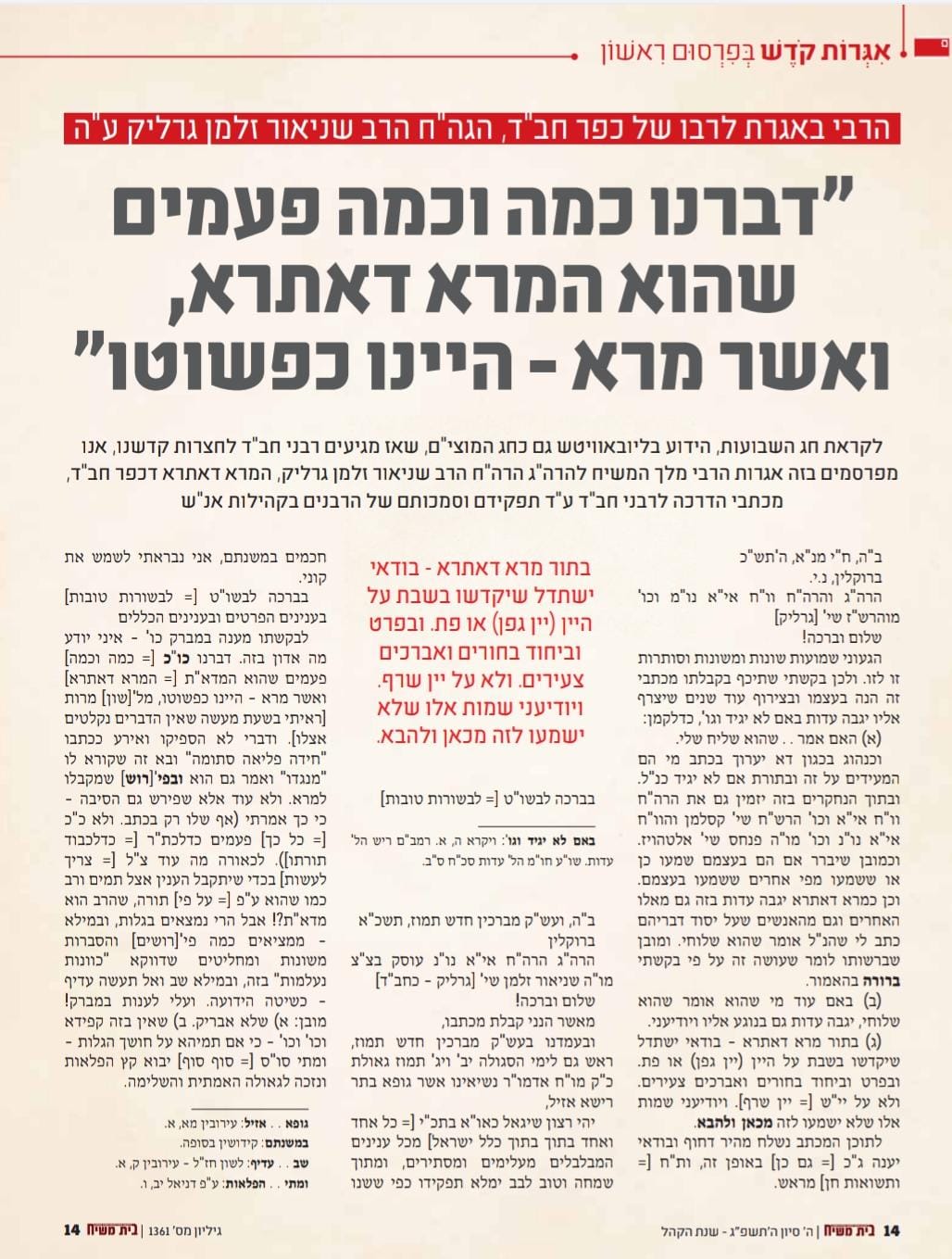
Matters went so far that in 5720 (1959–60) the Rebbe emphatically demanded of the rabbi of Kfar Chabad, Rabbi Shneur Zalman Garelik, that he act to ensure that people in Kfar Chabad not recite Kiddush over mashkeh, and that from then on he inform him of the names of those who nevertheless continued to make Kiddush over mashkeh[9].
To one of the Chassidim the Rebbe wrote that he was "alarmed" to hear of the reasoning to recite Kiddush over mashkeh and thereby "sanctify" his drinking, the complete opposite of the instruction of The Rebbe Rayatz[10].
In addition, in a number of places the Rebbe cites the statement of the Sages that a segulah for an increase in eyesight is to be careful with the wine of Kiddush and the wine of Havdalah, and Chassidim understood the intent to be that one should be careful to recite Kiddush and Havdalah specifically over wine, and not over other beverages such as chamar medinah[11].
Among Our Rebbeim
It is known regarding the Alter Rebbe that on the last night of his life, Motzaei Shabbos Parshas Shemos, the night of 24 Teves, he made Havdalah over coffee.
Likewise, hours before the passing of The Rebbe Rashab, his wife, Rebbetzin Shterna Sarah, handed him a cup of coffee. The lips of the Rebbe Rashab began to move in a whisper and his voice was not heard. One of those close to him who inclined his ear heard the Rebbe saying the text of Havdalah[12].
When Rebbetzin Nechama Dina once asked the Rebbe about Havdalah, the Rebbe gestured to her with his hand a motion of stirring with a spoon, and when she verified whether the Rebbe meant that she should make Havdalah over tea, the Rebbe nodded his head in the affirmative[13]..
At the time of the health incident on Shemini Atzeres 5738, the Rebbe refused the advice of the secretaries to make Kiddush over grape juice or the like, and made Kiddush specifically over wine.
In 5748 (1987–88), when a blessing for recovery was requested for the grandfather of R' Mordechai Feiglin, the Rebbe replied that he surely is careful to recite Kiddush and Havdalah specifically over wine[14].
See Also
External Links
- The Tzemach Tzedek, the maamar "Lehavin Hahefresh Bein Yom Tov Rishon L'Yom Tov Sheini" - 5618, published for the first time in Tishrei 5783 (2022) by the editorial staff of Otzar HaChassidim (PDF)
- Rabbi Elchanan Moshe Nachmanson, Kiddush and Havdalah over chamar medinah, Sinun Chabad
- Rabbi Meir Ashkenazi, Is it permitted to make Kiddush over mashkeh on Shabbos?, Sinun Chabad
References
- ↑ Shulchan Aruch of the Alter Rebbe, siman 272, se'ifim 12–15; Kuntres Acharon there, se'if katan 1.
- ↑ Siman 97, Badei HaShulchan, se'if katan 8.
- ↑ See the addenda to the Shulchan Aruch of the Alter Rebbe, siman 272, se'ifim 12–15, Alashvili edition.
- ↑ Shulchan Aruch of the Alter Rebbe, siman 271, se'ifim 20–21.
- ↑ Siman 289, se'if 7.
- ↑ Shulchan Aruch of the Alter Rebbe, siman 273, se'if 12.
- ↑ Shulchan Aruch of the Alter Rebbe, siman 296, se'ifim 16–18.
- ↑ Farbrengen of Shabbos Parshas Shemini 5723 (1963).
- ↑ Beis Moshiach weekly, Erev Shavuos 5783 (2023), page 14. Letter dated 18 Menachem Av 5723 (1963).
- ↑ Sha'arei Halachah U'Minhag, vol. 1, p. 266 (and apparently this is the letter to R' Avraham Yitzchak Shashonkin, 5 Teves 5723 (1962) (col.org.il)). Similarly, the Rebbe said at yechidus (on the night of 2 Adar 5723 (1963)) to Rabbi Azriel Zelig Slonim: "...See to it that the young people do not make Kiddush [and Havdalah] over mashkeh" (Sichos Kodesh 5723, p. 403). Similarly, he also said to R' Shneur Zalman HaLevi Duchman (on Shemini Atzeres 5729 (1968)), after he reported that he had made Kiddush over mashkeh: "That is a proper thing ("a gleiche zach"), since it is now Shemini Atzeres! [And he added:] After all, you are already over the age of forty, and this must be made clear, for otherwise they will all immediately make Kiddush over mashkeh.
- ↑ See Igros Kodesh, vol. 11, p. 375; Shulchan Aruch of the Alter Rebbe with the notes of Rabbi Alashvili, siman 271, note 58.
- ↑ Ashkavta D'Rebbi, p. 97.
- ↑ Testimony of Rabbi Chaim Baruch Halberstam.
- ↑ Teshurah from the wedding of his descendants (Deitch–Feiglin, 19 Cheshvan 5785 (2024)), page 39.