
Belz Chassidus: Difference between revisions
Translated from Hebrew Chabadpedia |
Language and style edit: natural English only, no change to facts |
||
| (12 intermediate revisions by the same user not shown) | |||
| Line 1: | Line 1: | ||
{{Short description|Chassidic dynasty founded by Rabbi Sholom Rokeach of Belz}} | |||
[[File:בעלז 3.jpg | |||
[[File:בעלז 3.jpg|thumb|The synagogue built by Rebbe [[Sholom Rokeach]], founder of the Chassidus, in the town of Belz]] | |||
'''Belz''' Chassidus (written in [[Yiddish]] '''Belza''') was founded by Rebbe [[Sholom Rokeach]] of Belz, a disciple of [[The Chozeh of Lublin|the Chozeh of Lublin]]. | '''Belz''' Chassidus (written in [[Yiddish]] '''Belza''') was founded by Rebbe [[Sholom Rokeach]] of Belz, a disciple of [[The Chozeh of Lublin|the Chozeh of Lublin]]. | ||
== History of the Chassidus == | == History of the Chassidus == | ||
After the passing of the founder of the Chassidus, Rebbe [[Sholom Rokeach]], his son Rebbe Yehoshua Rokeach of Belz, who also served as | After the passing of the founder of the Chassidus, Rebbe [[Sholom Rokeach]], he was succeeded by his son Rebbe Yehoshua Rokeach of Belz, who also served as the town's rabbi, and he in turn by Rebbe [[Yissachar Dov Rokeach (I)|Yissachar Dov Rokeach]] as [[Admor|Rebbe]]. After his [[Histalkus|passing]], his eldest son, Rebbe [[Aharon Rokeach]] of Belz, succeeded him as Rebbe and as rabbi of the town. The other brothers, including Rebbe [[Mordechai Rokeach]] of Bilgoraj, accepted his leadership. | ||
During the years of [[The Holocaust|the Holocaust]], Rebbe Aharon Rokeach | During the years of [[The Holocaust|the Holocaust]], Rebbe Aharon Rokeach escaped from [[Europe]] with the help of [[The Rebbe Rayatz|the Frierdiker Rebbe]] and reached [[Eretz Yisroel]], but his family could not escape and was murdered by the Nazis along with millions of Jews. | ||
After the passing of Rebbe Aharon, because his son Rebbe Moshe Rokeach had been murdered in the Holocaust, his nephew Rebbe [[Yissachar Dov Rokeach]] of Belz was appointed to succeed him. | After the passing of Rebbe Aharon, because his son Rebbe Moshe Rokeach had been murdered in the Holocaust, his nephew Rebbe [[Yissachar Dov Rokeach]] of Belz was appointed to succeed him. | ||
Rebbe [[Yehoshua Rokeach]], a great-grandson of Rebbe [[Yissachar Dov Rokeach (I)|Yissachar Dov Rokeach the first]], serves as [[Admor|Rebbe]] of "[[Machnovka-Belz Chassidus|Machnovka-Belz]]". Rebbe Yehoshua is the successor of his great-uncle, the Rebbe of [[Machnovka]] of the [[Chernobyl]] dynasty. | Rebbe [[Yehoshua Rokeach]], a great-grandson of Rebbe [[Yissachar Dov Rokeach (I)|Yissachar Dov Rokeach the first]], serves as [[Admor|Rebbe]] of "[[Machnovka-Belz Chassidus|Machnovka-Belz]]". Rebbe Yehoshua is the successor of his great-uncle, the Rebbe of [[Machnovka]] of the [[Chernobyl Chassidus|Chernobyl]] dynasty. | ||
== The | == The Connection with Chabad Chassidus == | ||
[[File:בעלזא עם הרבי.jpg|thumb|The [[Yissachar Dov Rokeach|current Rebbe of Belz]] during a [[Yechidus|yechidus]] with the Rebbe, 4 Adar II 5741 (1981)]] | |||
It is related | It is related that [[The Rebbe Maharash|the Rebbe Maharash]], as a young avreich, engaged in commerce and dressed as a merchant for the purpose. Once, while traveling outside [[Lubavitch]], he chanced upon a "tish" at the court of R' [[Sholom Rokeach|Sholom of Belz]]. Entering the beis midrash, R' Sholom said that a good fragrance was reaching him. Old and blind by then, he made his way through the crowd away from his usual place at the head of the table. The Chassidim told him he was going the wrong way, but he kept walking to the back of the beis midrash, went up to the Rebbe Maharash, took him by the hand, seated him beside himself at the head of the table and said: "Avreich! From me one does not hide." When he returned to Lubavitch and told his father, the Tzemach Tzedek, what had happened, his father said: "From such a possessor of ruach hakodesh you wish to hide?!"<ref>Admorei Chabad U'Vnei Doram, p. 74, from Chassidim who heard it from the Frierdiker Rebbe and from Rebbe Aharon of Belz; and Otzar Sippurei Chabad, vol. 2, p. 302. See also what the current Rebbe of Belz related about this in the name of his uncle Rebbe Aharon in the book Botzina Kadisha (a collection of stories... of the holy Rebbe of Belz...), p. 85.</ref>. | ||
R' [[Chaim Schneersohn]] witnessed a similar incident involving the [[Rebbe|Rebbe]], which he would tell again and again as follows: "When the Rebbe and Rebbetzin Chaya Mushka lived in Berlin, word spread one day that the Rebbe of Belz, Rabbi Aharon, had arrived in Berlin, and many went to greet him. The Rebbe asked his friend a Gur [[Chassid]] living in Berlin named R' Itche Meir Firstenberg, to accompany him, on condition that he not reveal his identity (in keeping with his modest, concealed conduct at that time). When they arrived, I happened to be there and knew who the Rebbe was. Noticing me, he asked me too not to reveal his identity to anyone, and I promised. At the Rebbe of Belz's lodging there was a long line of Jews waiting to give "shalom". He gave "shalom" with his hand wrapped in a towel<ref>Apparently because of his special scrupulousness regarding purity, as he said to his [[Meshamesh BaKodesh|attendant]]: "I have stringencies regarding clean hands. [https://web.archive.org/web/20220406184809/http://www.shturem.net/index.php?section=news&id=96263 When you serve me, if you touch your nose, your hair, or even a baby under the age of three – please wash your hands and only afterwards serve me" (see here] (Hebrew)</ref>, and his head bowed downward. When the Rebbe approached and gave him his hand in greeting, he raised his eyes, removed the towel from his hand and grasped the Rebbe's hand. [[Aharon Rokeach|Rebbe Aharon]] held the hand for a long time and asked: "Ver iz der yungerman?" ["Who is this young man?"]. "A geveinlicher yungerman" [="An ordinary young man"], the Rebbe answered. [[Aharon Rokeach|Rebbe Aharon]] responded and said: "A varime hentele. Yungerman, fun undz behalt men zich nit" [="A warm hand. Young man, from us one cannot hide"]. When I approached, I revealed to the Rebbe of Belz that the young man with the warm hand was the son-in-law of the Rebbe Rayatz, and the Rebbe of Belz said: "Yo yo, ich ze ich ze. Ich hob gefilt az dos iz an eidele hant" [="Yes, yes, I see, I see. I felt that this is a refined hand"]. The Rebbe of Belz then conversed with the Rebbe for about ten minutes, holding his hand all the while." | |||
Rabbi Moshe Mund, Av Beis Din of Mykolaiv, one of the prominent Belzer Chassidim of the previous generation, once spoke with Rabbi [[Elchanan Halperin]] about the Rebbe. According to Rabbi Halperin, the moment he mentioned the Rebbe, Rabbi Mund said with great emotion: "The [[Lubavitch|Lubavitcher]] [[Rebbe]] is a holy man," and related that he once | Rabbi Moshe Mund, Av Beis Din of Mykolaiv, one of the prominent Belzer Chassidim of the previous generation, once spoke with Rabbi [[Elchanan Halperin]] about the Rebbe. According to Rabbi Halperin, the moment he mentioned the Rebbe, Rabbi Mund said with great emotion: "The [[Lubavitch|Lubavitcher]] [[Rebbe]] is a holy man," and related that he was once traveling on an international [[Train|train]] from [[Paris]] to [[Warsaw]] when he noticed a refined, distinguished-looking [[Avreich|avreich]] find his compartment and take one of its four seats. Several stations later a gentile woman entered the compartment, as assigned by her ticket, whereupon the avreich got up, left the compartment (though it was open and others were there) and stood at the end of a car, immersed in a small [[Gemara]] in his hand for about ten hours – from shortly after the train left Paris at 8:00 p.m. until it reached Katowice at 7:30 a.m. At Katowice many passengers got off, including the woman; seeing the compartment empty, the avreich went in, sat down and went on studying. When the train reached its destination, Rabbi Mund saw a group of [[Chabad Chassidim]] who had come to greet the avreich, and realized that this was the young son-in-law of [[The Rebbe Rayatz|the Rebbe Rayatz]]<ref>[http://www.toratchabad.com/contents.asp?aid=41175 Toras Chabad for yeshiva students].</ref>. | ||
Rebbe Aharon of Belz related that his father Rebbe Yissachar Dov (the Maharid) very much wanted to obtain the commentary of the Tzemach Tzedek on the Mishnayos, and when a bookseller came to Belz and among his books he had the "Tzemach Tzedek" on the Mishnayos, they bought the book for the Maharid<ref>From the current Rebbe of Belz in the name of his uncle Rebbe Aharon. The book Botzina Kadisha (a collection of stories of the holy Rebbe of Belz), p. 85.</ref>. | Rebbe Aharon of Belz related that his father Rebbe Yissachar Dov (the Maharid) very much wanted to obtain the commentary of the Tzemach Tzedek on the Mishnayos, and when a bookseller came to Belz and among his books he had the "Tzemach Tzedek" on the Mishnayos, they bought the book for the Maharid<ref>From the current Rebbe of Belz in the name of his uncle Rebbe Aharon. The book Botzina Kadisha (a collection of stories of the holy Rebbe of Belz), p. 85.</ref>. | ||
| Line 27: | Line 28: | ||
At the yechidus in 5733 (1972–73), the Rebbe told Rebbe [[Yissachar Dov Rokeach|Yissachar Dov]] that he had met his uncle Rebbe [[Aharon Rokeach]] of Belz and saw that he was "form without matter – abstracted from the body". Following this, the conversation turned to the approach of Chassidus, which emphasizes guarding the health of the body, with the Rebbe explaining how this does not contradict the words of Chazal that strength of the body is weakness of the soul: these words of Chazal refer to strength in physicality – warmth and pleasure from bodily matters, which brings about weakness of the soul – whereas the approach of Chassidus, which emphasizes the necessity of bodily health, negates a deficiency in bodily health, since such a deficiency harms the health of the soul. | At the yechidus in 5733 (1972–73), the Rebbe told Rebbe [[Yissachar Dov Rokeach|Yissachar Dov]] that he had met his uncle Rebbe [[Aharon Rokeach]] of Belz and saw that he was "form without matter – abstracted from the body". Following this, the conversation turned to the approach of Chassidus, which emphasizes guarding the health of the body, with the Rebbe explaining how this does not contradict the words of Chazal that strength of the body is weakness of the soul: these words of Chazal refer to strength in physicality – warmth and pleasure from bodily matters, which brings about weakness of the soul – whereas the approach of Chassidus, which emphasizes the necessity of bodily health, negates a deficiency in bodily health, since such a deficiency harms the health of the soul. | ||
As the conversation continued, they spoke about printing the seforim of Chassidus and the need to study it, with the Rebbe urging the Rebbe of Belz to print the Chassidic works of the Belzer Rebbes even though they had been careful not to print them. The Rebbe explained that in Chabad too, [[The Rebbe Rayatz|the | As the conversation continued, they spoke about printing the seforim of Chassidus and the need to study it, with the Rebbe urging the Rebbe of Belz to print the Chassidic works of the Belzer Rebbes even though they had been careful not to print them. The Rebbe explained that in Chabad too, [[The Rebbe Rayatz|the Rebbe Rayatz]] acted this way, printing the works of his father [[The Rebbe Rashab|the Rebbe Rashab]], who had not wanted his writings printed, especially not in square letters. The Rebbe explained that the reason for such conduct is the decline of the generations and the spiritual maladies that are constantly being added. The Rebbe further brought two proofs that in certain situations, despite a decree on the part of a Torah scholar and leader of the generation, there is room not to comply with it – one from the "Maaseh Rav" regarding the writings of the Arizal, which [[Chaim Vital|Rabbi Chaim Vital]] ordered to be hidden away, and afterwards the great Torah leaders permitted them to be brought out and published; and the second from the halachic discussion and debate regarding a Torah scholar and leader of the generation who instructed that no eulogy be said for him – that there is room to say that it is permitted to eulogize him. Following this, the Rebbe of Belz asked what the difference is between the effect of studying Chassidus on the Jew who studies it and the effect of prayer, and the Rebbe answered that it is very hard to influence a bochur ("even a pious bochur") to pray at length for several hours, so that the prayer would truly influence and affect him, but it is easier to influence a bochur to delve into the teachings of Chassidus "for an hour and a half, two hours and even three hours". | ||
The Rebbe also explained that there is a real difference between past generations and our own days: then, the town and surroundings were in an atmosphere of fear of Heaven, but today the kelipah in the world is growing ever stronger and penetrating everywhere and at every age, and two consequences follow from this: first, that today without the study of Chassidus it is simply impossible to serve Hashem properly; and second, that in our times the study of Chassidus must be integrated into the "curriculum" as soon as the child reaches the age of education. | The Rebbe also explained that there is a real difference between past generations and our own days: then, the town and surroundings were in an atmosphere of fear of Heaven, but today the kelipah in the world is growing ever stronger and penetrating everywhere and at every age, and two consequences follow from this: first, that today without the study of Chassidus it is simply impossible to serve Hashem properly; and second, that in our times the study of Chassidus must be integrated into the "curriculum" as soon as the child reaches the age of education. | ||
| Line 41: | Line 42: | ||
During the wars in the State of Israel, the Rebbe of Belz sent his Chassidim to the front line to put tefillin on IDF soldiers. | During the wars in the State of Israel, the Rebbe of Belz sent his Chassidim to the front line to put tefillin on IDF soldiers. | ||
==The | ===The Rebbe's References to Belz Customs=== | ||
In his compilation "Between the Customs of Belz and Chabad"<ref name="Laufer1044">Rabbi Mordechai Menashe Laufer, [https://www.chabad.org.il/Magazines/Article.asp?ArticleID=10703&CategoryID=1870 "Between the Customs of Belz and Chabad"], ''Hiskashrus'' issue 1044, Chabad.org.il (Hebrew).</ref> Rabbi Mordechai Menashe Laufer gathered statements and references of the Rebbe, as well as comparisons between the Rebbe's customs and instructions and the customs of Belz. The main ones are: | |||
* '''Printing the teachings of the Belzer Rebbes''': On 25 Menachem Av 5717 (1957), shortly after the passing of Rebbe [[Aharon Rokeach]] of Belz, the Rebbe asked, at a [[Yechidus|yechidus]] with R' Nachum Rabinowitz, whether the holy Rebbe had left writings. When told that he had not, on account of the "tradition" in Belz not to print them, the Rebbe responded: "My revered father-in-law's father, the Rebbe (Rashab), also did not want his writings of Chassidus to be printed, and nevertheless my revered father-in-law, the Rebbe, printed them"<ref>''Shemen Sasson MeChaveirecha'', vol. 4, p. 2119.</ref>. And at the yechidus of the current Rebbe, Rabbi [[Yissachar Dov Rokeach]], in 5741 (1981), the Rebbe noted that when he read the Belz periodical "I found that they have indeed begun to publicize and print matters of Chassidus as well"<ref>The booklet that appeared on 20 Menachem Av 5769, pp. 9–10, 17; ''BeTzel HaChochmah'', p. 113.</ref>. | |||
* '''A tikkun for neglecting tefillin and for desecrating Shabbos''': On several occasions the Rebbe was asked about a "tikkun" for one who had not put on tefillin, and replied that its rectification is expertise in the laws of tefillin and in Chassidic discourses on the subject of tefillin, and similarly regarding one who stumbled in desecrating Shabbos<ref>''Shaarei Halachah U'Minhag'', vol. 5, p. 30; vol. 2, p. 224.</ref>. A similar instruction was given by the holy Rebbe Aharon of Belz: to one who desecrated Shabbos in the war out of necessity he instructed to study the laws of Shabbos for an entire year, and likewise regarding not putting on tefillin, to study these laws for an entire year<ref>''Minhagei Belz'' (Eretz HaKodesh 5743), p. 84.</ref>. | |||
* '''Being in Jerusalem at the time of the offering of the [[Korban Pesach|Pesach]]''': Between the years 5728–5735 the Rebbe's instruction was in effect to avoid being in Jerusalem at the time of the offering of the first and second Pesach. At the farbrengen of [[Acharon Shel Pesach]] 5728 the Rebbe expressed his opinion that from a halachic standpoint it is preferable to avoid being in Jerusalem on Pesach Sheni (14 Iyar), and all the more so on the first Pesach (14 Nissan, which includes women), during the hours in which the Pesach offering is brought, so as not to enter into a doubt or double doubt of an obligation of kares as a result of being in Jerusalem and not bringing it<ref>''Toras Menachem'', vol. 52, p. 303 ff.</ref>. It is related that in 5704 (1944), when the holy Rebbe Aharon of Belz came up to [[Eretz Yisroel]] and arrived in Jerusalem on 16 Shevat, he asked to find an apartment in Tel Aviv and asked to stay there until Pesach; his brother, the Rav of Bilgoraj (the father of the current Rebbe), expressed his assumption that Rebbe Aharon did not want by any means to remain in Jerusalem on Pesach, so as not to enter into the concern of an obligation to offer the Pesach, since one who is at a distance of fifteen mil from Jerusalem is called "on a distant road" and is not obligated to come to Jerusalem to offer it<ref>''HaRav HaKadosh MiBelza'' (Ohr HaChassidus, Jerusalem), p. 75; and see the author's compilation "Not to Be Near the Old City of Jerusalem on Erev Pesach," ''Haoros U'Biurim'' Oholei Torah, N.Y., issue 838 (Shavuos 5762), pp. 104–105.</ref>. | |||
The compilation also brings additional comparisons in the customs of the festivals – the blessing on [[Calabrian Esrog|Calabrian esrogim]] and esrogim of Eretz Yisroel, dancing after reciting [[Tashlich]], accompanying with candles on the night of [[Simchas Torah]], and the distribution of matzos on Erev Pesach<ref name="Laufer1044"/>. | |||
==The Tension with Belz== | |||
In 5749 (1988–89), during the period of the stormy elections in which the [[Misnagdim|Litvishe]] broke away from [[Agudas Yisroel]] and launched a dispute against the [[Chassidim|Chassidic]] community, and in which the Rebbe, in a one-time and exceptional step, instructed to vote for the Agudas Yisroel party – the Rebbe of Belz stood on the side of the Litvishe faction and thereby separated from the other Chassidic courts that had united under Agudas Yisroel. A gathering of the disputants was held, and one of their leaders spoke against the Rebbe, and no protest was heard from the Rebbe of Belz, who participated in the gathering<ref>Although according to the claim of Belzer Chassidim, the fact that the Rebbe of Belz lowered his head onto the table in view of everyone was an implied protest against the things that were said and a clarification that they were not to his liking.</ref>, and even though one of the Rebbes who participated stood up and objected to what was said, he did not rise to protest as well<ref>According to the version of Belzer Chassidim, the Rebbe of Belz conditioned his participation in that event on their not speaking against the Rebbe, but despite this the organizers did not keep their promise. The speaker even noted this, saying: "Although I committed myself, I cannot restrain myself".</ref>. Following these events, it was decided among [[Gur]] Chassidim, and the [[Beis Din Rabbonei Chabad in Eretz Yisroel|Beis Din Rabbonei Chabad]] likewise decided, not to rely on the Belz hechsher. As a result, a certain tension also arose between [[Chassidus Chabad|Chabad Chassidus]] and Belz Chassidus<ref>See Rabbi Ashkenazi, part 2.</ref>. | In 5749 (1988–89), during the period of the stormy elections in which the [[Misnagdim|Litvishe]] broke away from [[Agudas Yisroel]] and launched a dispute against the [[Chassidim|Chassidic]] community, and in which the Rebbe, in a one-time and exceptional step, instructed to vote for the Agudas Yisroel party – the Rebbe of Belz stood on the side of the Litvishe faction and thereby separated from the other Chassidic courts that had united under Agudas Yisroel. A gathering of the disputants was held, and one of their leaders spoke against the Rebbe, and no protest was heard from the Rebbe of Belz, who participated in the gathering<ref>Although according to the claim of Belzer Chassidim, the fact that the Rebbe of Belz lowered his head onto the table in view of everyone was an implied protest against the things that were said and a clarification that they were not to his liking.</ref>, and even though one of the Rebbes who participated stood up and objected to what was said, he did not rise to protest as well<ref>According to the version of Belzer Chassidim, the Rebbe of Belz conditioned his participation in that event on their not speaking against the Rebbe, but despite this the organizers did not keep their promise. The speaker even noted this, saying: "Although I committed myself, I cannot restrain myself".</ref>. Following these events, it was decided among [[Gur]] Chassidim, and the [[Beis Din Rabbonei Chabad in Eretz Yisroel|Beis Din Rabbonei Chabad]] likewise decided, not to rely on the Belz hechsher. As a result, a certain tension also arose between [[Chassidus Chabad|Chabad Chassidus]] and Belz Chassidus<ref>See Rabbi Ashkenazi, part 2.</ref>. | ||
In Adar 5770 (2010), Rabbi [[Yisroel Yosef Hendel]], rabbi of the Chabad community in [[Migdal HaEmek]], clarified that the accepted custom not to eat from the hechsher of [[Satmar]] and Belz remains in force, since no one has changed the previous rulings<ref>In an interview with [[Kfar Chabad Magazine]], issue of 18 Adar 5770 (2010).</ref>. | In Adar 5770 (2010), Rabbi [[Yisroel Yosef Hendel]], rabbi of the Chabad community in [[Migdal HaEmek]], clarified that the accepted custom not to eat from the hechsher of [[Satmar]] and Belz remains in force, since no one has changed the previous rulings<ref>In an interview with [[Kfar Chabad Magazine]], issue of 18 Adar 5770 (2010).</ref>. | ||
=== The | === The Reconciliation with Belz === | ||
In 5776 (2015–16), the Rebbe of Belz received R' [[Yoel Kahn]] for a conversation at his residence, in which he listened with great attention to sichos and practices of the Rebbe. | In 5776 (2015–16), the Rebbe of Belz received R' [[Yoel Kahn]] for a conversation at his residence, in which he listened with great attention to sichos and practices of the Rebbe. | ||
| Line 53: | Line 63: | ||
Today there is a warm relationship between Chabad and Belzer Chassidim, and many Belzer Chassidim study the works of our Rebbeim with the encouragement of the Rebbe of Belz. | Today there is a warm relationship between Chabad and Belzer Chassidim, and many Belzer Chassidim study the works of our Rebbeim with the encouragement of the Rebbe of Belz. | ||
==Picture | ==Picture Gallery== | ||
<gallery> | <gallery> | ||
File:בעלז 4.jpg|The gravesites of the Belzer Rebbes in the town of Belz in Ukraine | File:בעלז 4.jpg|The gravesites of the Belzer Rebbes in the town of Belz in [[Ukraine]] | ||
File:בעלזער.jpg|Rebbe [[Aharon Rokeach]] before [[The Holocaust|the Holocaust]] | File:בעלזער.jpg|Rebbe [[Aharon Rokeach]] before [[The Holocaust|the Holocaust]] | ||
File:בעלז 7.jpg|Rebbe [[Yissachar Dov Rokeach]], the current Rebbe of Belz | File:בעלז 7.jpg|Rebbe [[Yissachar Dov Rokeach]], the current Rebbe of Belz | ||
| Line 61: | Line 71: | ||
</gallery> | </gallery> | ||
==See | ==See Also== | ||
*[[Aharon Rokeach]] | *[[Aharon Rokeach]] | ||
*[[Mordechai Rokeach]] | *[[Mordechai Rokeach]] | ||
*[[Yissachar Dov Rokeach]] | *[[Yissachar Dov Rokeach]] | ||
==External | ==External Links== | ||
*''' | *'''[https://chabadlive.org/2023/08/כולו-צורה-סיפור-מפליא-על-פגישת-הבעלזע.html "Entirely form": an amazing story about the meeting of the "Belzer Rav" with the Rebbe]''', on the "[[Chabad Live]]" website (Hebrew) | ||
* Matzmiach Keren Yeshuah | * Matzmiach Keren Yeshuah [http://old2.ih.chabad.info/index.php?url=article_he&id=62632 (old2.ih.chabad.info)] (Hebrew) "How [[The Rebbe Rayatz|the Rebbe Rayatz]] helped rescue the Rebbe of Belz", a review in the bulletin "Ohr Min HaChoshech" published by Belzer Chassidim - | ||
*''' | *'''[https://chabadlive.org/2023/04/גלרייה-נדירה-פגישת-האדמור-מבעלז-עם-הרב.html Rare gallery: the meeting of the Rebbe of Belz with the Rebbe]''', on the "[[Chabad Live]]" website (photos) (Hebrew) | ||
== | == References == | ||
{{Reflist}} | {{Reflist}} | ||
{{Chassidic Courts}} | |||
[[Category: | [[Category:Rebbes of Belz|*]] | ||
[[Category:Chassidic Groups and Dynasties]] | [[Category:Chassidic Groups and Dynasties]] | ||
[[he:חסידות בעלז]] | [[he:חסידות בעלז]] | ||
Latest revision as of 23:48, 21 November 2026

Belz Chassidus (written in Yiddish Belza) was founded by Rebbe Sholom Rokeach of Belz, a disciple of the Chozeh of Lublin.
History of the Chassidus[edit | edit source]
After the passing of the founder of the Chassidus, Rebbe Sholom Rokeach, he was succeeded by his son Rebbe Yehoshua Rokeach of Belz, who also served as the town's rabbi, and he in turn by Rebbe Yissachar Dov Rokeach as Rebbe. After his passing, his eldest son, Rebbe Aharon Rokeach of Belz, succeeded him as Rebbe and as rabbi of the town. The other brothers, including Rebbe Mordechai Rokeach of Bilgoraj, accepted his leadership.
During the years of the Holocaust, Rebbe Aharon Rokeach escaped from Europe with the help of the Frierdiker Rebbe and reached Eretz Yisroel, but his family could not escape and was murdered by the Nazis along with millions of Jews.
After the passing of Rebbe Aharon, because his son Rebbe Moshe Rokeach had been murdered in the Holocaust, his nephew Rebbe Yissachar Dov Rokeach of Belz was appointed to succeed him.
Rebbe Yehoshua Rokeach, a great-grandson of Rebbe Yissachar Dov Rokeach the first, serves as Rebbe of "Machnovka-Belz". Rebbe Yehoshua is the successor of his great-uncle, the Rebbe of Machnovka of the Chernobyl dynasty.
The Connection with Chabad Chassidus[edit | edit source]

It is related that the Rebbe Maharash, as a young avreich, engaged in commerce and dressed as a merchant for the purpose. Once, while traveling outside Lubavitch, he chanced upon a "tish" at the court of R' Sholom of Belz. Entering the beis midrash, R' Sholom said that a good fragrance was reaching him. Old and blind by then, he made his way through the crowd away from his usual place at the head of the table. The Chassidim told him he was going the wrong way, but he kept walking to the back of the beis midrash, went up to the Rebbe Maharash, took him by the hand, seated him beside himself at the head of the table and said: "Avreich! From me one does not hide." When he returned to Lubavitch and told his father, the Tzemach Tzedek, what had happened, his father said: "From such a possessor of ruach hakodesh you wish to hide?!"[1].
R' Chaim Schneersohn witnessed a similar incident involving the Rebbe, which he would tell again and again as follows: "When the Rebbe and Rebbetzin Chaya Mushka lived in Berlin, word spread one day that the Rebbe of Belz, Rabbi Aharon, had arrived in Berlin, and many went to greet him. The Rebbe asked his friend a Gur Chassid living in Berlin named R' Itche Meir Firstenberg, to accompany him, on condition that he not reveal his identity (in keeping with his modest, concealed conduct at that time). When they arrived, I happened to be there and knew who the Rebbe was. Noticing me, he asked me too not to reveal his identity to anyone, and I promised. At the Rebbe of Belz's lodging there was a long line of Jews waiting to give "shalom". He gave "shalom" with his hand wrapped in a towel[2], and his head bowed downward. When the Rebbe approached and gave him his hand in greeting, he raised his eyes, removed the towel from his hand and grasped the Rebbe's hand. Rebbe Aharon held the hand for a long time and asked: "Ver iz der yungerman?" ["Who is this young man?"]. "A geveinlicher yungerman" [="An ordinary young man"], the Rebbe answered. Rebbe Aharon responded and said: "A varime hentele. Yungerman, fun undz behalt men zich nit" [="A warm hand. Young man, from us one cannot hide"]. When I approached, I revealed to the Rebbe of Belz that the young man with the warm hand was the son-in-law of the Rebbe Rayatz, and the Rebbe of Belz said: "Yo yo, ich ze ich ze. Ich hob gefilt az dos iz an eidele hant" [="Yes, yes, I see, I see. I felt that this is a refined hand"]. The Rebbe of Belz then conversed with the Rebbe for about ten minutes, holding his hand all the while."
Rabbi Moshe Mund, Av Beis Din of Mykolaiv, one of the prominent Belzer Chassidim of the previous generation, once spoke with Rabbi Elchanan Halperin about the Rebbe. According to Rabbi Halperin, the moment he mentioned the Rebbe, Rabbi Mund said with great emotion: "The Lubavitcher Rebbe is a holy man," and related that he was once traveling on an international train from Paris to Warsaw when he noticed a refined, distinguished-looking avreich find his compartment and take one of its four seats. Several stations later a gentile woman entered the compartment, as assigned by her ticket, whereupon the avreich got up, left the compartment (though it was open and others were there) and stood at the end of a car, immersed in a small Gemara in his hand for about ten hours – from shortly after the train left Paris at 8:00 p.m. until it reached Katowice at 7:30 a.m. At Katowice many passengers got off, including the woman; seeing the compartment empty, the avreich went in, sat down and went on studying. When the train reached its destination, Rabbi Mund saw a group of Chabad Chassidim who had come to greet the avreich, and realized that this was the young son-in-law of the Rebbe Rayatz[3].
Rebbe Aharon of Belz related that his father Rebbe Yissachar Dov (the Maharid) very much wanted to obtain the commentary of the Tzemach Tzedek on the Mishnayos, and when a bookseller came to Belz and among his books he had the "Tzemach Tzedek" on the Mishnayos, they bought the book for the Maharid[4].
The current Rebbe, Rebbe Yissachar Dov Rokeach, was in contact with the Rebbe, and twice during his stays in the United States – in 5733 (1972–73) and in 5741 (1981) – he entered yechidus with the Rebbe, in which they discussed matters of Torah and Chassidus and questions of outlook.
At the yechidus in 5733 (1972–73), the Rebbe told Rebbe Yissachar Dov that he had met his uncle Rebbe Aharon Rokeach of Belz and saw that he was "form without matter – abstracted from the body". Following this, the conversation turned to the approach of Chassidus, which emphasizes guarding the health of the body, with the Rebbe explaining how this does not contradict the words of Chazal that strength of the body is weakness of the soul: these words of Chazal refer to strength in physicality – warmth and pleasure from bodily matters, which brings about weakness of the soul – whereas the approach of Chassidus, which emphasizes the necessity of bodily health, negates a deficiency in bodily health, since such a deficiency harms the health of the soul.
As the conversation continued, they spoke about printing the seforim of Chassidus and the need to study it, with the Rebbe urging the Rebbe of Belz to print the Chassidic works of the Belzer Rebbes even though they had been careful not to print them. The Rebbe explained that in Chabad too, the Rebbe Rayatz acted this way, printing the works of his father the Rebbe Rashab, who had not wanted his writings printed, especially not in square letters. The Rebbe explained that the reason for such conduct is the decline of the generations and the spiritual maladies that are constantly being added. The Rebbe further brought two proofs that in certain situations, despite a decree on the part of a Torah scholar and leader of the generation, there is room not to comply with it – one from the "Maaseh Rav" regarding the writings of the Arizal, which Rabbi Chaim Vital ordered to be hidden away, and afterwards the great Torah leaders permitted them to be brought out and published; and the second from the halachic discussion and debate regarding a Torah scholar and leader of the generation who instructed that no eulogy be said for him – that there is room to say that it is permitted to eulogize him. Following this, the Rebbe of Belz asked what the difference is between the effect of studying Chassidus on the Jew who studies it and the effect of prayer, and the Rebbe answered that it is very hard to influence a bochur ("even a pious bochur") to pray at length for several hours, so that the prayer would truly influence and affect him, but it is easier to influence a bochur to delve into the teachings of Chassidus "for an hour and a half, two hours and even three hours".
The Rebbe also explained that there is a real difference between past generations and our own days: then, the town and surroundings were in an atmosphere of fear of Heaven, but today the kelipah in the world is growing ever stronger and penetrating everywhere and at every age, and two consequences follow from this: first, that today without the study of Chassidus it is simply impossible to serve Hashem properly; and second, that in our times the study of Chassidus must be integrated into the "curriculum" as soon as the child reaches the age of education.
At the yechidus in 5733 the Rebbe spoke with him about the need to print the writings of the Rebbe of Belz's grandfather. And at the yechidus in 5741, about the fact that even young girls must study Torah. When the Rebbe of Belz spoke against the approach of the Rebbe of Satmar, who wrote in his book Vayoel Moshe that the teachings of the Baal Shem Tov had been nullified, the Rebbe said: "Why mention the disgrace of the Jewish people, that such an 'approach' exists?"[5].
The Rebbe of Belz frequently quotes in his talks the words of the Alter Rebbe, and sometimes also of the Tzemach Tzedek and others.
The Rebbe of Belz encourages the bochurim and avreichim to delve into the works of the Alter Rebbe, and especially into the Tanya[6].
The Rebbe of Belz bought a letter in a Sefer Torah for his son, the child Rabbi Aharon Mordechai, in his childhood.
During the wars in the State of Israel, the Rebbe of Belz sent his Chassidim to the front line to put tefillin on IDF soldiers.
The Rebbe's References to Belz Customs[edit | edit source]
In his compilation "Between the Customs of Belz and Chabad"[7] Rabbi Mordechai Menashe Laufer gathered statements and references of the Rebbe, as well as comparisons between the Rebbe's customs and instructions and the customs of Belz. The main ones are:
- Printing the teachings of the Belzer Rebbes: On 25 Menachem Av 5717 (1957), shortly after the passing of Rebbe Aharon Rokeach of Belz, the Rebbe asked, at a yechidus with R' Nachum Rabinowitz, whether the holy Rebbe had left writings. When told that he had not, on account of the "tradition" in Belz not to print them, the Rebbe responded: "My revered father-in-law's father, the Rebbe (Rashab), also did not want his writings of Chassidus to be printed, and nevertheless my revered father-in-law, the Rebbe, printed them"[8]. And at the yechidus of the current Rebbe, Rabbi Yissachar Dov Rokeach, in 5741 (1981), the Rebbe noted that when he read the Belz periodical "I found that they have indeed begun to publicize and print matters of Chassidus as well"[9].
- A tikkun for neglecting tefillin and for desecrating Shabbos: On several occasions the Rebbe was asked about a "tikkun" for one who had not put on tefillin, and replied that its rectification is expertise in the laws of tefillin and in Chassidic discourses on the subject of tefillin, and similarly regarding one who stumbled in desecrating Shabbos[10]. A similar instruction was given by the holy Rebbe Aharon of Belz: to one who desecrated Shabbos in the war out of necessity he instructed to study the laws of Shabbos for an entire year, and likewise regarding not putting on tefillin, to study these laws for an entire year[11].
- Being in Jerusalem at the time of the offering of the Pesach: Between the years 5728–5735 the Rebbe's instruction was in effect to avoid being in Jerusalem at the time of the offering of the first and second Pesach. At the farbrengen of Acharon Shel Pesach 5728 the Rebbe expressed his opinion that from a halachic standpoint it is preferable to avoid being in Jerusalem on Pesach Sheni (14 Iyar), and all the more so on the first Pesach (14 Nissan, which includes women), during the hours in which the Pesach offering is brought, so as not to enter into a doubt or double doubt of an obligation of kares as a result of being in Jerusalem and not bringing it[12]. It is related that in 5704 (1944), when the holy Rebbe Aharon of Belz came up to Eretz Yisroel and arrived in Jerusalem on 16 Shevat, he asked to find an apartment in Tel Aviv and asked to stay there until Pesach; his brother, the Rav of Bilgoraj (the father of the current Rebbe), expressed his assumption that Rebbe Aharon did not want by any means to remain in Jerusalem on Pesach, so as not to enter into the concern of an obligation to offer the Pesach, since one who is at a distance of fifteen mil from Jerusalem is called "on a distant road" and is not obligated to come to Jerusalem to offer it[13].
The compilation also brings additional comparisons in the customs of the festivals – the blessing on Calabrian esrogim and esrogim of Eretz Yisroel, dancing after reciting Tashlich, accompanying with candles on the night of Simchas Torah, and the distribution of matzos on Erev Pesach[7].
The Tension with Belz[edit | edit source]
In 5749 (1988–89), during the period of the stormy elections in which the Litvishe broke away from Agudas Yisroel and launched a dispute against the Chassidic community, and in which the Rebbe, in a one-time and exceptional step, instructed to vote for the Agudas Yisroel party – the Rebbe of Belz stood on the side of the Litvishe faction and thereby separated from the other Chassidic courts that had united under Agudas Yisroel. A gathering of the disputants was held, and one of their leaders spoke against the Rebbe, and no protest was heard from the Rebbe of Belz, who participated in the gathering[14], and even though one of the Rebbes who participated stood up and objected to what was said, he did not rise to protest as well[15]. Following these events, it was decided among Gur Chassidim, and the Beis Din Rabbonei Chabad likewise decided, not to rely on the Belz hechsher. As a result, a certain tension also arose between Chabad Chassidus and Belz Chassidus[16].
In Adar 5770 (2010), Rabbi Yisroel Yosef Hendel, rabbi of the Chabad community in Migdal HaEmek, clarified that the accepted custom not to eat from the hechsher of Satmar and Belz remains in force, since no one has changed the previous rulings[17].
The Reconciliation with Belz[edit | edit source]
In 5776 (2015–16), the Rebbe of Belz received R' Yoel Kahn for a conversation at his residence, in which he listened with great attention to sichos and practices of the Rebbe.
Chabad activists who were present at the visit asked the Rebbe of Belz whether, now that they had "renewed the connection", it would be possible to invite the rosh yeshiva of Mevakshei Hashem for the study of Pnimiyus HaTorah, Rabbi Pinchas Friedman, to participate in the farbrengen of the Festival of Redemption, Yud-Tes Kislev, which would be held a few days later at Binyanei HaUma, and the Rebbe of Belz responded that they should ask him. When they asked whether the Rebbe of Belz was giving "approval" for this, the Rebbe of Belz responded, "There is no need for approval".
Today there is a warm relationship between Chabad and Belzer Chassidim, and many Belzer Chassidim study the works of our Rebbeim with the encouragement of the Rebbe of Belz.
Picture Gallery[edit | edit source]
-
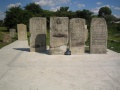 The gravesites of the Belzer Rebbes in the town of Belz in Ukraine
-
 Rebbe Aharon Rokeach before the Holocaust
-
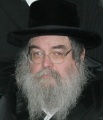 Rebbe Yissachar Dov Rokeach, the current Rebbe of Belz
-
 The central synagogue of the Chassidus in Jerusalem


See Also[edit | edit source]
External Links[edit | edit source]
- "Entirely form": an amazing story about the meeting of the "Belzer Rav" with the Rebbe, on the "Chabad Live" website (Hebrew)
- Matzmiach Keren Yeshuah (old2.ih.chabad.info) (Hebrew) "How the Rebbe Rayatz helped rescue the Rebbe of Belz", a review in the bulletin "Ohr Min HaChoshech" published by Belzer Chassidim -
- Rare gallery: the meeting of the Rebbe of Belz with the Rebbe, on the "Chabad Live" website (photos) (Hebrew)
References[edit | edit source]
- ↑ Admorei Chabad U'Vnei Doram, p. 74, from Chassidim who heard it from the Frierdiker Rebbe and from Rebbe Aharon of Belz; and Otzar Sippurei Chabad, vol. 2, p. 302. See also what the current Rebbe of Belz related about this in the name of his uncle Rebbe Aharon in the book Botzina Kadisha (a collection of stories... of the holy Rebbe of Belz...), p. 85.
- ↑ Apparently because of his special scrupulousness regarding purity, as he said to his attendant: "I have stringencies regarding clean hands. When you serve me, if you touch your nose, your hair, or even a baby under the age of three – please wash your hands and only afterwards serve me" (see here (Hebrew)
- ↑ Toras Chabad for yeshiva students.
- ↑ From the current Rebbe of Belz in the name of his uncle Rebbe Aharon. The book Botzina Kadisha (a collection of stories of the holy Rebbe of Belz), p. 85.
- ↑ Siach Sarfei Kodesh, p. 397.
- ↑ So he instructed the rosh yeshiva of the Belz yeshiva in Jerusalem and the rosh yeshiva of the Belz yeshiva in Ashdod, and others.
- ↑ 7.0 7.1 Rabbi Mordechai Menashe Laufer, "Between the Customs of Belz and Chabad", Hiskashrus issue 1044, Chabad.org.il (Hebrew).
- ↑ Shemen Sasson MeChaveirecha, vol. 4, p. 2119.
- ↑ The booklet that appeared on 20 Menachem Av 5769, pp. 9–10, 17; BeTzel HaChochmah, p. 113.
- ↑ Shaarei Halachah U'Minhag, vol. 5, p. 30; vol. 2, p. 224.
- ↑ Minhagei Belz (Eretz HaKodesh 5743), p. 84.
- ↑ Toras Menachem, vol. 52, p. 303 ff.
- ↑ HaRav HaKadosh MiBelza (Ohr HaChassidus, Jerusalem), p. 75; and see the author's compilation "Not to Be Near the Old City of Jerusalem on Erev Pesach," Haoros U'Biurim Oholei Torah, N.Y., issue 838 (Shavuos 5762), pp. 104–105.
- ↑ Although according to the claim of Belzer Chassidim, the fact that the Rebbe of Belz lowered his head onto the table in view of everyone was an implied protest against the things that were said and a clarification that they were not to his liking.
- ↑ According to the version of Belzer Chassidim, the Rebbe of Belz conditioned his participation in that event on their not speaking against the Rebbe, but despite this the organizers did not keep their promise. The speaker even noted this, saying: "Although I committed myself, I cannot restrain myself".
- ↑ See Rabbi Ashkenazi, part 2.
- ↑ In an interview with Kfar Chabad Magazine, issue of 18 Adar 5770 (2010).