Chassidim of Poland

Chassidim of Poland (Polish Chassidim) is a term (in Chabad parlance) for the general Chassidic groups that follow the path of the Baal Shem Tov, most of them also following the path of the Maggid of Mezeritch, but with an emphasis on Chagas[1].
Attitude Toward Chabad Chassidus[edit | edit source]
These differences of opinion generally did not cause a split between Chabad Chassidus and the other Chassidic groups. Therefore, even tzaddikim whose path in Chassidus was very different from the Chabad path, such as Rabbi Levi Yitzchak of Berditchev and Rabbi Mordechai of Chernobyl (who even expressed his opinion differing from the path of the Chabad Rebbes), made marriage matches with the Chabad Rebbes. Likewise, in all public and private activities, an indescribable deep love prevailed between the Chabad Rebbes and the other Rebbes who follow the path of general Chassidus.
History[edit | edit source]
In 5557 (1797), the Alter Rebbe published the Tanya. He also began delivering maamarim in a more expanded and explained manner, and appointed young scholars to see to spreading and explaining the teachings of Chassidus in a way that would be understood by the common people[2]. Sefer HaTanya was a tremendous innovation relative to the period before its publication, since it was the first book to present the teachings of Chassidus in an expanded and explained manner. When Rabbi Avraham of Kalisk heard of this, he came out sharply against this approach. Rabbi Avraham argued against the work that it deviates from the original path of the Chassidic movement. According to him, the Alter Rebbe had deviated from the path of leadership paved by "our Rebbes", namely the Maggid of Mezeritch and Rabbi Menachem Mendel of Vitebsk, "who were very guarded and careful in their words not to convey [these matters] to the majority of Chassidim, nearly all of them, but only by way of mussar and to bring them into the covenant of faith in the Sages"[3]. He held that the conduct of the Chassidim at large should be based on "faith in the Sages" (emunas chachamim) and on simple fear of Heaven, whereas engagement in the secrets of the Torah, which Rabbi Shneur Zalman revealed in his book, should be limited to the elite. He based his words on the verse "The righteous shall live by his faith"[4]: do not read yichyeh (with a chirik, "shall live") but yechayeh ("shall give life"), meaning that the tzaddik, through his knowledge of the secrets of the Torah, exempts the people from the need to study them, and they need only believe in the tzaddik. The Alter Rebbe answered him[5] on this. The Alter Rebbe's approach is that each person must contemplate the words of Chassidus himself and let them influence him, and not rely on the avodah of the tzaddik[6].
In 5560 (1800), Rabbi Avraham published a letter in which he retracted his dispute[7] and agreed that the path of the Alter Rebbe, according to which every person must contemplate the words of Chassidus, is true and "is the path of the Baal Shem Tov and the Rav, the Maggid... and how could it occur to anyone to dispute this".
The dispute that broke out after the printing of the Tanya in 5557 (1797) spread and branched out, and over the years the great Chassidic Rebbes of that time became involved in it. Rabbi Avraham was joined by Rabbi Baruch of Mezhybizh and Rabbi Asher of Stolin, while Rabbi Levi Yitzchak of Berditchev supported the Alter Rebbe. Rabbi Nachman of Breslov also tried to make peace between the sides during his visit to Eretz Yisroel in 5559 (1799). The Alter Rebbe, too, tried to end the dispute in a journey he made to the great Rebbes in 5570 (1810), but the discussions did not resolve the dispute[8].
The Dispute of Approaches[edit | edit source]
Saying Little Torah and Relying on the Tzaddik[edit | edit source]
When the wedding of the Mitteler Rebbe's daughter to Rabbi Yaakov Yisroel of Cherkas took place, the Mitteler Rebbe delivered several discourses at the wedding. The Maggid of Chernobyl, by contrast, opposed saying much Torah, and so when they asked him to say Torah, he said: "Let a little water be brought, and wash your feet" – one should say a little Torah, but the main thing is to wash the "feet" (i.e., habits); "and recline under the tree" – to lean on the tzaddik, who will connect the person to Hakadosh Baruch Hu in serving Hashem[9].
These two principles are contrary to the Chabad teaching, according to which one should study Chassidus abundantly, and through this a person can fulfill in himself the rule of the mind over the heart; and as explained in Sefer HaTanya, if a person is unable to actually produce love and fear in his heart, he may suffice with what he can do, namely intellectual fear and love combined with the hidden love; and a person should not lean on the tzaddik in his avodah, but rather serve Hashem himself.
On these principles many of the Polish Chassidic groups held like the Chernobyl approach. Likewise, it is cited in the name of Rabbi Pinchas of Koritz[10]: "He said that a person should not hear too many words of Torah, for through this his wisdom becomes greater than his deeds; rather, he should hear one thing and fulfill it, and afterward hear more and fulfill it". Rabbi Menachem Mendel of Vitebsk writes similar words in his book Pri Ha'aretz[11].
Different is Breslov Chassidus, which, although it emphasized reliance on the tzaddik even more than the other Polish Chassidim, in an extremely radical manner, on the other hand championed the study of the Chassidic works of Rabbi Nachman of Breslov, which deal with exceedingly profound matters.
Polish Customs and Their Practice in Chabad[edit | edit source]
The Attire of Polish Chassidim[edit | edit source]
The Rebbe Rashab spoke about the virtue of the external aspect of Poland, namely the matter of attire, saying: "I am pained and worried that we do not live in Poland"[12].
The Rebbe Rayatz, too, greatly praised the attire of Polish Chassidim, who are highly recognizable by their Jewish dress, and said that he wished he could also institute this attire in Chabad[13].
Saying Tachanun on Days of Hilula[edit | edit source]
The Rebbe related: I once asked my father-in-law, the Rebbe, what is the reason that Chabad Chassidim customarily say Tachanun on the yahrzeit of tzaddikim (unlike the custom of Polish Chassidim).
He answered that this is the best time to request and to accomplish etc. ("where is there a better time to pray for things").
The Rebbe explained: The explanation of this is that in Poland they do not say Tachanun, because the elevation on the day of the yahrzeit of the tzaddik who "gives life through his faith" effects an elevation in all those connected to him, who are in a state above the matters for which Tachanun must be said (even though this is not in an inward manner); but Chabad Chassidim, of whom inwardness and avodah specifically are demanded, want to elevate ("take along") the body as well, a body that has been washed ("a washed-off body"), and therefore they say Tachanun then too[14].
Wearing a Gartel[edit | edit source]
One of the things distinguishing Chabad Chassidim from Polish Chassidim concerns the wearing of the gartel, namely that bochurim refrain from wearing a gartel before their marriage[15]. The explanation for this is that the gartel is associated with the level of "makifim" (encompassing lights), something a person begins to be connected with only after his marriage.
Nevertheless, it is customary among Chabad Chassidim to wear an elastic band over the tzitzis beneath the shirt, which also helps to keep the tzitzis stretched so that they do not become crumpled under the garments – something that constitutes a halachic problem according to the view of the Alter Rebbe. Some bochurim wear a thin gartel instead of the elastic band.
An exception is wearing a gartel when entering yechidus or when writing a pidyon nefesh to the Rebbe, which is customary also among unmarried bochurim[16].
Mitzvah Tantz[edit | edit source]
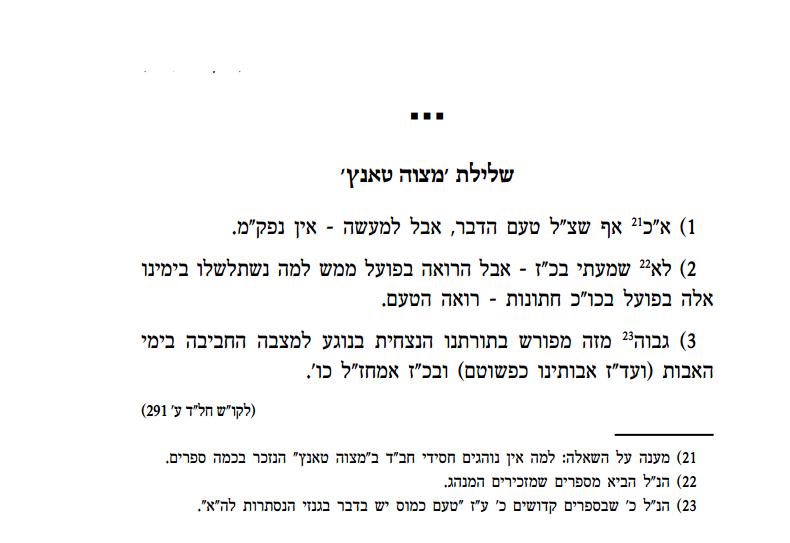
Rabbi Gavriel Zinner asked the Rebbe why Chabad Chassidim did not practice the custom of the mitzvah tantz as is the custom of Polish Chassidim. The Rebbe replied to him in a letter that he had not heard the reason for this, but based on what is seen in practice, what developed from it at many weddings, one can understand the reason they did not practice it; as we find in the Midrash regarding good things practiced by the holy Avos that were disqualified because improper conduct developed from them (see Sifrei and Rashi on Shoftim 16:22). In practice, however, he wrote that "it is not my business to diminish the celebrations of Jews", and that in practice they should ask a halachic authority about it[17].
When to Begin Putting on Rabbeinu Tam Tefillin[edit | edit source]
Unlike the custom of most Chassidim, who begin to put on Rabbeinu Tam tefillin in addition to Rashi tefillin after the wedding, the custom of Chabad Chassidim since 5736 (1976), when the Rebbe urged the wearing of Rabbeinu Tam tefillin[18], is to begin putting them on together with beginning to put on Rashi tefillin (i.e., two months before the bar mitzvah).
See Also[edit | edit source]
External Links[edit | edit source]
- Tag: General Chassidus, on the "Lachluchis Geulatis" website
- The prayer of a Chabadnik and the prayer of another Chassid
- Chabad Chassidim or Chassidim of "Poh Lin"?, Hageula.com (Hebrew)
References[edit | edit source]
- ↑ Serving Hashem primarily through emotion (love) for Hashem (without intellectual reasoning), as opposed to Chabad Chassidus, whose focus is intellectual understanding that acts upon the emotions.
- ↑ Introduction to the above-mentioned Igros Kodesh, pp. 47–48.
- ↑ The above-mentioned Igros Kodesh (5772), appendices 22–23, p. 498.
- ↑ Chavakuk 2:4.
- ↑ This letter is not in our possession.
- ↑ See Toldos Chabad B'Eretz HaKodesh, p. 24 ff. (PDF) (Hebrew).
- ↑ The above-mentioned Igros Kodesh, appendices 29–30.
- ↑ On the journey see Yehoshua Mondshine, Masa Berditchev, 5770. On his meeting with Rabbi Nachman during the journey see Rabbi Yehoshua Mondshine, The Meetings of Rabbi Nachman of Breslov with the Alter Rebbe, Maayanosecha issue, 24 Teves 5774 (2013), p. 11. (PDF).
- ↑ Cited in the writings of R' Y. the shochet, and some of the words are cited in the Rebbe's Reshimos 5691–5695.
- ↑ In "Imrei Pinchas", Gate 5, matters of Torah study.
- ↑ (4) Sefer Pri Ha'aretz – Parshas Naso: When one increases study and wisdom in knowledge but not deeds, his wisdom will exceed his deeds; and not only will it not rectify him, but on the contrary, it overturns him on his face, as mentioned. And as the saying (Sukkah 52) "Whoever is greater than his fellow, his inclination is greater than him" – and they did not say this only in a general sense, but even if one increases knowledge of rebukes and mussar, wisdom and knowledge of how to be saved from that desire, but does not increase in the mitzvos of the limb specific to that desire, he is likewise harmed more by his wisdom. And this is the saying of our Sages of blessed memory (Berachos 63a): Why is the section of the sotah juxtaposed to the section of the nazir? To tell you that whoever sees a sotah in her disgrace should abstain from wine; which is not so if he does not see a sotah in her disgrace and does not know wisdom and knowledge to be so admonished – he need not abstain from wine. Seemingly it is the opposite: on the contrary, by his seeing, all the women are admonished, and he need not abstain. But it is as we said above, that through his seeing he is admonished and understands more truly not to engage in this desire, and from then on he needs more and more guarding, for he does not yet have deeds to protect him so that the knowledge [and wisdom] not be overturned on its face.
- ↑ Reshimos HaYoman p. 170; see also Sefer HaSichos 5683, end of p. 46 ff.
- ↑ Reshimos 5691.
- ↑ Toras Menachem – the link may be broken (Hebrew)
- ↑ Igros Kodesh vol. 10, p. 394 (Hebrew).
- ↑ See the Rebbe's instruction on this in Yemei Bereishis, p. 55.
- ↑ Likkutei Horaos U'Minhagim B'Inyanei Chasunah, p. 149 (Hebrew).
- ↑ Printed in the book "Yalkut Bar Mitzvah", pp. 6–55 – an unedited transcript; and in Sefer HaSichos 5749 (1988–89), vol. 2, p. 632 (also printed in the book "Yalkut Bar Mitzvah", p. 57): "In our generation the custom has spread (and particularly the Chabad custom) to begin putting on Rabbeinu Tam tefillin at the same time as beginning to put on Rashi tefillin (including also regarding the period of preparation before bar mitzvah) – see Likkutei Sichos vol. 2, p. 507 and note 39, and it was explained at length in the sichah of Purim 5736".