
Matzeivah (Tombstone)
Matzeivah (tombstone) is a stone slab marking the grave of the deceased and recording details about them.
In Jewish History[edit | edit source]
The Torah mentions several times the setting up of a matzeivah to mark a grave, such as that of Rochel, marked by Yaakov[1], and others. Some even set up matzeivos for themselves in their lifetimes, such as Avshalom, son of King David[2].
In Torah literature, matzeivos are called "nefashos"[3].
There are many Jewish customs regarding when matzeivos are set up and how they are placed on the grave[4].
The details on the matzeivah vary markedly between communities, but most inscribe at the top the letters פ.נ. (po nitman, "here lies buried"), followed by the name of the deceased, the names of his parents and his family name, the date of passing, and the letters תנצב"ה, which together form the acronym for "May his (her) soul be bound up in the bond of life"[5].
In the Teachings of Our Rebbeim[edit | edit source]
When asked about matzeivos, the Rebbe gave guidance on their wording and setting up, but stressed that the main matzeivah is not the stone but Jewish conduct according to Torah and mitzvos – the true, eternal matzeivah for the elevation of the deceased's soul[6].
Many Chassidic families submitted the wording of their loved ones' matzeivos to the Rebbe, who reviewed and corrected it[7].
Great Chassidim avoided honorific titles, and many instructed that the simplest possible wording be used on their own matzeivos.
Customs and Instructions[edit | edit source]

- One should avoid a matzeivah that differs unusually from the other matzeivos in the cemetery, both in its inscription and in other respects[8].
- One should try to mention the person's lineage and affiliation, since passersby who read the inscription arouse merits for his soul[8].
- According to the instruction of our Rebbeim, one should mention the names of the Rebbeim to whom the deceased was connected[8].
- One should avoid writing exaggerations that do not match reality[9].
- The wording should be with the consent of the descendants of the deceased[6].
- It is customary to set up the matzeivah soon after the Shiva; even where the custom is to wait, one should try to set it up earlier, while respecting local custom[6].
- The matzeivah should be placed in the manner customary throughout the cemetery, and if possible, even after it has been set up, it should be adjusted to match the others[10].
- Our custom is that the letters should specifically be engraved (sunken), based on the words of our Sages that raised letters are harmful to memory (cause forgetfulness)[10].
- The wording of the matzeivah should be with the consent of the Chevra Kadisha[11].
- The Rebbe encouraged the widespread custom of setting up a memorial matzeivah for parents whose burial place is unknown, or of mentioning them on another matzeivah[11].
- It is customary to avoid writing in a foreign language on the matzeivah[12].
- If a sick person was given an additional name and passed away before thirty days had elapsed, the new name is not used and is not written on the matzeivah[13].
- When a new matzeivah is erected in place of an old one, the old one should be put in genizah and not thrown away[14].
- It is not customary to place flowers on the matzeivah (this is a non-Jewish custom)
Matzeivos of Our Rebbeim[edit | edit source]
-
 The matzeivah of The Alter Rebbe
-
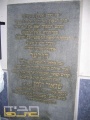 The matzeivah of The Mitteler Rebbe
-
 The matzeivos of The Tzemach Tzedek and The Rebbe Maharash
-
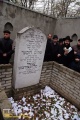 The matzeivah of The Rebbe Rashab
-
 The matzeivah of the Rebbe Rayatz


See Also[edit | edit source]
- HY"D - Hashem yikom damo (May Hashem avenge his blood)
External Links[edit | edit source]
References[edit | edit source]
- ↑ Bereishis 35:20.
- ↑ Shmuel II 18:18.
- ↑ "Those who escort him say to him, 'Go in peace,' as it says, 'And you shall come to your fathers in peace.' They mark the entire cemetery and build a nefesh over the grave. For the tzaddikim, a nefesh is not built over their graves, for their words are their memorial, and a person should not turn to visiting the graves" (Rambam, Hilchos Avel 4:4). "Rabbi Nosson says: a nefesh is built for him over his grave" (Mishnah Shekalim 2:5). And elsewhere.
- ↑ This was apparently influenced by the burial practices customary in the countries where they lived: in Europe the matzeivah is generally placed vertically, whereas in countries under the influence of Islam, the Jewish communities there customarily placed the matzeivah horizontally.
- ↑ Based on the wording of the verse in the words of Avigail to Dovid, Shmuel I 25:29.
- ↑ 6.0 6.1 6.2 Shaarei Halachah U'Minhag, Yoreh De'ah, vol. 1, p. 370 (Hebrew).
- ↑ See, for example, The life of R' Saadya, page 8.
- ↑ 8.0 8.1 8.2 Shaarei Halachah U'Minhag, Yoreh De'ah, vol. 1, p. 368 (Hebrew).
- ↑ Shaarei Halachah U'Minhag, Yoreh De'ah, vol. 1, p. 369 (Hebrew).
- ↑ 10.0 10.1 Shaarei Halachah U'Minhag, Yoreh De'ah, vol. 1, p. 371 (Hebrew).
- ↑ 11.0 11.1 MiBeis HaMalchus 4, p. 141.
- ↑ Responsa Tzitz Eliezer vol. 9, 14; Responsa Maharam Schick, Choshen Mishpat, siman 56.
- ↑ Gesher HaChaim ch. 1, se'if 5; Responsa Mishneh Halachos vol. 16, siman 112; and see Shaarei Halachah U'Minhag vol. 3, p. 301.
- ↑ When R' Yosef Nimotin reported to the Rebbe that he had erected a new matzeivah on the resting place of his father, Rabbi Levi Yitzchak, the Rebbe asked him what he had done with the previous matzeivah, and when he answered that he had thrown it away, the Rebbe told him that he should have buried it (Sefer Zichronos Kovlanov, p. 189). But see He honors him in his life and honors him in his death from R' Chaim Elazar Gorelik, who was involved together with him, and who remembers the response differently.